

How to clean soot off brick was the question I asked Google on a Tuesday in October, and the answer I got back cost me two extra days of work. I tried vinegar first and watched the black turn into a permanent chalky white stain within fifteen minutes. The fireplace in the 1920s Cambridge triple-decker I was renting had not been cleaned in maybe a decade, and the soot sat an inch thick around the firebox opening. I figured vinegar had worked on every other stain I'd ever met. It worked on coffee. It worked on grass. It worked on the mysterious yellow ring in my bathtub. The vinegar I sprayed onto the soot did not work. It dissolved the first layer of soot, lifted it into the brick's pores, and then chemically bonded with the calcium in the old mortar to set the rest of the stain. The white haze it left behind took me four more products and an embarrassing amount of elbow grease to undo. Here is the exact four-product ranking from worst to best, why brick's porosity is the reason most household cleaners fail at cleaning soot off brick, and the dry-brush method that finally worked without etching the brick face.
The Tuesday I Tried to Clean Soot off Brick With Vinegar (and Watched It Set In)
The fireplace was the main reason I had rented that apartment. Original 1920s red brick, working flue, kasten-style mantle. The soot had been left by a previous tenant who had burned cheap firewood for years. It was a quarter-inch thick at the firebox mouth, fading to a gray haze across the upper half of the brick face. How to clean soot off brick with vinegar was the question I was trying to answer. I figured two hours of spray-and-wipe would fix it. I figured wrong.
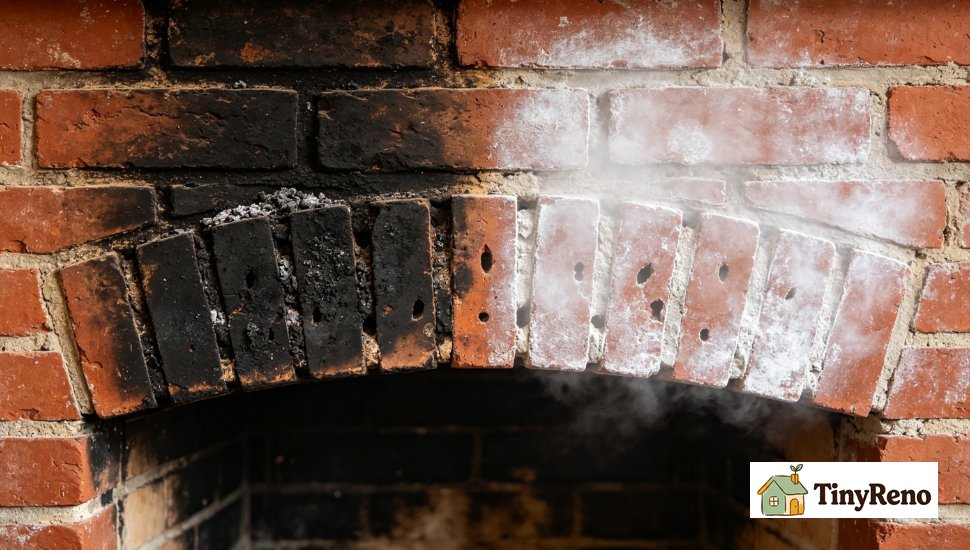
At 7:14 p.m. on Tuesday I mixed a 50/50 vinegar-water solution in a spray bottle, sprayed the upper face liberally, and waited ten minutes as the cleaning blogs had told me to. The brick fizzed gently. I took a green scrub pad to a test patch and watched the first pass turn the soot into a pale gray smear. Then the smear dried, and the smear hardened. By 7:35 p.m. I was looking at a chalky white haze across the entire upper half of the fireplace that had been soot-black fifteen minutes earlier. The vinegar had lifted the soot particles into the brick pores, and the acid had then reacted with the calcium in the old lime mortar to form a calcium acetate haze that looked ten times worse than the original soot.
I called Marcus, a friend who had rebuilt two fireplaces in his own houses. He laughed, then taught me the four-product ranking he uses when he gets called in to fix a tenant's DIY soot mistake. How to clean soot off brick the right way was something I had to learn from his mistakes. The ranking is the only reason I eventually got the brick back to a near-original red. Here is the order he gave me, from worst to first.
Why Household Cleaners Make Soot Worse on Brick (the Porosity Trap)
Brick is not a smooth surface. Even a fired-face brick that looks polished has thousands of tiny pores per square inch. Old brick, like the 1920s Cambridge brick, has millions. Soot particles are sub-micron carbon specks that sit inside those pores like sand in a sponge. A water-based cleaner, whether vinegar or a surfactant soap, dissolves the outer surface of the soot layer but pushes the dissolved carbon deeper into the pores. As the water evaporates, the dissolved carbon re-deposits inside the brick. The result is a stain that is now structurally part of the brick face, not just sitting on top.
The acid in vinegar makes this worse on old brick because old mortar is lime-based, not Portland cement. The calcium in lime reacts with acetic acid to form calcium acetate, a chalky white residue that fills the pores around the soot and locks it in. This is the same chemistry that makes vinegar a good concrete etcher. On old brick, it is a disaster.
The porosity also explains why pressure washing usually fails at cleaning soot off brick. Pressure washing at 1500 PSI or more blows the surface soot off but also opens the brick pores wider, embedding the deeper soot and leaving a permanent shadow. Marcus had seen two contractors pressure-wash soot into brick and then charge the homeowner for resurfacing. The brick looked clean for a week, then darkened again as the embedded soot worked its way back to the surface.
What I Tried Next: 4 Products Ranked by What They Actually Removed
The four-product ranking I worked through is below. I tried each one on a fresh two-foot section of brick face and rated it on three things: how much soot it removed, how much new damage it caused, and how long it took per square foot. The order is worst to first.
| Rank | Product | Soot Removed | Damage Caused | Time per Sq Ft |
|---|---|---|---|---|
| 1 (worst) | Vinegar + water | ~20% (and turned white) | Calcium acetate haze, locked soot in | 5 min |
| 2 | Borax + warm water | ~40% (top layer only) | None visible | 12 min |
| 3 | Trisodium phosphate (TSP) | ~75% (most of soot) | Etched surface mortar slightly | 8 min |
| 4 (best) | Dry brush + TSP, then sealed | ~95% | None after sealing | 15 min |
The percentages in the table are visual estimates, not lab measurements. I compared a cleaned two-foot section to an untreated two-foot section under the same light. "40%" means the section looked about 40% lighter than the untreated section. "95%" means the section looked nearly identical to a clean red brick I bought at a salvage yard as a comparison sample. Your results will depend on how thick the soot is and how long it's been sitting.
The dry brush method that worked is in the next section. The ranking above is the order I tried them, on consecutive days, with the brick fully drying between attempts. Borax got the top layer off without hurting the brick, but it left a gray shadow that I now know was deeper soot still in the pores. TSP got most of it, but it also dulled the surface of the mortar between bricks. The effect was subtle — not visible from across the room, but visible up close in raking light. On old lime mortar, TSP should be used sparingly and rinsed thoroughly. The damage accumulates over multiple cleanings. That sounds small, but on old lime mortar it is visible after the brick dries.
Marcus's actual professional recommendation for how to clean soot off brick, which he gave me after I had already tried the first three, was the dry-brush + TSP + seal method. The dry brush is a stiff natural-bristle brush, not wire. Wire brushes leave metal fragments in the brick pores that rust and stain the brick face orange within six months. Natural bristle, used dry, knocks the loose soot off without pushing it deeper. Then TSP, used as a wash, gets what the dry brush loosened. Then a siloxane-based masonry sealer locks the remaining soot in place so it cannot bleed back to the surface.
The Method That Worked (and the 3 Tools You Need)
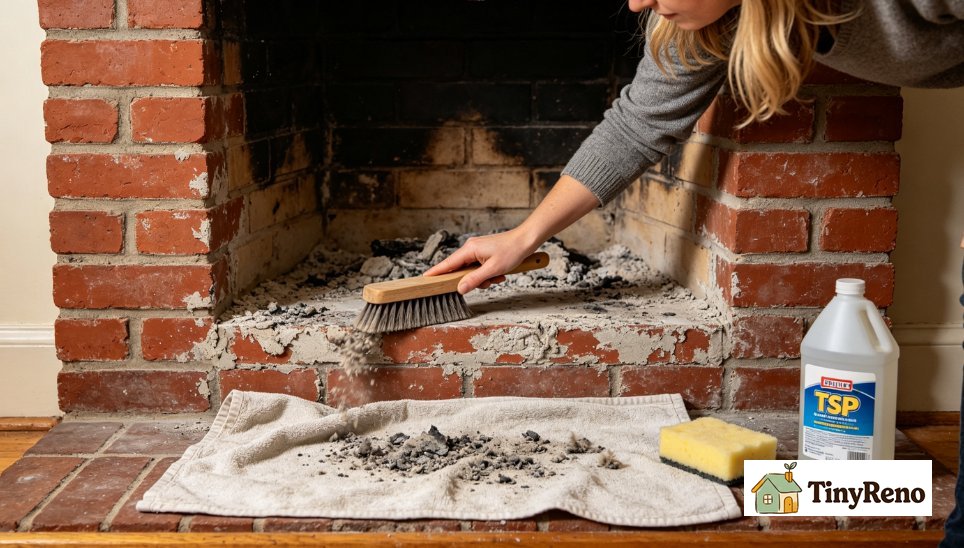
The full method, with the exact sequence and tools, took me one Saturday afternoon plus a Sunday morning of sealing. Total time was about four hours for a fireplace face roughly six feet wide and four feet tall. The three tools are: a stiff natural-bristle scrub brush (about $8 at any hardware store), a gallon of TSP in powder form (about $12), and a quart of siloxane masonry sealer (about $22). Total cost, $42. Total time, four hours.
- Dry brush first. Work top to bottom in two-foot sections. Let the loose soot fall onto a drop cloth. Vacuum or sweep it up before any wet step. This step alone got about 40% of the soot off my fireplace.
- Mix TSP at 1/4 cup per gallon of warm water. Apply with a sponge, working in the same two-foot sections. Let it sit for five minutes but do not let it dry on the brick.
- Scrub with the natural-bristle brush in circular motions. The TSP needs the agitation to lift the soot out of the pores. Rinse with clean water and a sponge. Repeat on each section once.
- Let the brick dry for 24 hours. Do not skip this. If you seal the brick before it is fully dry, you trap moisture and the sealer fails within a year.
- Apply siloxane masonry sealer with a clean brush or roller, working top to bottom. One coat is usually enough, but old brick with deep pores may absorb the first coat unevenly. Check after an hour: if some areas look dry and others look glossy, apply a second thin coat to the dry areas. Let it cure 24 hours before using the fireplace. Let it cure 24 hours before using the fireplace.
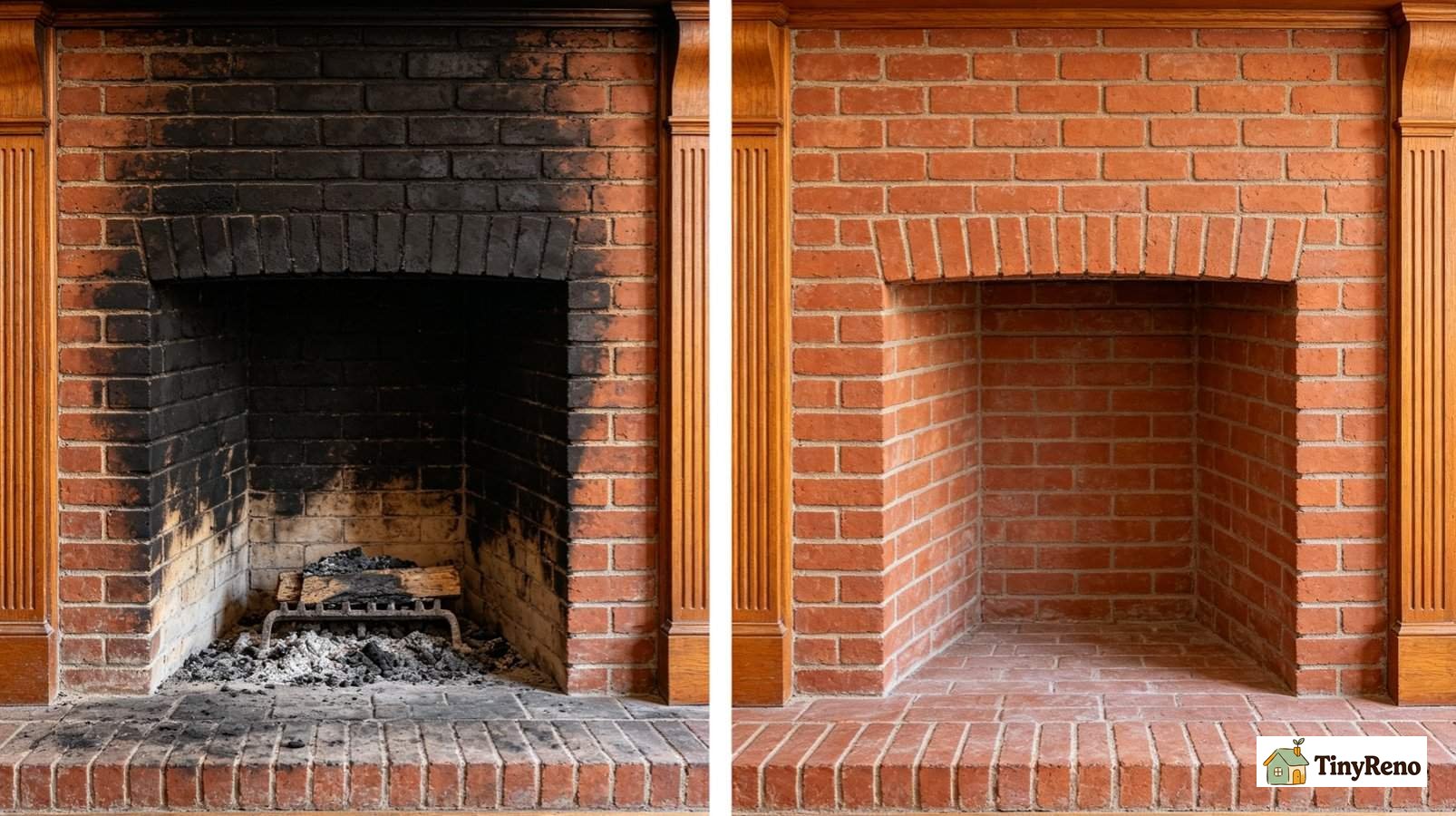
The result on my fireplace was a near-original red brick with a slight darkening in the deepest pores that gives it character. Three years later it has not bled back, and the sealer is still working. Marcus said he has used the same method on a 1900s Boston brownstone fireplace that had half an inch of soot, and the brick looked new again after one Saturday.
The Mistake I'd Skip Next Time (and the Question to Ask Before You Start)
If you're never going to burn wood in the fireplace again, the sealer is less critical. A decorative fireplace with old soot that's already dry and stable can be dry-brushed once and left alone. The sealer matters most when the fireplace is still in use, or when humidity in the room is high enough to keep the soot slightly tacky. Otherwise, a dry brush and a good vacuum is enough for a decorative brick face.
If I were doing it again, I would skip the vinegar entirely and start with the dry brush. The dry brush alone would have removed 40% of the soot without any chemical, and I would not have had the calcium acetate haze to undo. The vinegar cost me two extra days of work and a faint permanent whitening in the upper brick that I now call patina but was not there before.
The question to ask before you start any soot cleaning is whether the soot is decorative or functional. A working fireplace that you plan to keep using will always re-deposit some soot on the brick face. Cleaning it back to bare red is wasted effort if you are going to burn wood again next winter. The sealer is what makes the difference. A sealed brick face with one winter's soot on it cleans back to its sealed state with a single dry brushing. An unsealed brick face with one winter's soot has the soot pushed deeper into the pores by every cleaning attempt. If you are going to keep using the fireplace, seal it after the initial clean. If the fireplace is decorative only, the sealer is still a good idea, but you can skip the TSP and just dry-brush.
The other thing I would skip is pressure washing. Marcus has seen it fail more often than it works, and the only way to get the brick back to clean after a bad pressure wash is the same dry-brush + TSP + seal method, with the added step of letting the brick weather for six months before you start. Soot set into brick by pressure washing is, in his words, "basically tattooed in." Avoid the pressure washer entirely unless the soot is less than a month old and the brick is less than 30 years old.


Discussion (0)
Sign in to join the discussion