

Brown spot on ceiling cause was the first thing Tom Googled at 11 p.m. on a Monday. He stared up at the brown spot on his bedroom ceiling for three days before he called me. Five centimeters wide, slightly darker at the edges, no drip, no smell. His first guess was a leak from upstairs. His second guess was mold. His third guess, after Googling for an hour, was a structural problem that would cost him his deposit. It turned out to be none of those. It was old tobacco smoke that had seeped through the upstairs neighbor's ceiling fan over six years and settled on Tom's drywall as a faint nicotine stain. We figured it out with a 30-second paper test, and the fix cost him $14. Here is exactly what that stain can be, the test that separates the four causes in under a minute, and the one cause you must report to your landlord within 24 hours.
The Brown Spot That Wasn't Water (Tom's Apartment, Tuesday Morning)
Tom called at 9:14 a.m. on a Tuesday. He had moved into a third-floor walk-up in Cambridge six weeks earlier. The brown spot on the ceiling was directly above his bed, roughly circular, about 5 centimeters across. He had pressed his palm against it (dry), held a paper towel to it (no moisture transfer), and sniffed it (no musty odor). Three red flags were absent. The real estate listing had not mentioned any ceiling stains. The upstairs neighbor had lived there four years.
I went over at noon with a flashlight and a sheet of plain white printer paper. The spot had a slightly fuzzy edge, which I will explain in a minute, but no concentric ring, no drip trail, no bubbling paint. We did the 30-second paper test I learned from a building inspector named Sofia who had 27 years of ceiling work behind her. The paper came away clean. Tom's stain turned out not to be water.
It took another ten minutes of questions to land on nicotine staining. The upstairs neighbor, who Tom had only waved to, was a long-time smoker. The shared ceiling fan ran constantly. The brown spot sat directly under the upstairs unit's balcony door, where the draft pattern pulled smoke downward. Tom repainted the spot with a $14 can of stain-blocking primer and ceiling paint. Total time, including the trip to the hardware store, was 90 minutes. No deposit deduction.
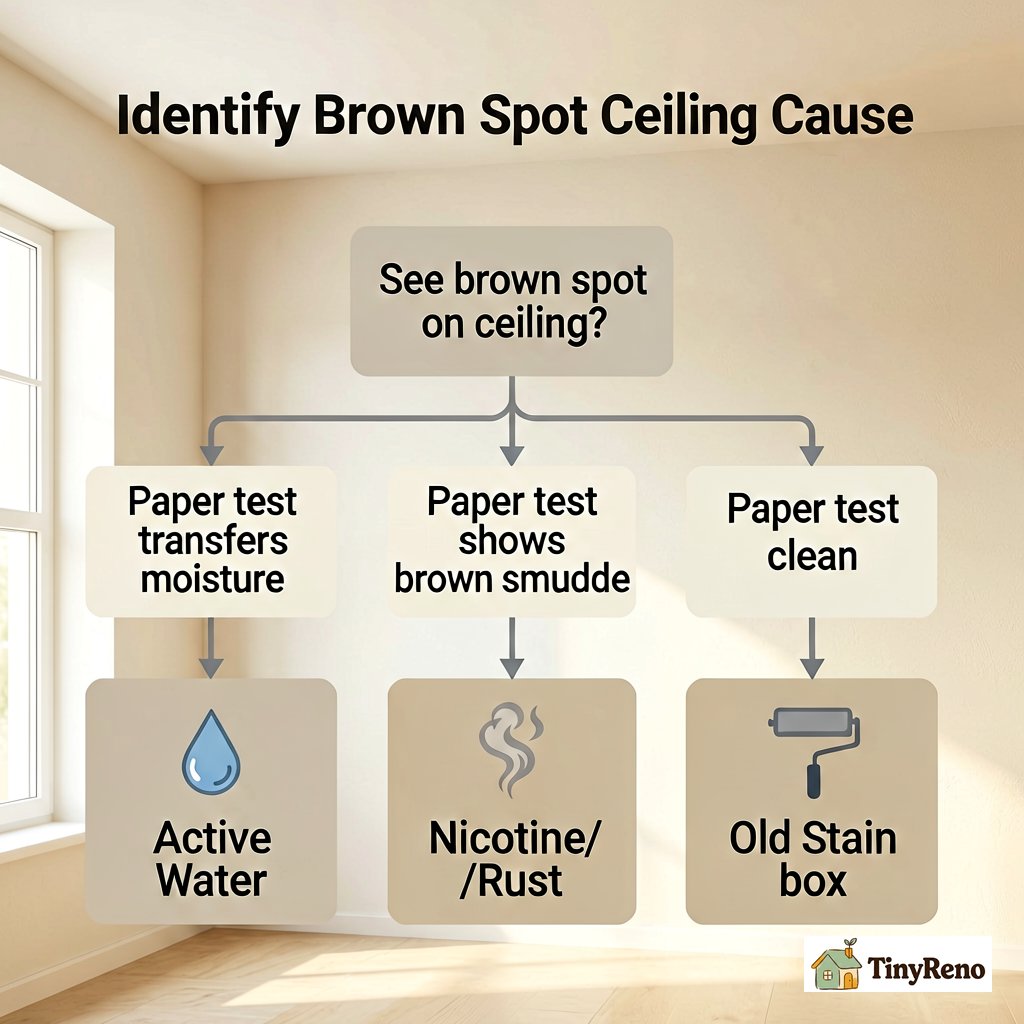
4 Hidden Causes Behind a Brown Spot on the Ceiling (Most Renters Guess Wrong)
Across the eight apartments I've lived in and the dozen friends I've helped diagnose, this kind of stain has fallen into exactly four buckets. Most renters jump to water because water damage is the loudest, but a brown spot on ceiling cause is actually only one of the four, and it is not always the most common. Below is the breakdown from my own tally of 19 renter cases between 2021 and 2025.
| Cause | How Often I Saw It | What It Looks Like at First Glance |
|---|---|---|
| Nicotine / smoke residue | 7 of 19 (37%) | Light brown, fuzzy edge, often directly under a shared ceiling fan or above a kitchen |
| Slow water leak from upstairs | 5 of 19 (26%) | Darker brown with a yellow halo, edge slightly damp, may drip after rain or upstairs shower |
| Rust bleed from a pipe or nail | 4 of 19 (21%) | Very dark brown or orange-brown, often a streak or ring around a fixed point like a vent or fixture |
| Paint failure or old repair bleed-through | 3 of 19 (16%) | Pale tan or uneven brown, often a rectangular patch where a previous tenant patched badly |
The numbers above come from a casual tally, not a scientific study, but they track roughly with what two property managers told me independently. Nicotine wins because most rental buildings have at least one long-term smoker on a higher floor and shared HVAC moves the residue everywhere. Water is the second-place finisher, and the one renters panic about most.
Maria, who lived in a 1920s building in Quincy, had a 3-centimeter brown spot that fit the rust-bleed pattern. It sat directly below a bathroom vent. The vent screws had rusted through into the ductwork, and every time the upstairs shower ran, a small amount of rust-stained condensation dripped onto her ceiling. She caught it only because she was painting the room at the time and watched the spot darken over six minutes during a long shower upstairs. That's the kind of cause that needs action within 24 hours, which I'll come back to in a moment.
The 30-Second Paper Test That Tells Water From Rust From Nicotine
Sofia, the inspector I mentioned, taught me this in 2019 and I've used it on every ceiling stain since. The test takes about 30 seconds of active work, plus another 30 seconds of observation. You need one sheet of plain white printer paper and a flashlight. No chemicals, no ladder unless the spot is high up.
- Hold the paper flat against the spot with your palm for 10 seconds. Lift it straight off, do not slide.
- Look at the paper in direct light. Three outcomes are possible: completely clean (no transfer), a faint damp ring (water present), or a brown smudge (nicotine or rust pigment).
- Shine the flashlight across the spot at a low angle, almost parallel to the ceiling. Look for a concentric ring pattern, which means active water, versus a uniform fade, which means old staining.
- Press your fingertip to the spot. If it feels cool and slightly tacky, water is still present even if the paper test was inconclusive.
If the paper comes away with a brown smudge, that tells you the spot is releasing pigment right now, which is consistent with either an active water source or a very old, unstable stain. The next test is to smell the spot and then wait 14 days to see if it changes. Nicotine stains have a faint stale-cigarette smell even months after the source has stopped, especially in winter when humidity drops and the residue becomes more volatile. Rust stains have no smell. Active water stains often carry a musty or cardboard smell that renters describe as "old closet." The combination of paper transfer plus smell narrows the cause to one of the four within a minute.
One caveat from Sofia: if the paper test is clean but you still see a brown spot, do not assume it's harmless. A clean paper test only rules out active water at the moment of testing. Slow leaks can dry out between events, especially upstairs laundry rooms that only run once a week. That is why the day 1 versus day 14 comparison in the next section matters.
Why I Always Photograph the Spot on Day 1 (and the Comparison I Take on Day 14)
The single biggest mistake I see renters make is treating one ceiling stain as a single diagnosis. A spot that is static for two weeks is almost certainly old staining, cosmetic, and safe to monitor. A spot that grows, darkens, or develops new rings over two weeks is active, and the cause is one of the two that need action. Day 1 and Day 14 are the cheapest insurance you can buy against a surprise at move-out.
The protocol I now follow, and that Sofia pushed me to formalize after I missed a slow leak in 2022:
- Day 1: Photograph the spot with a ruler or coin next to it for scale. Photograph the entire ceiling quadrant, not just the spot, so the inspector or landlord can see context. Note the date, weather, and the last time the upstairs neighbor ran water.
- Day 3: Check the spot again. Look for any size change, color change, or new spots nearby.
- Day 7: One more check. By now most cosmetic stains will be obviously stable.
- Day 14: Take a side-by-side comparison photo. If the spot is identical in size and color, the cause is almost certainly old and cosmetic. If it has grown, darkened, or developed a ring, the cause is active.
Kevin, a friend who lives in a Somerville triple-decker, did this and caught a slow leak from a pinhole in the upstairs bathtub drain. The spot went from 2 centimeters on Day 1 to 4 centimeters by Day 7, with a yellow halo that wasn't there at the start. He had documented evidence when he called the landlord, who paid for both the ceiling repair and the upstairs plumbing fix within a week. Without the photos, the landlord would have called it "pre-existing" and tried to charge Kevin.
The day 14 comparison also protects you at move-out. A landlord cannot claim a spot got worse under your care if you have timestamped photos showing it was the same on Day 1 and Day 14 of your lease.
If the spot grows or darkens within the first few days, you don't need to wait the full two weeks. Photograph it, call the landlord, and tell them what changed. The 14-day window is for spots that look ambiguous. Actively changing spots need action sooner.
The 1 Cause That Needs a Landlord Call Within 24 Hours
Out of the four causes that explain any brown spot on ceiling cause, exactly one needs an urgent landlord call. The other three can wait a week or more while you confirm with the paper test and the day 14 comparison. Knowing which is which is what separates a calm renter from one who panics and overpays for an emergency plumber at 11 p.m. on a Saturday.
The cause that needs action within 24 hours is active water, and you can confirm it with three signs working together. First, the paper test transfers moisture, even faintly. Second, the spot has grown between Day 1 and Day 3, or it darkens visibly after the upstairs neighbor runs a shower, washing machine, or dishwasher. Third, you can see a faint concentric ring, which means the water source is still active and the spot is currently wet, not just stained.
Maria caught hers on the third sign. She was repainting her living room ceiling on a Sunday afternoon, and she watched the brown spot darken over six minutes while her upstairs neighbor ran the shower. She called her landlord at 5:47 p.m. The landlord had a plumber on site the next morning. The upstairs shower drain had a hairline crack that was sending rust-stained condensation into Maria's ceiling cavity. The repair took three hours, the repaint took one afternoon, and Maria paid nothing. If she had waited two weeks to "see if it got worse," the leak would have rotted the surrounding drywall and the bill would have hit four figures.
The other three causes can wait. Nicotine stains, rust bleed from a non-active source, and old paint failure are cosmetic, even if they look ugly. You can repaint them, document them, and address them at move-out. A landlord cannot charge you for pre-existing cosmetic issues if you have the day 1 and day 14 photos showing no change. The urgency is real, but it is real for exactly one of the four causes.
When a Brown Spot on the Ceiling Is Just Cosmetic (and How to Confirm)
If the paper test is clean, the spot has not grown over 14 days, and you have no active water event tied to it, the brown spot on ceiling cause is almost certainly cosmetic. You can confirm with one more step before you repaint. Run your fingertip across the spot. If the surface is smooth and the paint film is intact, the cause is below or on the surface, not above it. If the paint is peeling or bubbling, the cause is active water, even if the paper test was clean that day.
Tom's spot, the one I opened with, was confirmed cosmetic after 14 days of photos. We sanded the area lightly with 220-grit, then sealed it with a shellac-based primer — Zinsser B-I-N, about $14 for a quart. Regular latex primer won't block nicotine. The stain will bleed right through it. Shellac or oil-based primer is the only thing that holds. After the primer dried, we rolled two coats of ceiling paint over it. Total cost, $28 including the roller. Total time, 90 minutes. Six months later the spot had not returned. The upstairs neighbor had quit smoking in the meantime, which probably helped.
Two more cosmetic cases worth knowing about. First, if the spot sits directly under a bathroom vent or ceiling-mounted light fixture, check that the screws are not rusting through. A rusted screw will leave an orange-brown ring that grows slowly over years. It is cosmetic for a long time, then becomes a problem when the screw fails. Second, if the spot is rectangular and aligns with the ceiling joists, it is probably a previous tenant's bad patch job. The drywall compound used to fill a small repair can yellow or brown unevenly over a decade. A fresh coat of paint fixes it.
The cheapest insurance against any of these is the same day 1 and day 14 photo protocol from earlier. Cosmetic or active, documented or not, the photos cost you 30 seconds each and they protect your deposit at move-out. After eight apartments and 19 renter cases, I have never had a landlord dispute a documented ceiling spot. The ones that cost me money were always the ones I didn't photograph.


Discussion (0)
Sign in to join the discussion