

How to fix hard water in shower became my urgent question the week my landlord's water softener died without anyone telling me. I'd been in the Phoenix rental for three months when I noticed the glass door fogging over with something that wouldn't wipe off. By day four, my hair felt like straw and my skin itched in the same places every morning — the back of my calves, the inside of my elbows, the band of my watch. By day nine, the showerhead's spray had turned into nine weak streams instead of one even rain. That's when I learned that hard water fixes aren't one-size-fits-all. The right fix depends entirely on the mineral level in your water — and figuring that out takes five minutes and a $4 test strip.
This guide is the one I wish I'd had on day one. It splits renter fixes into three mineral-level tiers, so you stop buying the wrong product and start with what actually works for the water coming out of your showerhead.
Why the Same Fix Works for One Renter and Fails for Another
One thing the test strip doesn't explain is why hard water makes your skin itch. The short version: minerals in the water react with soap to form a film that clings to skin. That film disrupts your skin's natural moisture barrier, which leads to dryness and itching. The harder the water, the more film forms per shower.
Hard water is water with dissolved minerals — mostly calcium and magnesium. The concentration is measured in grains per gallon (gpg) or parts per million (ppm). The EPA doesn't regulate hardness, so two apartments on the same street can have wildly different levels depending on whether the building uses a softener, what the municipal supply looks like, and how old the building's plumbing is.
I learned this the hard way. My upstairs neighbor — same building, same water supply — had almost no problem. Her shower stayed clear, her hair behaved, her water heater didn't rumble. The only difference was a softener under her sink that the landlord had installed for free. I didn't have one. By the time I tested my water at 18 gpg (very hard), I'd already spent $60 on products that worked for 8 gpg water and did nothing for mine.
The chemistry is straightforward: more minerals means more buildup on glass, more soap scum that won't rinse, more damage to hair and skin, and more strain on every fixture. But the fix is not "use more cleaner." The fix changes based on the level.
Step Zero: Test Your Water Before You Buy Anything
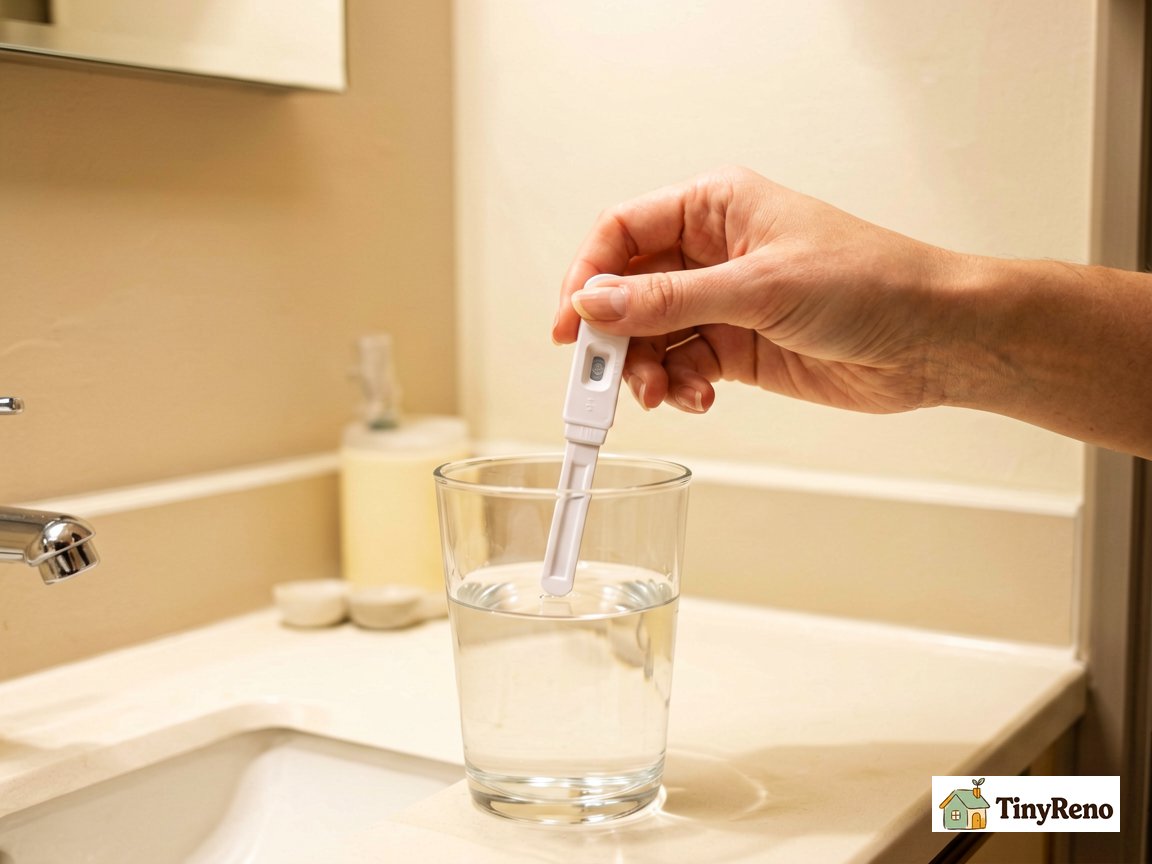
Skip the guesswork. Buy a $4 hard water test strip at any hardware store or pool-supply shop. Dip it in cold tap water, wait the time on the package (usually 15 seconds), and compare the color to the chart.
| Reading | Level | Color |
|---|---|---|
| 0–3 gpg | Soft | Clear/yellow |
| 4–7 gpg | Moderately hard | Light pink |
| 8–12 gpg | Hard | Pink |
| 13+ gpg | Very hard | Dark pink/red |
The strip cost me less than a bottle of cleaner. The number it gave me — 18 gpg — saved me from buying the wrong product three more times.
If you rent and can't test your own water, look up the municipal water report for your zip code. It's public. The numbers are averages, but they'll at least put you in the right tier. My Phoenix-area report said 12-22 gpg. The strip confirmed 18.
Tier 1 (4-7 gpg): The Vinegar-and-Microfiber Routine
If your water tests moderately hard, you don't need chemicals. You need consistency.
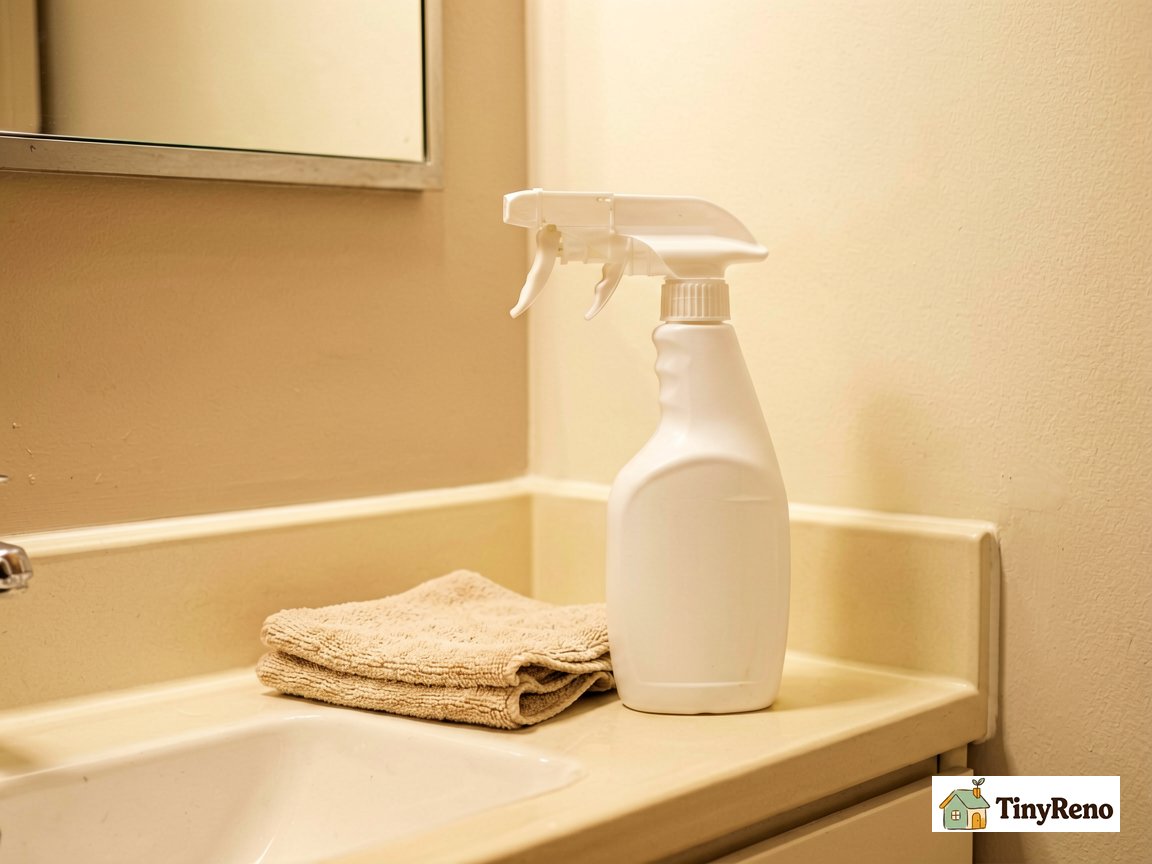
The routine that worked for a friend in Denver with 6 gpg water: keep a spray bottle of 50/50 white vinegar and water in the bathroom. After every shower, spritz the glass door and the showerhead nozzles. Wipe down with a microfiber cloth (not a paper towel — paper towels leave lint that traps minerals).
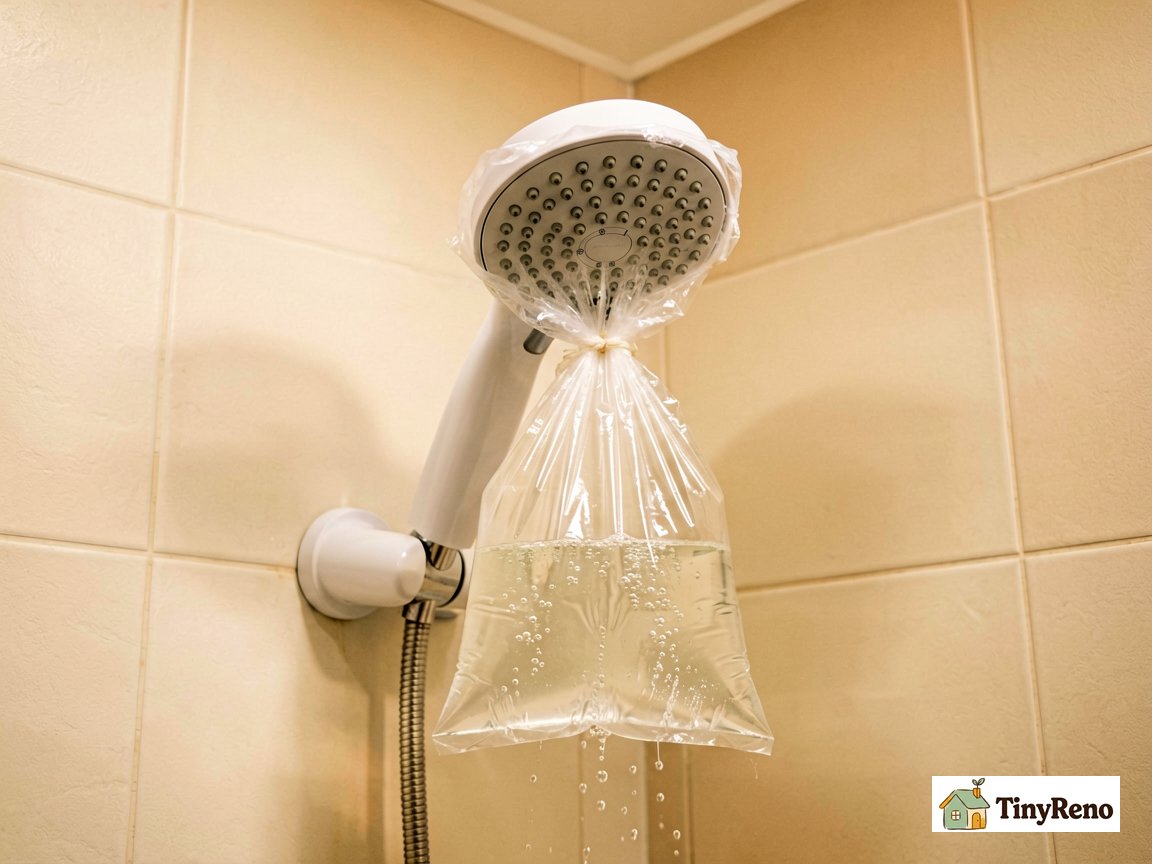
Twice a month, do a deeper clean: pour a cup of vinegar into a plastic bag, tie it around the showerhead so the nozzles soak for 30 minutes. The mineral buildup in the nozzles dissolves back into the water and washes away when you run the shower.
Cost: $3 for a gallon of vinegar, $7 for two microfiber cloths, $0 for the spray bottle you already have. Total: $10 once. This routine keeps moderately hard water from becoming a problem — but it won't reverse existing buildup, and it doesn't help if your water is harder than 7 gpg.
The catch: this only works if you actually do it after every shower. I tried this for a week at 18 gpg and the buildup kept winning. Vinegar at 5% acidity isn't strong enough for very hard water.
Tier 2 (8-12 gpg): The Citric Acid Powder Wash
When my upstairs neighbor told me about her softener, she also mentioned the powder she used before the softener got installed. It's a citric acid powder — sold as "hard water remover" or "lime and calcium remover" — and it works at higher concentrations than vinegar.
The application is simple: mix a tablespoon of powder with a cup of warm water to make a paste. Apply to the glass door, tile grout, and showerhead with a soft cloth. Let it sit for 5 minutes. Scrub gently. Rinse.
I tested this at my 18 gpg apartment. The powder cut through the existing buildup in three weekly applications. It also dissolved the mineral deposits in my showerhead's nozzles — the spray went from 9 weak streams back to one even rain after the second treatment.
Cost: $12 for a container that lasts 6 months at weekly use. The downsides: it's not safe on natural stone (marble, travertine, some tiles). Test a small spot first. Rinse thoroughly after use — leftover citric acid can irritate skin, especially if you have eczema or sensitive skin. And it has a faint citrus smell that disappears after 10 minutes.
This tier is the sweet spot for most renters in moderately hard to hard water zones. It works without installation, fits in a cabinet, and lasts months.
Tier 3 (13+ gpg): The In-Line Showerhead Filter
At 18 gpg, the citric acid powder slowed the buildup but didn't stop it. After four weeks of weekly treatments, the glass door was cloudy again and my hair was still straw-dry. The mineral level was too high for surface treatments to keep up.
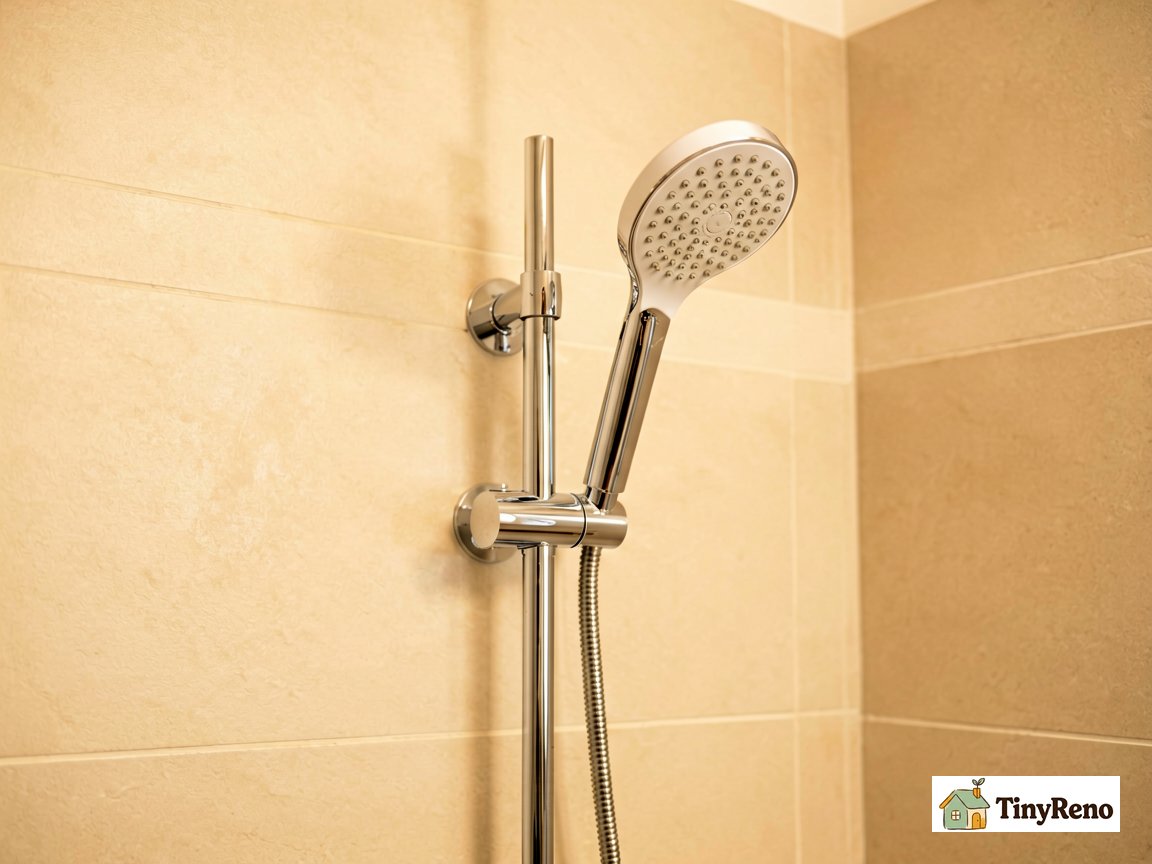
The fix that finally worked for my 18 gpg water: a $35 in-line showerhead filter. But know this — these filters are not true water softeners. They reduce some minerals and improve feel, but they don't change the actual hardness. For very high mineral levels, they slow the buildup rather than eliminate it. That's still a big improvement, but it's not the same as a whole-house softener. These screw between the shower arm and the existing showerhead — no tools, no plumber, no lease violation. The filter uses a replaceable cartridge (mostly KDF-55 and calcium sulfite) that strips minerals as the water passes through.
I installed one in my bathroom in eight minutes. The first thing I noticed was the water tasted different — softer, less metallic. The second thing was that my skin stopped itching after three days. The third thing was the shower glass stayed clear for two weeks without any treatment.
Cartridges last 3-6 months depending on usage. A 6-pack costs $40. So the annual cost is around $75 — comparable to the powder, but zero ongoing labor.
This is the tier where most Phoenix, Las Vegas, San Antonio, and Tucson renters end up. If your water tests over 13 gpg and you rent, this is the only sustainable fix. Vinegar won't keep up. Powder won't keep up. The filter is the only thing that treats the water at the source.
How do you know when to change the filter? The spray pressure drops, the water starts feeling harder again, or the filter body darkens. Most cartridges are designed to be changed every 3–6 months, but if your water is at 18 gpg like mine, expect closer to 3 months.
What Doesn't Work (And Why I Tried Them)
Before I figured out my water was at 18 gpg, I bought three things that didn't work for me but might work for someone with softer water.
Soap-free body washes. Marketed as "hard water friendly," these add more surfactants to compensate for minerals reacting with soap. They help slightly at 4-7 gpg. They do nothing at 18 gpg. Cost: $14. Result: marginal.
Magnetic water conditioners. Clip-on devices that supposedly alter mineral structure with magnets. No peer-reviewed evidence they work. Cost: $25. Result: zero change in buildup after four weeks.
Bottle of "hard water shower cleaner." Most of these are diluted vinegar with fragrance. Cost: $8. Result: same as vinegar, more expensive.
The pattern: products designed for 6 gpg water don't work at 18 gpg. The fix has to match the level.
How to Maintain Whatever Fix You Choose
Whatever tier fits your water, the maintenance is the same.
For glass doors: squeegee after every shower. Takes 15 seconds. Prevents 90% of mineral film from forming. This is the single highest-leverage habit, regardless of water level.
For showerheads: pour a cup of vinegar over the nozzles once a month. Don't remove the showerhead — just pour and let gravity do the work. The vinegar sits in the nozzles for the few minutes the water drains and dissolves the loose minerals.
For hair: a clarifying shampoo once a week strips mineral buildup from hair shafts. Cheap ones work as well as expensive ones. Lather, leave for 2 minutes, rinse. Don't do it more than weekly — clarifying shampoo is drying.
For skin: rinse with cool water for the last 30 seconds of every shower. Hot water opens pores and lets minerals in. Cool water closes them. Took me three weeks to make this a habit; the difference in my skin's itch was noticeable by week two.
What is the fastest way to remove hard water buildup in a shower? The fastest is citric acid powder on existing buildup (5 minutes of contact, then rinse). For prevention, a squeegee after every shower is faster than any product — 15 seconds, no chemicals.
Will a water softener help with hard water in shower? Yes, but renters usually can't install one. A whole-house softener requires plumbing modifications. The renter-friendly alternative is an in-line showerhead filter ($35, no install), which works at the showerhead only. Anyone asking how to fix hard water in shower at the renter level ends up at this filter.
How do you know if your water is too hard? A $4 test strip from a hardware or pool-supply store, dipped in cold tap water for 15 seconds, gives you a reading in gpg. Over 7 gpg is "hard" and needs more than vinegar. Over 13 gpg needs an in-line filter. Knowing your level is the first step in how to fix hard water in shower without wasting money on the wrong product.
Can renters really fix hard water in shower without a plumber? Yes — the entire how to fix hard water in shower decision is renter-scoped. Vinegar (Tier 1), citric acid powder (Tier 2), and in-line showerhead filter (Tier 3) all install without tools, without lease violations, and without landlord permission. The only fix that requires plumbing is a whole-house softener, which renters can't install anyway.
What I'd Tell a Renter in a New City
The week I moved into the Phoenix apartment, I should have spent five minutes and four dollars on a test strip. Instead I spent sixty dollars on products that didn't work and another eighty on the filter I should have bought first.
Test your water first. Match the fix to the level. Don't trust product marketing. If you're in a hard water region and renting, the $35 in-line filter is the single best $35 you'll spend on the apartment.
The glass door in my bathroom is still clear two months later. The showerhead sprays evenly. My hair behaves. The landlord's water softener is still broken. I haven't called to fix it.


Discussion (0)
Sign in to join the discussion