

Closet sliding door hardware. I learned those four words on a Saturday morning in March when the mirror panel on my bedroom closet came off its upper track at 6:40 a.m., bounced once on the floor, and slid two feet into the wall. The panel was a 90-pound slab of mirrored glass. The dent it left in the drywall is still there, covered by a framed poster my landlord insisted I hang before she signed off the move-out inspection. I never replaced that drywall. I did, however, learn exactly which sliding door hardware parts are worth swapping and which ones are not.
The three parts that actually wear out
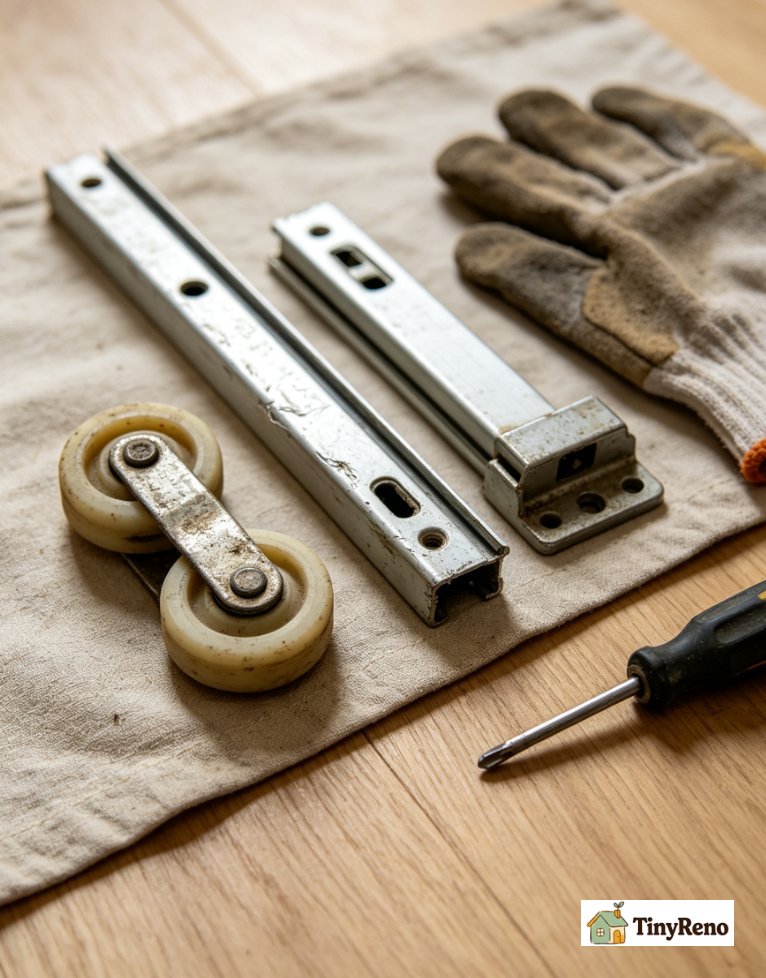
If you have a sliding closet door, you have three pieces of closet sliding door hardware that move every time you open or close the door. Two of them wear out on a predictable schedule. The third one almost never does, and replacing it is what most of the YouTube videos get wrong.
The rollers are the small wheel assemblies at the top of each door panel. They run inside the upper track and carry the entire weight of the door. On a 90-pound mirrored panel, each roller holds about 45 pounds. The nylon wheel on a stock roller is rated for roughly 8 to 12 years of normal use, and after that the wheel starts to flatten on one side. A flattened roller makes a clicking sound when the door moves, and eventually the door starts to bind at the same spot every cycle. If you feel a regular bump every few inches, that's the flat spot hitting the track once per revolution. If the sound is more random, check for a dented track instead.
The upper track is the horizontal channel mounted to the header above the closet opening. It does not move. It gets dented, however, when a panel jumps the track — usually because a roller was already failing. A dented track will not let a new roller ride smoothly. You can see a dent by running a finger along the inside of the track and feeling for any spot that catches. Most dents are at the ends, where panels tend to slam.
The bottom guide is the small plastic or metal piece screwed into the floor (or the lower track) that keeps the door panel from swinging. It does not carry weight. It only keeps the panel aligned. The bottom guide almost never wears out on its own. The two times I have replaced one, the original had been cracked by something heavy being dropped on it. If your bottom guide looks intact, leave it alone.
What I bought, and what held up after a year
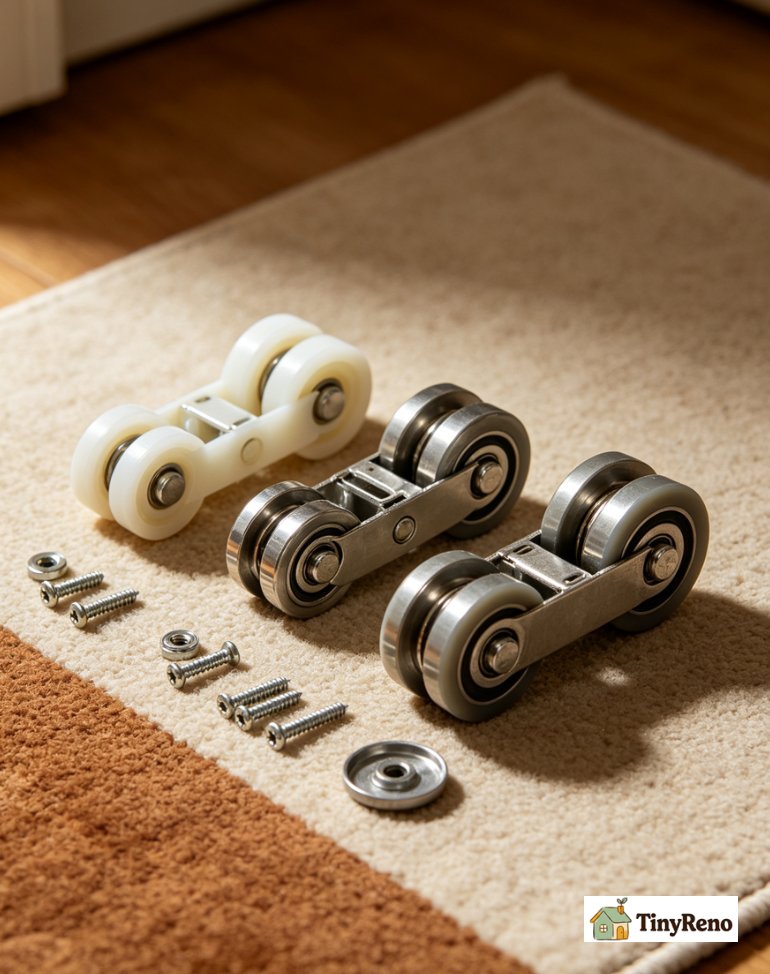
I bought three closet sliding door hardware kits during the four weeks after the mirror incident, because the dented track forced me to replace the rollers anyway and I wanted to test replacements. The kits ranged from $11 to $38. All three claimed to be universal fit. None of them were truly universal, and one of them was on the floor inside a week.
Kit one was the $11 plastic roller set from a hardware store chain. Two wheels, two housings, four screws. The wheels were 1 inch in diameter, which is the size my closet door wanted. The housings were stamped steel, which felt solid until I installed them and realized the mounting holes did not line up with the existing bracket slots on my door panel. I had to drill two new holes in each panel. They have been holding for 14 months.
Kit two was the $18 stamped-steel roller set sold by an online hardware brand. Same 1-inch wheel. Better-finished housing. The mounting holes did line up with my panel brackets. They have also been holding for 14 months. This is the kit I would buy again.
Kit three was the $38 ball-bearing roller set marketed as "heavy-duty for mirrored doors." The wheels were 1.25 inches — the wrong size for my track, which is probably why one of them shattered inside the track on day six. I shouldn't have installed them. The lesson here isn't that ball-bearing rollers are bad; it's that wheel size has to match the track.
| Kit | Price | Wheel size | Mounting fit | Status at 14 months |
|---|---|---|---|---|
| Plastic roller set (chain store) | $11 | 1 in | Required new holes | Holding — 14 months |
| Stamped-steel roller set (online brand) | $18 | 1 in | Fit existing brackets | Holding — 14 months |
| Ball-bearing heavy-duty set | $38 | 1.25 in | Wrong wheel size | One shattered day 6, three in drawer |
The decision tree I now use, when friends ask which closet sliding door hardware kit to buy, looks like this.
- If the door is a hollow-core panel under 40 pounds — a $11 plastic roller set is fine, and the missing mounting holes take 10 minutes to drill.
- If the door is a mirrored or solid-core panel over 40 pounds — a $18 stamped-steel roller set with the right wheel diameter (measure yours first).
- If you do not know your door weight — measure the wheel diameter and buy a kit that matches. The "heavy-duty" ball-bearing kits are not heavier-duty; they are just a different size.
The $18 kit is what I bought to replace the broken mirror panel hardware, and it is the same kit still riding the track today. If your closet is also doubling as your only storage, the related guide on 6 no-drill hanger setups for renter closets is the next thing worth reading once the door rolls smoothly again.
The 20-minute swap, step by step
One thing before you start: if the door panel itself is cracked or the track is bent, that's a landlord repair in most leases. Replacing rollers is renter-friendly. Replacing an entire mirrored door panel is not. I only bought the new panel because my landlord and I agreed in writing that I'd handle it and deduct the cost from that month's rent. Get that kind of agreement before you buy anything bigger than a roller set.
Step one. Lift the door panel up into the upper track and tilt the bottom out toward you. Most closet doors lift off the bottom guide with one hand once you have a grip on the top edge of the panel. If the panel is a mirrored slab, get a second person. A 90-pound mirror falling on a foot is a bad Saturday.
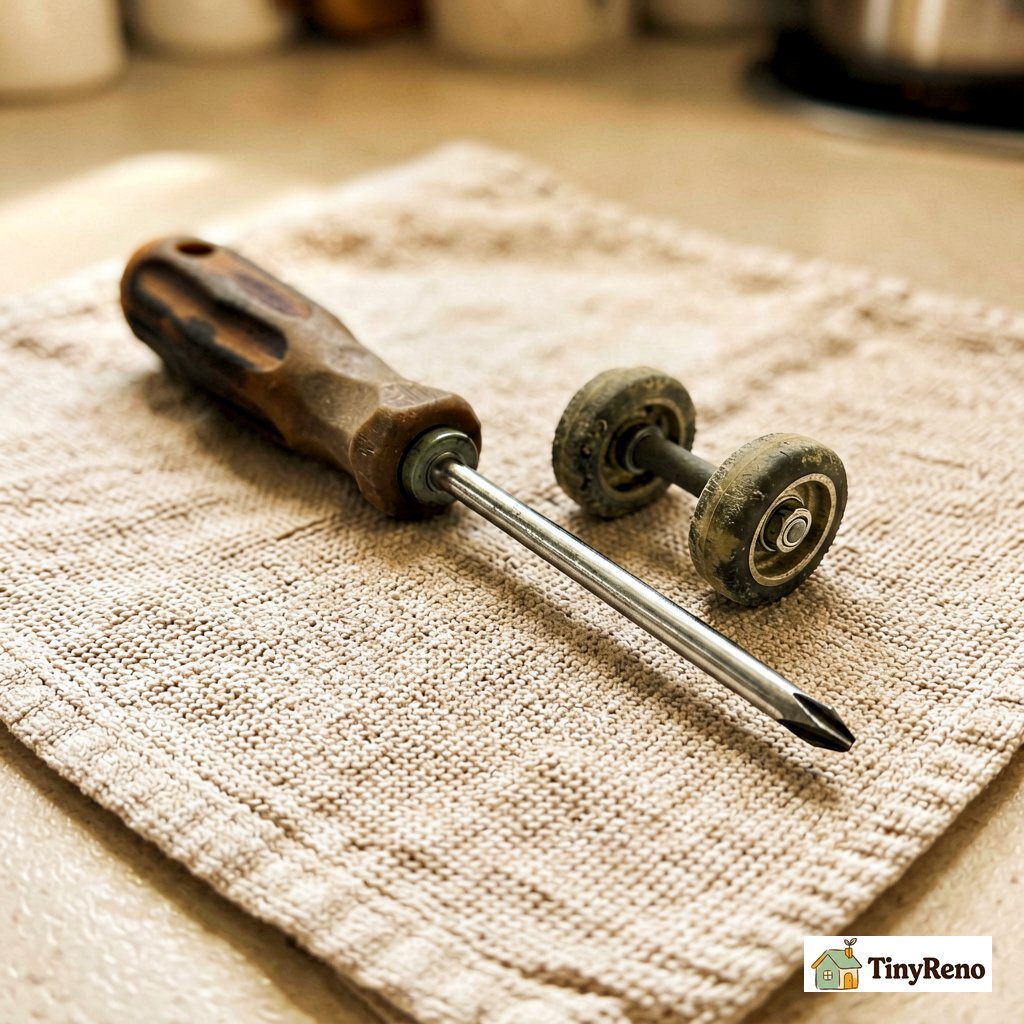
Step two. Lay the panel flat on the floor, mirrored side down. Unscrew the two roller assemblies from the top edge of the panel. Each assembly is usually held by two screws into the wood frame at the top of the panel. Set the screws aside in a small dish so they do not roll under the radiator.
Step three. Pull the old rollers out of the upper track. They slide out at one end of the track. If the track has end caps, pry the end caps off first with a flathead screwdriver wrapped in painter's tape so you do not scratch the paint.
Step four. Slide the new rollers into the upper track. Test that they roll smoothly by flicking each one with a finger. If a roller does not spin freely, the wheel is the wrong size or the track has a dent. Stop and figure out which one.
Step five. Reattach the roller assemblies to the top of the door panel. Lift the panel back into the upper track, lower the bottom edge onto the bottom guide, and slide the door back and forth three times. If it catches, the wheels need a quarter-turn adjustment. Most rollers have a small screw on the side that raises or lowers the wheel by a few millimeters.
The whole job takes 20 minutes for a single panel if the mounting holes line up, and 35 minutes if you have to drill new ones. I timed it. If your closet door panel is a hollow-core slab without rollers (some older apartments), the sliding screen door removal walkthrough covers a similar lift-out pattern that works on those panels too.
One year later: the same kit, the same track
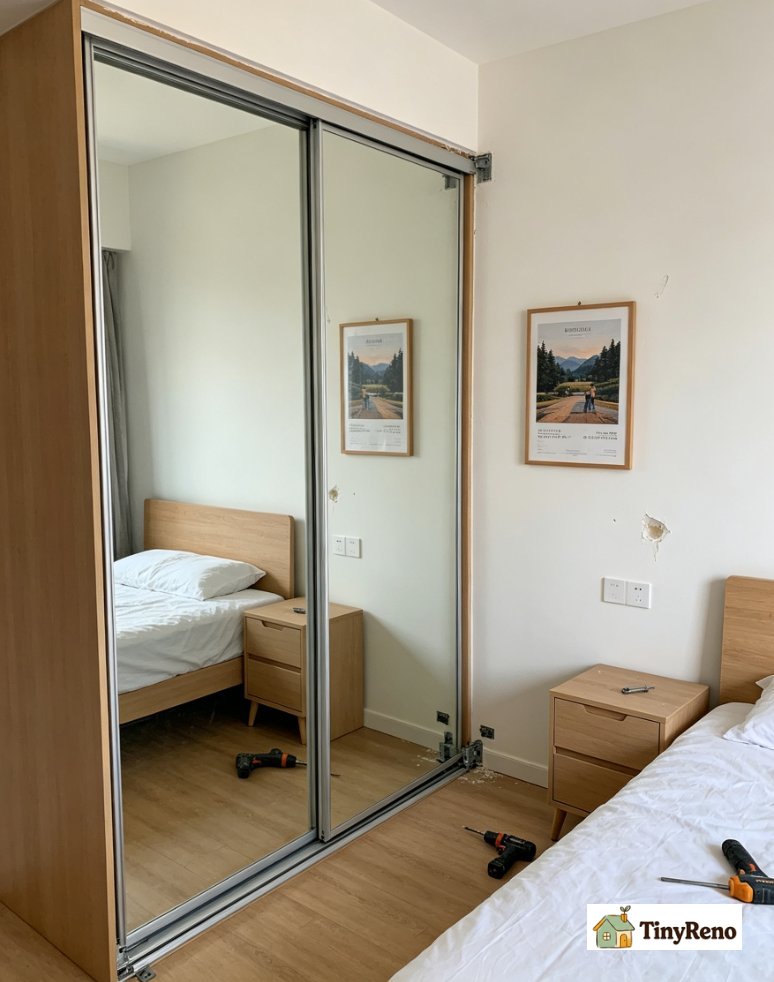
The $18 stamped-steel roller kit is still on the upper track of my closet, riding a track that has a small dent near the left end where the mirror panel jumped it. The dent is small enough that the new rollers roll right past it without clicking. The panel itself is a new 50-pound mirrored slab from a glass shop, not from the landlord, which cost $140 and is the real reason the closet door does not make noise anymore.
The dent in the drywall is still covered by the framed poster. The bottom guide has not been touched. The two plastic roller sets I drilled into the other closet are still rolling, and I have not replaced a roller in 14 months.
If you do end up needing a full closet door replacement because the panels themselves are cracked, the door install pattern is similar to the shower head swap renter walkthrough in that the trick is to work slowly and not force anything — both jobs fail the same way when renters try to muscle through a stuck part.
If your closet door is clicking, the closet sliding door hardware that needs replacing is the rollers, not the track and not the bottom guide. Measure your wheel diameter, buy the $18 stamped-steel kit, and set aside 20 minutes on a Saturday morning before the dent in the drywall happens to you.


Discussion (0)
Sign in to join the discussion