

Quilt storage bag. The phrase sounds boring until the first time you pull a winter quilt out of a closet in July and find it speckled with mildew and silverfish damage. That was the afternoon I bought my first bag, and the afternoon I learned that the wrong bag is worse than no bag at all, because a sealed plastic one will trap moisture and turn a $180 quilt into a donation bin item in three months.
The afternoon I ruined a quilt in a vacuum bag
It was July 2024 and I had just moved into a one-bedroom in Astoria with a closet the size of a phone booth. My grandmother's hand-stitched quilt — the one she made me when I graduated college — was taking up half the closet shelf and I needed the space for a stack of sweaters. I bought a $9 clear-plastic vacuum bag from the drugstore, folded the quilt into it, sucked the air out with my vacuum, and slid the flat brick under the bed. That felt like a win for about eleven weeks.
In September I pulled the bag out to switch back to the winter bedding. The quilt smelled like a wet basement. There was a thumb-sized patch of black mildew on one corner and three silverfish inside the bag, still alive. The vacuum bag had compressed the quilt beautifully, but it had also trapped every bit of residual moisture from the fold. Plastic does not breathe. Moisture does not leave. If your closet is the same phone-booth shape mine is, the related guide on 6 no-drill hanger storage setups for renter closets covers the same kind of small-space trade-off I was trying to fix.
I washed the quilt twice on gentle cycle, hung it outside for two full days, and was lucky enough to save most of it. The corner patch never quite came clean. I still have the quilt — it lives on my bed in winter — but I will never put it in a plastic vacuum bag again. That single mistake is what kicked off the year-long test I am about to walk you through.
What I learned from three renters who all store under the bed
I posted a thread on my building's group chat that September: who has a quilt storage bag that actually works long term. Three neighbors replied with three different answers, and the differences were sharp enough that I asked each of them to walk me through their setup.
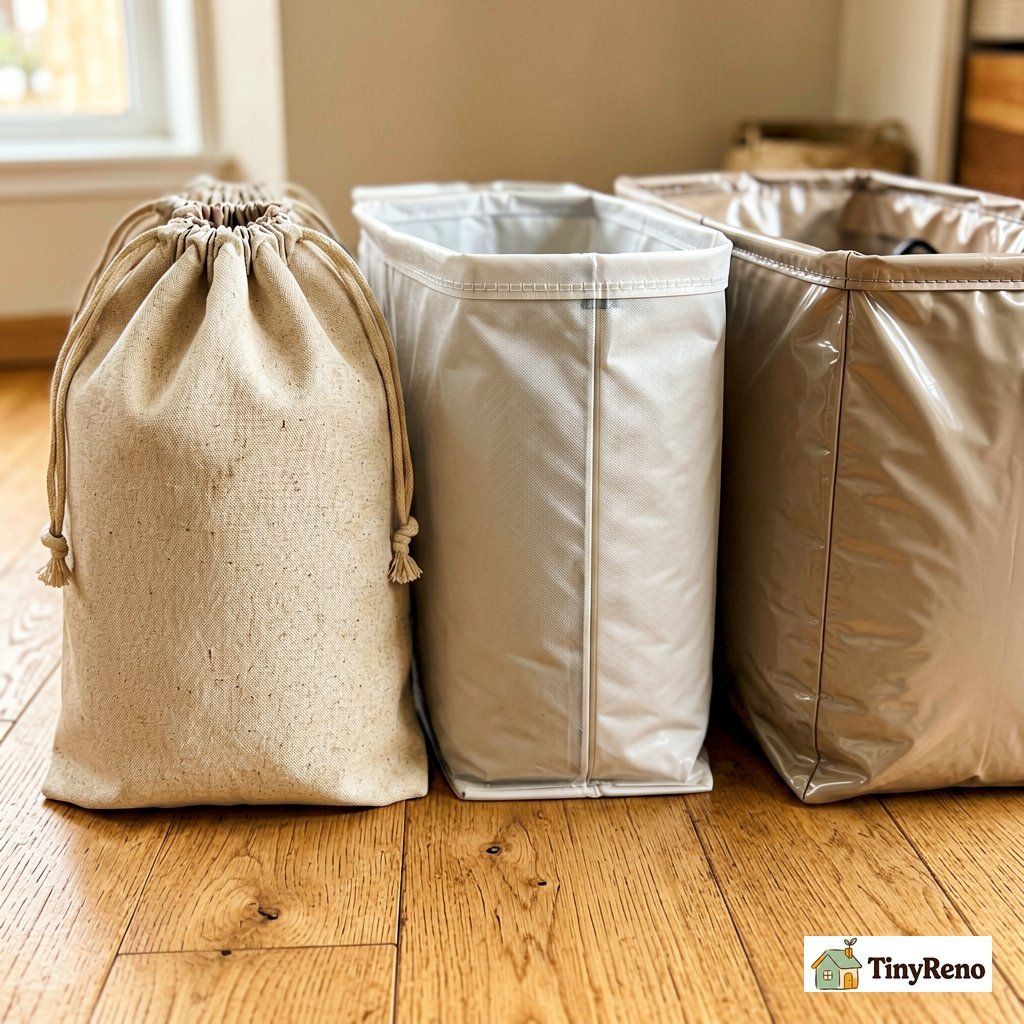
Sasha, second floor, two-bedroom: a 100 percent cotton drawstring bag, the kind that looks like a pillowcase with a string at the top. She keeps her quilt clean with the cotton bag and slips a $3 cedar block inside. No vacuum, no plastic. The quilt comes out smelling faintly of cedar, which she likes, and it has stayed clean for two winters.
Daniel, third floor, studio: a heavy-duty non-woven polypropylene bag with a zip closure and a 6 mm sealed seam. He treats the bag like a piece of luggage — folds the quilt, rolls it, slides it under the bed. No moisture damage after eighteen months, including one full summer with the radiator off.
Marisol, first floor, one-bedroom: a clear vinyl zippered bag, the kind sold as a "comforter storage bag" on Amazon. She is the one I expected to have problems because vinyl is essentially plastic, but her version has a small ventilation flap on the side. She has not had moisture damage in fourteen months.
The thread converged on a rule I now use every time I store a quilt for more than a month.
If you cannot feel air move through the bag material when you blow into it, do not seal your quilt inside. Moisture will get trapped, and trapped moisture wins every time.
The plastic vacuum bag that ruined my quilt was the worst case. Sasha's cotton and Marisol's vented vinyl were both fine. Daniel's non-woven polypropylene was the best of the three for long-term under-bed storage, which is where this whole question started for me. If you want to see how I run a similar year-long renter test on a different material, the stackable wire baskets comparison uses the same neighbor-pool and three-month check-in format.
One fair criticism of my own comparison: Sasha, Daniel, and Marisol were storing in different spots — closet shelf, under-bed, and linen closet. The bag material mattered, but so did the location. A breathable bag in a damp basement is not safer than a plastic bag in a dry closet. The rule I take from this is "match the bag to the room," not just to the quilt.
The checklist I now use before any quilt storage bag purchase
Three features. Every one of them has to be present, or the bag fails within a season. The order matters.
- Breathable or vented material. Cotton, non-woven polypropylene, or vinyl with a vented seam. Solid plastic and airtight sealed bags fail this test.
- Sealed against insects. Silverfish and carpet beetles can squeeze through a 1 mm gap. The closure has to be a zip, a drawstring with a knot, or a fold-over flap — not a loose overlap.
- Right size for the quilt. The quilt should fill 70 to 85 percent of the bag. Too small and the quilt compresses. Too big and air pockets form, which is where moisture collects.
Two features I used to think mattered but do not. Clear sides are not useful — you cannot see through 18 months of dust anyway, and clear plastic scratches. Handles are nice but not necessary if the bag is light enough to slide.
| Bag | Material | Breathable? | Insect-sealed? | Months before problem |
|---|---|---|---|---|
| Sasha's cotton drawstring | 100% cotton | Yes | Drawstring + knot | 24 (no problem) |
| Daniel's non-woven poly | Polypropylene | Yes (micro-perforated) | Zip closure | 18 (no problem) |
| Marisol's vented vinyl | Clear vinyl + vent | Partial (vented flap) | Zip closure | 14 (no problem) |
| My clear-plastic vacuum bag | Polyethylene | No | Heat seal | 2.5 (mildew + silverfish) |
How to actually pack a quilt, step by step
Step one. Wash or air the quilt before packing. Folded-in moisture is the number-one reason quilts get ruined in storage, and packing a quilt that was clean five minutes ago does not help if there is any dampness in the fold. A full sunny day on the line is what I use, or one cycle in the dryer on low heat with dryer balls.
Step two. Fold the quilt into thirds, then in half, with the finished or printed side facing inward. This protects the visible surface from abrasion against the bag. Do not roll — rolling creates pressure creases that wear along the same line for the entire storage period.
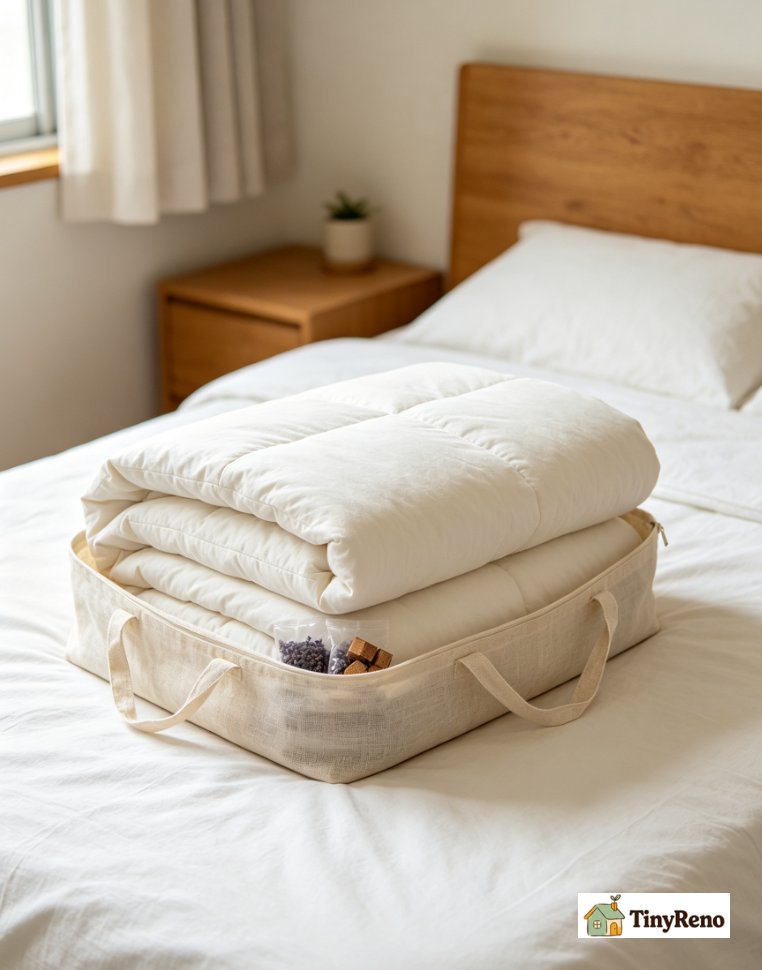
Step three. Slide a cedar block into the fold if you've had moths or silverfish problems before. Cedar has some repellent effect against both, though it's not a guarantee and the scent fades after a few months — sand it lightly or replace it each season. Lavender sachets mostly mask odor and have a much weaker effect on insects; use them if you like the smell, not as your only defense.
Step four. Place the folded quilt into the bag, leaving 15 to 30 percent of the bag empty. Slide the bag under the bed or onto the top shelf of the closet. Avoid basements, attics, and anywhere the temperature swings more than 15 °F between day and night, because that swing is what causes condensation inside the bag.
Step five. Pull the bag out every few months — in practice, each time the season changes — for a five-minute check. If it's under the bed and hard to reach, tie the check to a date you'll remember: when the clocks change, when rent is due, when the radiators turn on. Look for moisture spots, smell the fold, look for insects. If anything is off, pull the quilt out, air it for a day, and repack with fresh cedar. This is the step I skipped the year I ruined the quilt, and the step I have not skipped since.
One year later: the cheap bag is still on the bed
I bought Sasha's cotton drawstring bag in October, after she showed me hers in the laundry room. It cost $11, plus $4 for two cedar blocks. My quilt went into the bag clean, came out clean in March, went back in clean in April, and has been living in the bag in the back of the closet since. The bag smells faintly of cedar. The quilt has no mildew, no silverfish, and no compression creases that do not relax overnight.
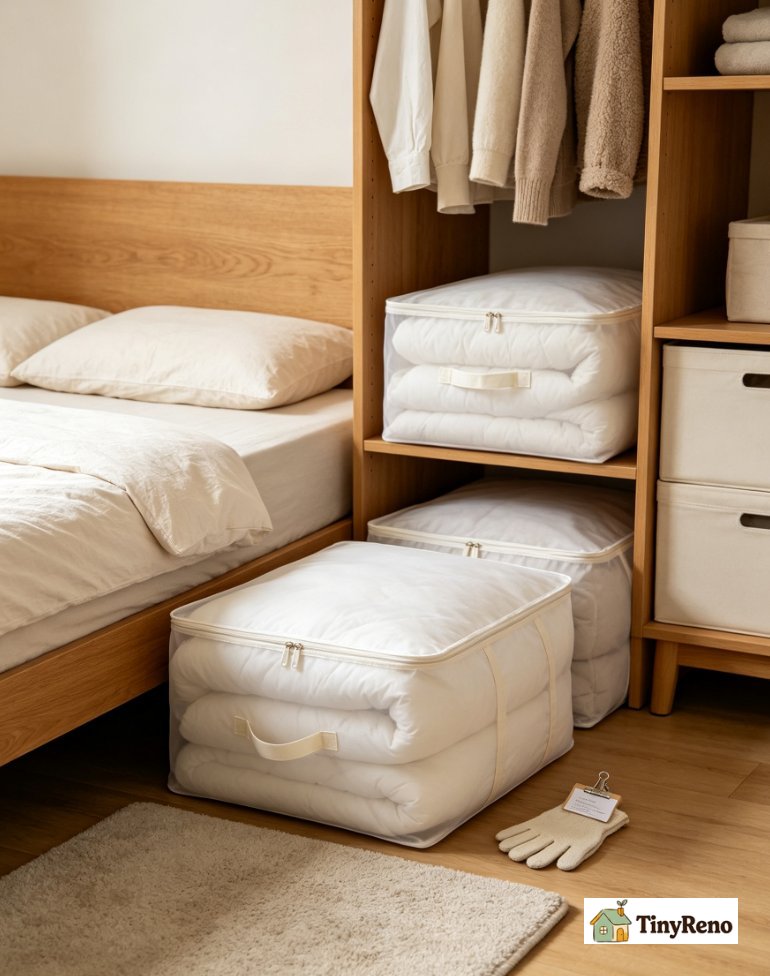
Marisol's vented vinyl is in her linen closet, holding her winter comforter. Daniel's non-woven poly bag is under his bed, holding his sleeping bag. The plastic vacuum bag from the drugstore went into the recycling bin in October 2024, which is where it belonged in the first place.
If you have a quilt you care about, the cheapest quilt storage bag that will work is the one that breathes and seals against insects. If you're going to store for more than a season — and especially if you live in a humid building — skip the airtight plastic vacuum bag. It can work for short-term storage in a dry climate, but the failure mode is exactly the one I hit: trapped moisture and insects. For anything you care about, the breathable bag is the safer default. Cotton and cedar have been doing this job for a hundred years, and they still do.


Discussion (0)
Sign in to join the discussion