

Dehumidifier for dust mites. I typed those four words into Amazon on a Tuesday in February because I had been sneezing every morning for three weeks and I blamed the radiators. I did not blame the radiators for long. A $12 humidity meter told me the real story: my bedroom was sitting at 64 percent relative humidity all winter, and dust mites breed fast once the room crosses 50 percent. Buying a dehumidifier for dust mites was the next step, but I had no idea which one would actually move that number — and I had no idea that one of the three I tried would break in eleven days.
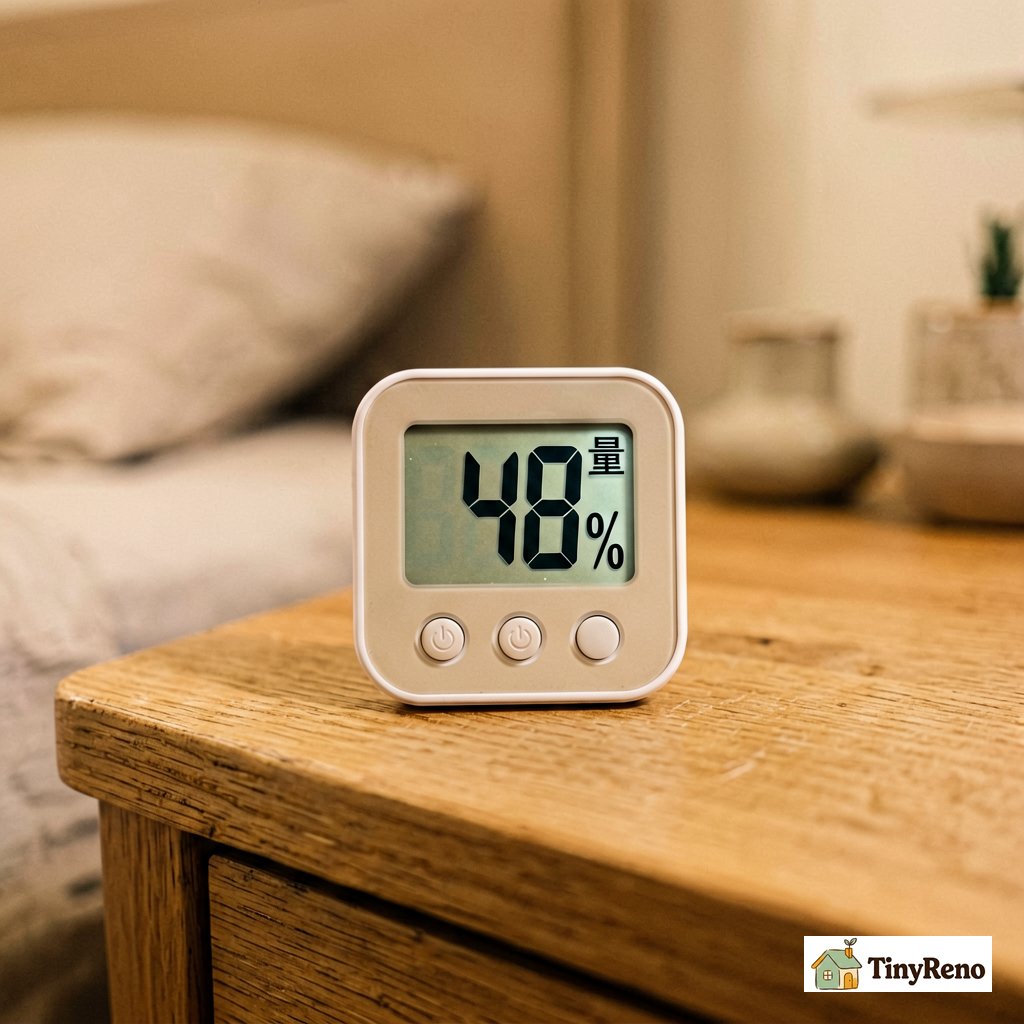
The morning I realized the sneezing was not a cold
It took me longer than it should have. Three weeks of waking up congested, two boxes of tissues, one round of over-the-counter cold medicine that did nothing — I kept telling myself it was the dry heat from the radiator kicking on at 5 a.m. The radiator was part of it, but not the part I thought.
My downstairs neighbor Priya knocked on my door one Saturday and asked if I had been sick too. She had the same symptoms. She also had a humidity meter she had bought for her violin, and she held it up to my doorway and said: "Read this. Sixty-four. That's not the cold, that's the air." I ordered the same meter that night — a basic digital one with a min/max memory — and confirmed her number the next morning.
Once I knew the room was at 64 percent RH, I started reading. Dust mites need three things: warmth, food (skin flakes), and humidity above 50 percent. Cut the humidity, and the population crashes within weeks. The mechanism is direct — below 50 percent, the mites cannot absorb enough water from the air to survive. A dehumidifier for dust mites is not a marketing trick; it is the lever that pulls the humidity number down. If your morning routine looks like mine did, the related guide on fixing hard water in a renter shower follows a similar diagnostic pattern — measure first, then act.
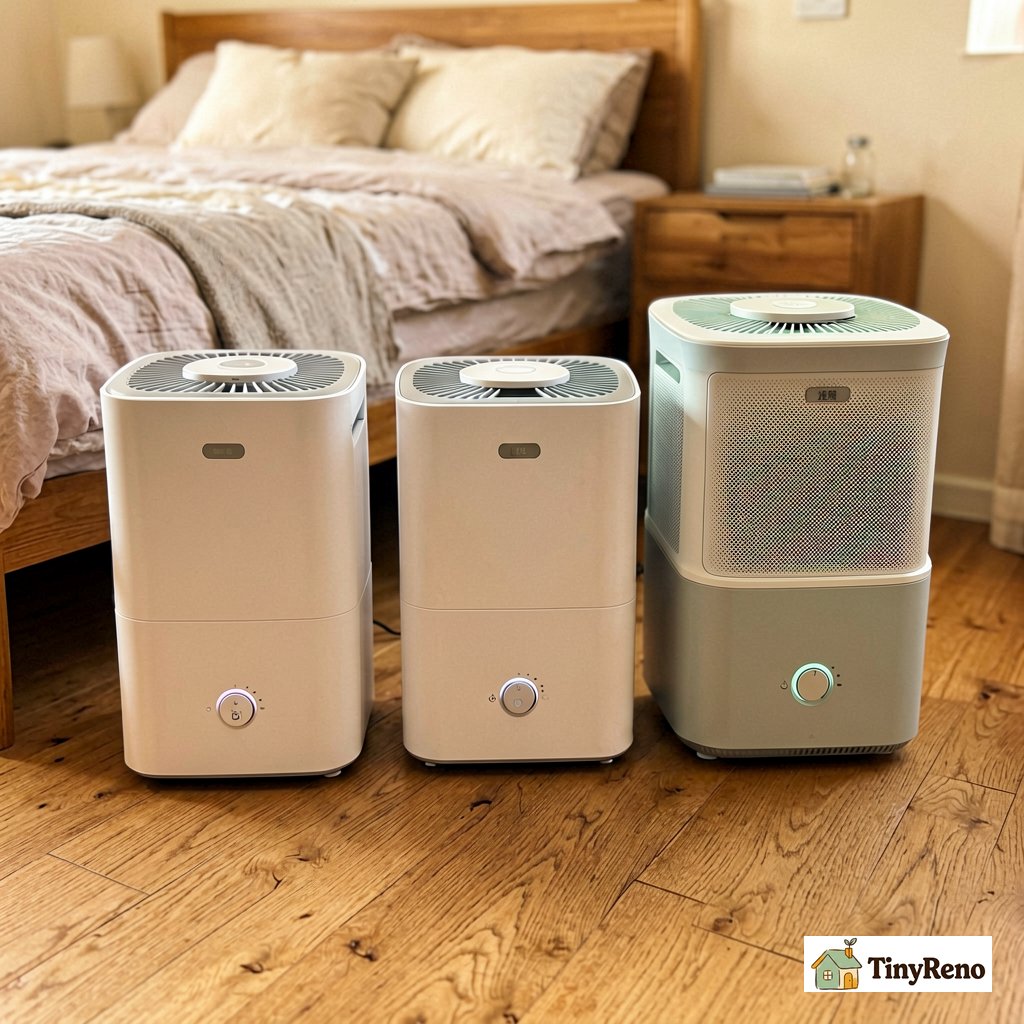
The three units I tried, and the one that died in eleven days
I bought three units over the course of four weeks. None of them cost more than $90. All three were small enough to live on a shelf in my closet, which mattered because my lease says nothing about appliances but my landlord definitely notices when the electricity bill jumps $40.
Unit one was a 1,500 ml thermoelectric Peltier dehumidifier, the kind shaped like a small trash can. It was quiet, it pulled about 250 ml a day at 64 percent RH, and it died on day eleven. The fan motor started making a clicking noise and then it stopped pulling anything. I returned it. Unit two was a slightly larger 2,000 ml desiccant dehumidifier that used a refillable silica wheel. Quieter than the Peltier, but the silica needed baking at 250 °F every two weeks, which meant oven time and a smell I did not want in a one-bedroom apartment.
Unit three was a 2,000 ml compressor dehumidifier — the kind with a small refrigerated coil. It was louder than the other two (about 38 dB on low, 42 dB on high), but it pulled 400 to 500 ml a day at 64 percent RH, and After three weeks it dropped my bedroom to a steady 47 to 49 percent, and it's still running three months later. I can't speak to its long-term reliability beyond that — compressor units have their own failure modes, just later ones — but for a rental where every purchase has to earn its place, it's the only one of the three I'd buy again. The upholstery test report from a similar 30-day budget buy uses the same kind of multi-unit comparison structure if you want to read another renter's before/after.
| Unit | Type | Daily pull at 64 percent RH | Noise | Days before problem |
|---|---|---|---|---|
| Peltier 1,500 ml | Thermoelectric | ~250 ml | Quiet | 11 (motor failed) |
| Desiccant 2,000 ml | Silica wheel | ~300 ml | Very quiet | Maintenance every 14 days |
| Compressor 2,000 ml | Refrigerated coil | ~450 ml | 38–42 dB | Running 90+ days |
The decision tree I now use, when friends ask, looks like this.
- If the bedroom holds below 50 percent RH already — you do not need a dehumidifier. Vacuum more often and wash bedding weekly in hot water.
- If the room sits between 50 and 60 percent RH — a small Peltier will work in summer but is unreliable long term. Plan to replace it in a year.
- If the room is above 60 percent RH — go straight to a compressor unit. The noise is worth the consistency.
The $12 humidity meter was the actual purchase that mattered. Without it I would still be blaming the radiator.
The email I sent my landlord before I plugged anything in
Here is the thing renters always forget: you can buy the dehumidifier, you can run it for three weeks, you can drop your humidity to 48 percent — and none of that matters if your landlord sees a $40 spike on the electric bill and assumes you are growing something illegal in the closet. I learned this the hard way from a college friend who got a noise complaint about her "appliance" before anyone even asked what it was.
I sent a short email two days before I plugged the compressor unit in. The structure is the one I now use for any renter appliance that draws more than a laptop.
Hi [landlord name], Quick heads-up — I am planning to run a small dehumidifier (about 2,000 ml/day capacity, roughly 200 watts) in my bedroom for the next month or two. Reason: my humidity meter has been reading 64 percent RH, and dust mites breed fast above 50 percent. I have been waking up congested for three weeks. The unit is on the floor of my closet, on a hard surface, with the reservoir emptied every morning. It will pull about 5 to 7 kWh per day, which I expect to add roughly $20 to $25 to the electric bill. Happy to talk through it if you have questions. [Your name]
Three things this email does that matter for a renter. It states the wattage, so your landlord can sanity-check the bill. It states the placement, so there is no surprise appliance in the living room. And it states the duration, so it reads as a temporary fix, not a lifestyle change. I have used this template four times now for different appliances and the response has always been a one-line "fine, thanks for asking."
What three weeks at 48 percent RH actually changed
One thing worth stating up front: my bedroom is small — roughly 120 square feet — and I keep the door closed while the dehumidifier runs. In a larger room, or with the door open, the same unit would pull the humidity down more slowly. If your space is bigger than that, or you can't close the door, size the unit accordingly.
I am going to be careful here because the internet is full of before-and-after stories that overstate the win. I did not stop sneezing entirely. I did stop sneezing in the first ten minutes after waking up, which had been the worst part of my morning for a month. The morning congestion dropped from a 7/10 to about a 3/10. The itchy eyes went away by week two.
Priya, who started a compressor unit two weeks after I did, reported the same pattern. The slow improvement was actually useful — it kept me from abandoning the test at week one, when nothing had changed yet. Dust mite populations do not crash overnight. The literature I read after the fact suggests a 50 percent reduction in two weeks and a near-elimination in four to six weeks if humidity stays below 50 percent the whole time. That matched what I saw.
The other thing that changed was my bedding routine. A dehumidifier for dust mites does not replace hot-water washing, and it does not replace a mattress encasement. The three work together: encasement blocks the mites already inside the mattress, hot water (at least 130 °F) kills the ones in the sheets, and the dehumidifier keeps new ones from recolonizing. Skip any one of the three and the population bounces back in a month. If you have not yet dealt with the encasement side, the 3-renter mattress comparison covers the encasement fit question in detail.
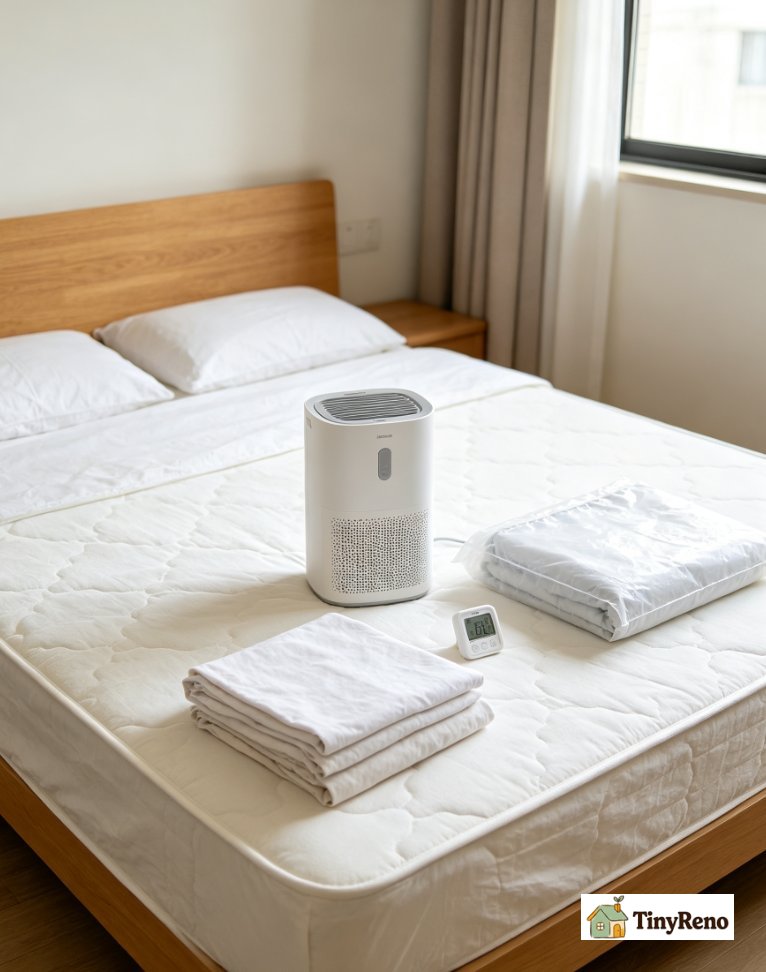
The unit is still running. Priya's is too.
Three months later, the compressor unit is on a shelf in my closet, the reservoir is on auto-shutoff so it cannot overflow, and my humidity meter still reads 47 to 49 percent on most mornings. I empty it every morning over the bathroom sink — about 400 ml on a humid day, 200 ml on a dry one. The electric bill went up $22 the first month and $18 the second. I have not gone back to the $12 cold medicine.
Priya bought the same model after her eleven-day Peltier died. Her unit sits on top of a stack of books in her bedroom — which I've told her not to do. A dehumidifier needs to be level and stable, and books are neither. So far it hasn't tipped, but it's a spill waiting to happen. She still has the violin humidity meter, and she still has the morning sneezing, mostly gone.
If your bedroom is reading above 55 percent RH on a $12 meter, and you have ruled out the radiator and the headboard and the cat, a dehumidifier for dust mites is the lever. Buy the meter first. The unit is the second decision, not the first.


Discussion (0)
Sign in to join the discussion