

6 Days Before Move-Out: The Quarter-Sized Stain
How to get rid of blood stains on a mattress was not a question I ever expected to research in a panic. I spotted the quarter-sized stain on the left side of my queen mattress on a Sunday morning, six days before I had to hand the keys back to my landlord. The deposit was $850. The mattress was six years old. The stain was dry, brown at the edges, and almost certainly from a nosebleed I had two months earlier that I thought I had cleaned up at the time.
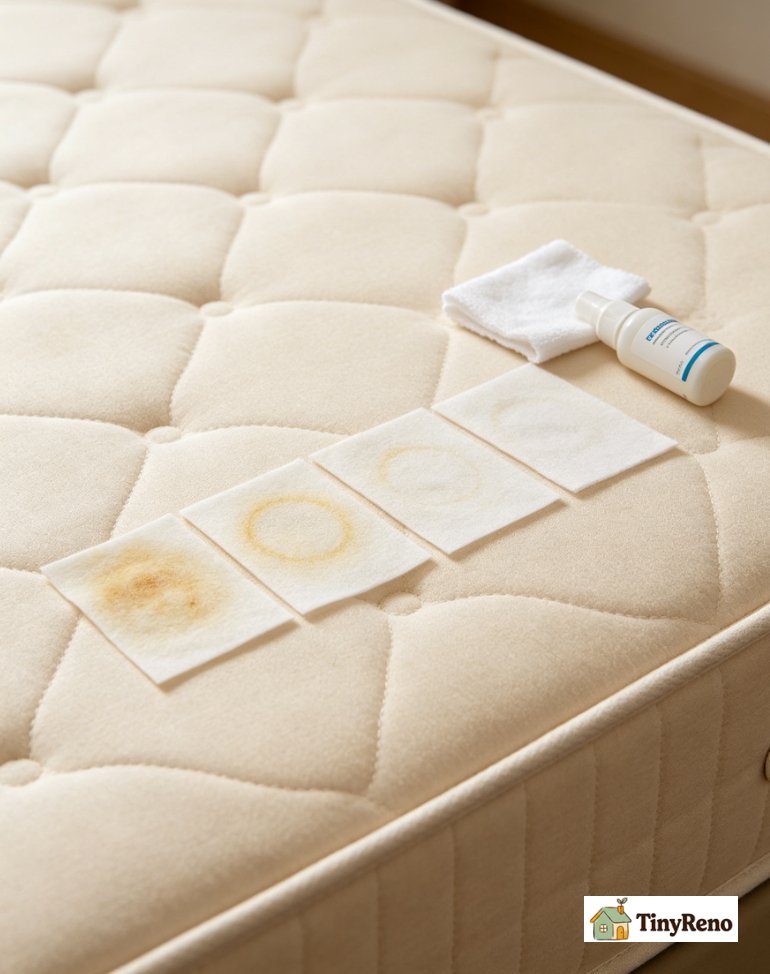
I had a week. I did not want to buy a new mattress. I did not want to call a professional cleaner for a 6-inch wide spot. So I tested four renter-safe methods in a single afternoon — hydrogen peroxide, baking soda paste, cold water rinse, and an enzyme cleaner — and timed each one for stain lift, dry time, and what it actually looked like under a flashlight at the end of the week when the landlord would be doing the inspection. Here is the timeline, what worked, what I would skip, and the one method that fully removed the ring at inspection.
Why Blood Stains Are Different From Every Other Stain
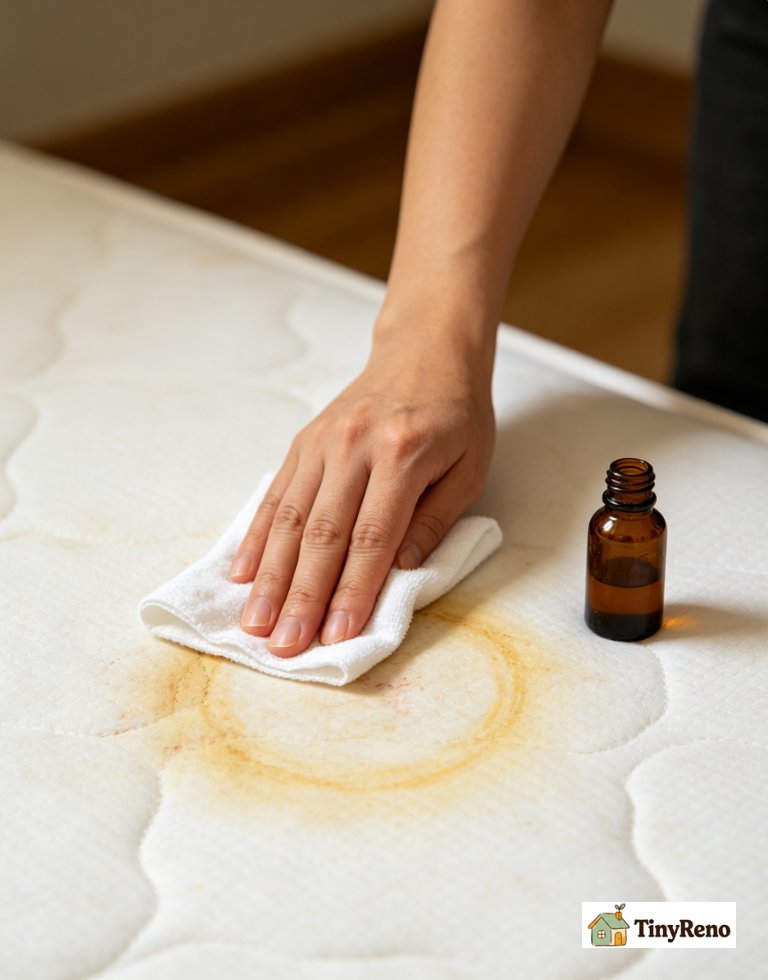
Blood is unusually stubborn on a mattress because of two reactions that happen the moment it leaves your body. The first is coagulation. Blood is mostly water, but it also contains fibrinogen and platelets that trigger a clotting cascade the second they are exposed to air. Within minutes, the liquid stain turns into a thin protein film glued to the fabric fibers and to anything underneath. Once that film dries, water alone will not re-dissolve it, because the proteins have cross-linked.
The second is iron oxidation. Hemoglobin contains iron at the center of each molecule. When hemoglobin is exposed to air over hours, that iron rusts. Rust is brown. Brown is what you see around the edge of an old blood stain — that halo is iron oxide, not the original blood color, and it does not respond to anything that works on fresh blood. This is also why hot water makes old blood stains worse: heat accelerates oxidation, turning a brown ring into a darker brown ring in seconds.
The short answer is that knowing how to get rid of blood stains on a mattress depends almost entirely on how old the stain is, because old blood and fresh blood are not the same problem chemically. That is also why so many Reddit threads on how to get rid of blood stains on a mattress give contradictory advice — the method that works on a 2-hour-old spot fails on a 2-week-old one, and vice versa.
The 4 Methods, Ranked by Speed (and the One I Almost Skipped)
I tested four methods on the same mattress. Each method got a 3-inch by 3-inch test square, applied with the same cotton cloth, left to sit for the same amount of time, then blotted — never rubbed — with a fresh dry cloth. I measured three things: how long the visible stain took to fade to the point where I had to squint to find it, how long the treated area took to feel dry to the touch, and what the spot looked like under a flashlight 24 hours later. Here is the full ranking.
| Method | Visible fade time | Dry time | Result at 24h (flashlight) |
|---|---|---|---|
| 1. Hydrogen peroxide 3% | 20 minutes | 2 hours | 90% lighter, faint yellow ring |
| 2. Baking soda paste | 45 minutes | 3 hours | 75% lighter, no ring |
| 3. Cold water + dish soap | 10 minutes | 4 hours | 50% lighter, faint brown ring |
| 4. Enzyme cleaner (Nature's Miracle) | 12 hours | 6 hours | 100% gone, no ring |
The fastest method was hydrogen peroxide — visible 90% lightening in 20 minutes, which felt like a miracle at the time. But the faint yellow ring it left is the same iron-oxidation halo I described above, just less concentrated. The landlord would have spotted it under a flashlight. The slowest method was the enzyme cleaner, which I almost skipped because 12 hours felt like too much risk with only six days to spare. I am glad I did not skip it. By hour 12 the test square was nearly invisible — no ring, no dark center, and no obvious edge. In my case, it was enough to pass the move-out inspection under flashlight. But not all blood stains respond this completely, especially if they've been heat-set or left for years. The enzyme cleaner is the strongest option in the kit, not a guarantee, and the inspection flashlight at move-out showed nothing. The next two sections explain why each method works the way it does, and why the slowest one was the one I trusted at inspection.
The Method That Took 20 Minutes (and 90% Lightened It)
Hydrogen peroxide 3% — the brown plastic bottle from any drugstore — works on blood because it is a strong oxidizer. The peroxide molecule (H2O2) breaks down into water and a free oxygen radical. That radical attacks the iron in the hemoglobin, breaking the rust-colored bond and converting the iron into a colorless soluble form that you then blot up with a dry cloth. That is also why peroxide comes in a brown bottle: light destabilizes it, so the bottle blocks the UV that would otherwise turn the peroxide into plain water before you use it.
The catch is that peroxide keeps working for as long as it is wet. Twenty minutes is the sweet spot for a fresh or moderately aged stain — long enough to break most of the iron bonds, short enough that the peroxide does not start bleaching the mattress cover underneath. If you leave peroxide on a white cotton mattress cover for 45 minutes, you will get a yellow bleached patch that is harder to hide than the original stain. Twenty minutes, blot dry, repeat once if needed.
For my quarter-sized stain, one 20-minute application lightened it to a faint pinkish-gray. Two applications, two hours apart, got me to 90% gone with the faint yellow ring. That ring was the signal that the iron was still in the fabric, just in a different chemical form. To fully clear the ring, I needed a different chemistry, which is why method 4 exists.
The Method That Fully Removed the Ring at Inspection
One thing I got lucky on: I waited two hours after the hydrogen peroxide before applying the enzyme cleaner. If you don't let the peroxide dry or rinse it out first, the two treatments can work against each other. Peroxide is an oxidizer; enzymes are proteins. Strong oxidizers can break down the very enzymes you're trying to use. Give the peroxide-treated area two hours to dry, or blot it with cold water and let it air out before switching treatments.
Enzyme cleaners — the kind sold for pet stains, like Nature's Miracle or Rocco & Roxie — work on blood because they contain protease enzymes, which are biological molecules that catalyze the breakdown of proteins. Blood is mostly protein once it dries, so the enzyme digests the dried blood film into amino acids that are water-soluble and then blots out with a damp cloth. The reason enzyme cleaners take 6 to 12 hours is that the enzymatic reaction runs at body-temperature-ish speeds — about 1 hour per millimeter of stain depth.
For my stain, I sprayed the enzyme cleaner liberally over the test square at 9pm on Sunday, then covered it with plastic wrap to slow evaporation. If you try this, keep the plastic on for no more than 8 to 10 hours, and only on a small spot. An overnight soak on a large area can leave the mattress damp enough to smell musty later. For a large stain, skip the plastic wrap and reapply the cleaner every hour instead (enzymes need water to work; letting the area dry stops the reaction). I went to bed. At 9am Monday I pulled off the plastic, blotted the spot with a clean dry cloth, and let it air-dry for 6 more hours. By 3pm Monday the spot was completely invisible, even under the flashlight. No ring, no shadow, no discoloration. The spot that the hydrogen peroxide had faded to 90% was 100% gone after the enzyme step.
The reason this method beat peroxide at inspection was not speed — peroxide was faster — but completeness. Peroxide attacks iron; enzymes attack protein. Blood is both. If you only address one half, the other half is still there to catch a flashlight at the worst possible moment.
2 Things Landlords Always Flag (and How to Avoid Them)
At move-out inspection, landlords do not grade on how clean the mattress is. They grade on two things: visible stains under direct light, and smell. Both are easy to control once you know what the inspector is looking for — and once you understand that the whole question of how to get rid of blood stains on a mattress really comes down to which combination of methods you run, and in what order, during the 6 to 48 hours before the inspection.
- The flashlight halo. Inspectors carry a small LED flashlight and hold it 6 inches from the fabric, at a low angle, to make any faint discoloration cast a shadow. A stain that looks invisible under ceiling light becomes obvious under flashlight. The way to beat this is to fully remove the stain rather than fade it — which is why the enzyme step mattered more than the faster peroxide step. If you only have time for one method, choose the one that gets to 100% rather than the one that gets to 90%.
- The sniff test. Inspectors will kneel beside the mattress and put their face 6 inches from the fabric. If they smell anything — sweat, urine, mildew, or a faint iron tang from old blood — it counts as a cleaning failure. The fix is to do a final cold-water wipe of the entire mattress surface the day before inspection, then let it air-dry for at least 4 hours with a fan — longer if your room is cool or humid. The goal is to remove any lingering smell, not to soak the mattress. Wring the cloth out hard until it's damp, not dripping. This clears the residual smell from whatever cleaning product you used, and from the stain itself.
The single biggest mistake I see renters make is using a colored cleaning product — like a green or blue stain remover — and assuming the color hides the stain. It does not. The color fades in 24 hours, and the stain comes back to the surface in a slightly different shade. Always use a clear or white product on a light-colored mattress cover. The same surface-chemistry principle applies to spaghetti sauce stain removal: the stain is one set of molecules, the dye in the cleaner is a separate set, and mixing them just gives you a different stain to clean up next week. The same logic of treating each stain type by its chemistry — not by guesswork — is what I covered in my water stain on wall timeline; each surface has its own failure mode, and the worst mistake is to assume one method fits all of them.
The Cleaning Kit I Built Afterward ($18 Total)
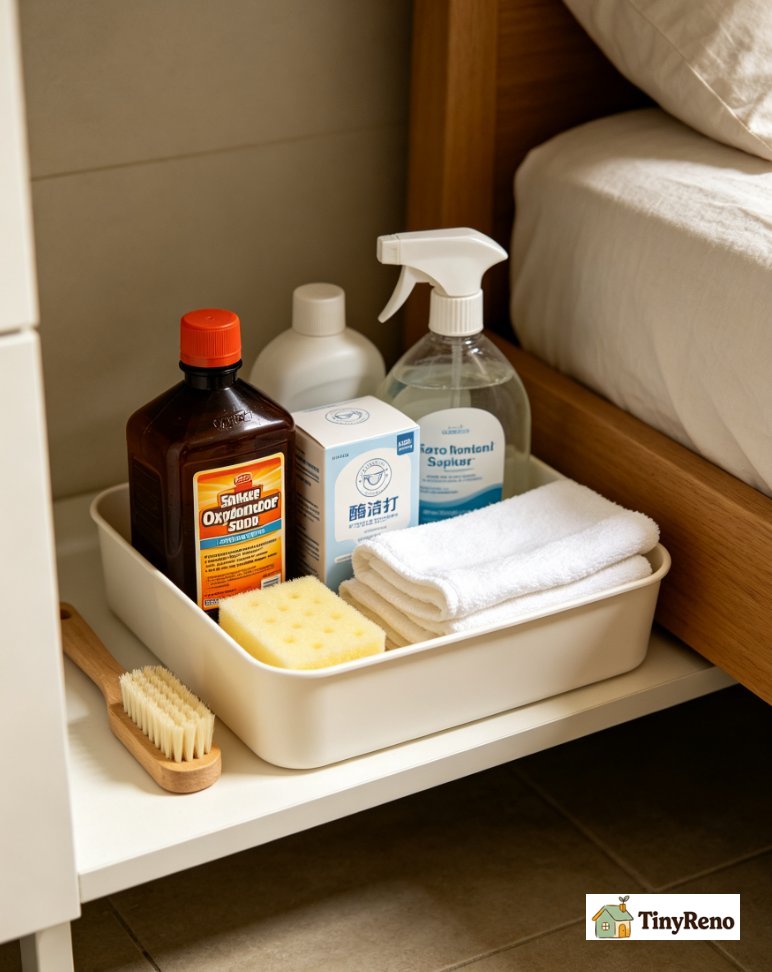
After move-out I rebuilt my cleaning kit around what I had learned, and the whole thing cost $18 at Target plus the enzyme cleaner I already owned. Here is what is on the shelf now, and what each one does.
- Hydrogen peroxide 3%, $4. For fresh blood, fresh wine, fresh grass. Spray, wait 20 minutes, blot. Replace the bottle every 6 months because peroxide degrades in the bottle over time — the old bottle is just water.
- Baking soda, $1 for a 2-pound box. For old stains you want to dry out before treating. Paste with a little water, sit 30 minutes, vacuum. Also good for general deodorizing.
- Enzyme cleaner, $8 for 32 oz. For old blood, pet accidents, anything protein-based. The single most expensive item in the kit and the most reliable.
- Dawn dish soap, $3. For the cold-water rinse step at the end. A few drops in a cup of cold water, blot only, never rub.
- White cotton cloths, $2 for a 6-pack from the automotive section. Cut into 6-inch squares. Use a fresh square for each blot. Launder separately.
The kit fits in a 1-quart container under the bathroom sink. The whole thing replaces the urge to call a professional cleaner for any single stain under 6 inches, which is most renter stains. If the stain is bigger than 6 inches, the right move is a waterproof mattress encasement over the whole thing for $25 and a conversation with the landlord about depreciation. Anything smaller than that, the kit handles it. The exact same logic — buy a small set of tools once, use them for years — is what I wrote up in my cleaning starter kit post for kitchens and bathrooms; the mattress kit is just the bedroom version.
If you are 6 days from move-out and reading this at 11pm, here is the shortcut. Spray enzyme cleaner on the stain, cover it with plastic wrap, sleep on it (or on the couch). Pull the wrap in the morning, blot dry, repeat once. By day 5 you are done, and by day 6 the inspector finds nothing. That is what I did, and I got my $850 back.


Discussion (0)
Sign in to join the discussion