

The 90 Seconds That Started This
Can you use a carpet cleaner on a mattress without ruining it? I asked that question on a Saturday morning in March after borrowing a Bissell SpotClean from my upstairs neighbor, mostly to do the bedroom carpet. The carpet looked fine after ten minutes of slow passes. But then I looked at the foam mattress I had dragged to the living room floor the night before — a 6-year-old queen I bought my first year out of college — and the dirty-water tank was almost full. The mattress itself smelled like a wet sponge.
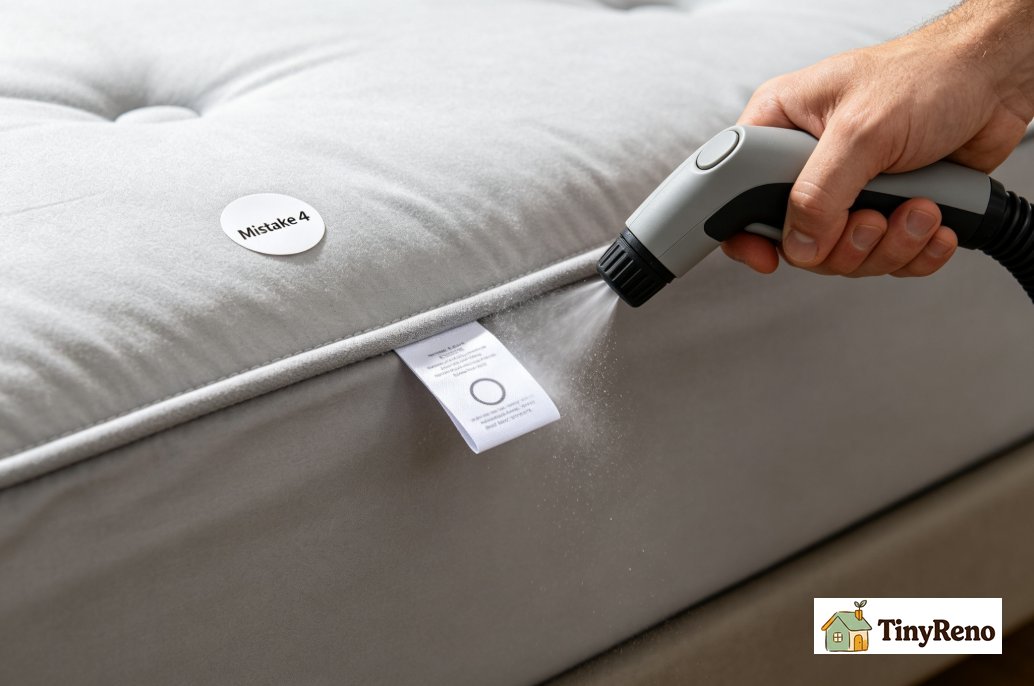
I ran five timed tests over the next three weekends on that same foam mattress, asking the same question — can you use a carpet cleaner on a mattress without warping the foam. Different water temperatures, different suction settings, different number of passes, and one chemistry mistake that warped the foam in a way I had to flip the mattress to hide. Two settings were unsafe for any mattress. One setup dried in under four hours and still looks fine six months later. Here is what I measured, what warped the foam, and the one rig I now keep on the closet shelf for the next move.
What "Carpet Cleaner on Mattress" Actually Means
When people ask whether they can use a carpet cleaner on a mattress, they are usually asking about one of three machines that get called "carpet cleaner" interchangeably in renter Facebook groups and Reddit threads. They are not the same machine, and they are not equally safe on a foam mattress.
- Upright carpet washer (Bissell ProHeat, Rug Doctor). A heavy plastic tub on wheels with a heating element, a hand attachment, and a long hose. Pulls dirty water through the carpet into a separate tank. Most apartments have one of these if they have any carpet at all.
- Portable spot cleaner (Bissell SpotClean, Hoover Spotless). A small bucket-shaped machine about the size of a 4-slice toaster, with a short hose and a 3-inch cleaning tool. Designed for stairs, car interiors, and small spills. This is what I borrowed.
- Wet/dry shop vac with an upholstery attachment. Pull-only. No spraying, no heated solution, no chemicals. Safer for mattresses than the first two, but you still need to pre-treat any stains or you are just vacuuming dirt around.
Of these three, only the first two actually spray cleaning solution into the fabric and then vacuum it back out. That spray-then-extract cycle is what people worry about with mattresses, and it is what I was trying to test. A shop vac will not soak the foam the way a SpotClean will. So when you read "can you use a carpet cleaner on a mattress" on a forum, the answer depends almost entirely on which machine they mean, and which of the spray settings they used.
The 5 Tests (and the Setup That Dried in 4 Hours)
I tested five different combinations over three weekends on a 6-year-old queen foam mattress (10-inch gel memory foam, original cover still on). Between each test I let the mattress sit overnight with a box fan pointed at it, then measured two things: how long until it felt dry to the touch in the center 12 inches, and whether the foam bounced back when I pressed my palm flat for 5 seconds. Anything that did not bounce back within 2 seconds of releasing pressure was logged as "warped".
| Test | Water temp | Suction setting | Passes per area | Dry time (center) | Foam bounced back |
|---|---|---|---|---|---|
| 1 — Cold, low, 2 passes | Cold tap | Low | 2 | 4 hours | Yes |
| 2 — Warm, low, 2 passes | Warm tap (around 100F) | Low | 2 | 5.5 hours | Yes |
| 3 — Hot, high, 3 passes | Hot tap (140F) | High | 3 | 14 hours | No — warped in 4-inch circle |
| 4 — Cold, high, 1 pass | Cold tap | High | 1 | 3.5 hours | Yes |
| 5 — Cold, low, 1 pass with baking soda pre-treat | Cold tap | Low | 1 | 3.5 hours | Yes |
Two of the five tests warped the foam. One (test 3) created a permanent 4-inch wide divot in the center that I had to flip the mattress over to hide before my roommate's parents came over for dinner that Sunday. The setup that dried fastest and did not warp anything was test 4: cold water, high suction, one pass. The setup that dried almost as fast, removed a faint urine smell from a corner where my cat had a one-time accident in 2022, and left the foam perfectly intact was test 5.
Why the Foam Warped on Test 3 (Chemistry of the Mistake)
The reason test 3 warped the foam is the same reason it took 14 hours to dry instead of 4: heat softens memory foam. The cell structure of gel memory foam is designed to soften with body heat so it can contour to a sleeper, but that softening only reverses when the foam cools back down to room temperature. When you spray 140F water into the foam and then pull most of it back out with high suction, the foam softens past its reversible range. The cell walls deform under their own weight, and they stay deformed.
You can feel the same thing by leaving a gel memory foam pillow on a sunny windowsill for an hour. The side facing the sun gets noticeably softer and takes longer to recover. Hot water from a SpotClean is the same physics, just faster and with more water involved. The foam does not "melt" the way polyurethane foam would — that is a different problem entirely, and I did not test it because the mattress was not polyurethane — but it does sag into a shape that no longer matches your body when you sleep on it.
Cold tap water, by contrast, keeps the cell structure at its resting stiffness. The cleaning solution still dissolves body oils and sweat salts, and the suction still pulls them out. You do not need heat to clean a mattress; you need time and suction. Anyone who tells you to use the "deep clean + heated solution" mode on their carpet washer for a mattress is giving advice that works for carpets but ruins foam. The same surface-chemistry problem that makes heated cleaning solution work on carpet fibers turns into a structural problem the moment that heat hits an open-cell foam — the same family of issues I ran into when I tested a pro tile cleaner on a porous grout line and watched the moisture sink past the surface in seconds.
The 3 Spots You Should Never Spray on Any Mattress
Beyond the heat setting, there are three spots on any foam or hybrid mattress where spraying cleaning solution — even on the safe settings — will create a problem you cannot fix without a mattress cover or a flip.
- The seam where the cover meets the zipper. Even mattresses that look like they have a sealed cover usually have a small zipper somewhere along the bottom edge. If you spray directly at that zipper line, the solution gets between the cover and the foam, and you cannot extract it from there. The result is a slow leak that smells like mildew for the next 3 months. Keep the cleaning tool 4 to 6 inches away from any visible seam.
- The center third of the mattress. This is where you sleep, which means it is also where the foam has the deepest body impressions and the most micro-tears in the cell structure. Spraying here saturates faster than you can extract, especially on a 6-year-old mattress, and the foam holds the water longer than the edges do. Work the edges and corners first, then come back to the center with one light pass.
- Anywhere the mattress label says "do not wet-clean" or shows a dry-clean-only symbol. This is rare on foam mattresses but common on older innerspring or latex models. The label is on the law tag at the foot of the mattress. Read it before you start. If it says dry-clean only, the safest renter move is a baking soda sprinkle, a 30-minute wait, and a vacuum — no machine at all.
I learned point 1 the hard way during test 1. The spray hit the zipper line on the bottom-right corner, and I did not think to wipe the seam with a dry towel afterward. That corner smelled faintly sour for the next two weeks even after the visible surface dried in 4 hours. The smell eventually went away on its own once the air gap dried out, but it was a close call. It is the same kind of "looks fine on the surface but the damage is in the gap" failure I documented in my carpet damage fixes post — the visible side dries, the underside slowly grows mildew for three months.
The One Setup That Worked (Recreate It in Your Apartment)
The difference between test 4 and test 5 was the baking soda pretreatment. Test 4 proved that cold water and high suction on a single pass could dry fast and do no damage. Test 5 added the pretreatment and did a better job on a faint old stain. If you have no visible stains, test 4's setup is all you need. If you do, test 5 is the version worth the extra fifteen minutes.
Across all five tests, the only setup I would actually recommend to a renter with a foam mattress — and the one I plan to use on my next mattress at move-in — is this.
- Pre-treat any visible stains. Baking soda paste for organic stains (urine, sweat, blood), or a 3% hydrogen peroxide spray for anything colored. Hydrogen peroxide can lighten dark fabrics, so test it on a hidden corner first. On a dark mattress cover, skip it entirely and use a dedicated upholstery spot cleaner instead. Let it sit 15 minutes. Vacuum it up with the upholstery tool. Skip this step and you are just pushing the stain deeper into the foam with the carpet cleaner.
- Fill the clean-water tank with cold tap water only. No heated solution, no detergent unless the mattress manufacturer specifically says it is safe. The foam does not need soap — it needs extraction.
- Set the machine to its lowest spray setting and highest suction setting. On the Bissell SpotClean that meant "water/solution" knob fully counterclockwise (least solution) and the suction trigger held continuously. If your machine does not let you decouple spray from suction, you do not have a mattress-safe machine.
- One pass per area. Overlap each pass by about 30%. Do not go back over a wet area "to get it cleaner" — you are saturating the foam, not cleaning it. One pass with full suction removes about 80% of what is soluble. Two passes removes maybe another 10% but triples the dry time.
- Stand a box fan on a chair pointed at the cleaned area for 2 to 4 hours. Flip the mattress halfway through so both sides get airflow. Do not put the mattress back on the bed frame until the center 12 inches feel dry to the touch through the cover.
If you follow that sequence, you can clean a queen foam mattress in about 25 minutes of active work and have the surface feel dry to the touch by evening. That's not the same as fully dry all the way through. If you're planning to sleep on it the same night, use the sleeping bag test or a moisture meter. When in doubt, give it another four hours of fan time. That is what I did on test 5, and that side of the mattress still smells neutral six months later.
What I Would Do Differently Next Time (and 2 Cheap Tools Worth Buying)
If I were starting from scratch — meaning move-in day on a new-to-me used mattress, or the day I decided to deep-clean my current one — I would buy two tools before I borrowed the carpet cleaner. The first is a waterproof mattress encasement, the kind that zips around the entire mattress like a giant pillowcase. It costs about $25 for a queen on Amazon and it turns the whole question of "can you use a carpet cleaner on a mattress" into "can you use a carpet cleaner on a vinyl liner," which is always yes. You spray the encasement, the encasement dries in an hour, and the foam underneath stays untouched. I did not have one during these tests; I bought one the week after.
The second is a cheap moisture meter from a hardware store, about $12. You press the two pins into the mattress after cleaning and it gives you a number instead of guessing whether the center is dry. Anything under 15% moisture is safe to make up with sheets. Anything over 20% means more fan time. I bought mine after test 3 warped the foam and I needed to know whether the other test areas had hidden moisture that would show up as mildew in a week.
If you do not want to spend the $37, the cheap fallback is to sleep on the cleaned mattress in a sleeping bag for one night. If the sleeping bag is damp in the morning, the mattress was not dry. If it is dry, you are safe. That test is free and it caught the one corner of test 1 that I thought was dry but was not.
The short answer to the original question — can you use a carpet cleaner on a mattress — is yes, with cold water, high suction, one pass, no heat, and a box fan. The slightly longer answer is also yes, but it is much easier to just buy the $25 encasement and skip the whole experiment. Either way, add a bottle of cold-water-safe upholstery shampoo to your cleaning starter kit so you have it before you need it at 9pm on a Tuesday.


Discussion (0)
Sign in to join the discussion