

How to get stains out of hardwood floors — that's the question I spent three days answering last Thanksgiving after my cousin Maya knocked a glass of red wine off the kitchen counter.
Last Thanksgiving, my cousin Maya knocked a glass of red wine off the kitchen counter — and I spent the next three days figuring out how to get stains out of hardwood floors the hard way. It hit my new — well, new to me — engineered oak floor, sat there for what felt like a full minute while my brain caught up to my hands, and then I was on my knees with a dish towel trying to blot up a stain that was already setting. By the time I got the wine up, the floor had a faint pink shadow where the glass had been. Three days later, after I'd tried everything in the cabinet and the stain had gotten darker instead of lighter, I gave up and called my mother.
My mother grew up in a house with original 1960s oak floors and has been getting stains out of hardwood floors since before I was born. She also called her neighbor, who's a flooring installer. And she texted my friend across town, who's a renter with two cats and a coffee habit that has put three different stains in her floor over the past year. By the end of the day, I'd heard four different methods for how to get stains out of hardwood floors — all from people who'd tried them, all from people who'd actually used them. This article is what they told me, plus what I tried, and what worked.
The first ten minutes: what you do before you do anything else
Every single person I asked — Maya, the floor installer, my mother, my friend with the cats — said the same thing first: the ten minutes after the spill matter more than the next ten days. Whatever stain you're dealing with, the fresher it is, the easier it is to get out. A red wine stain that gets blotted up within a minute is a non-event. A red wine stain that sits for an hour is a sanding job.
The procedure for the first ten minutes is the same regardless of what spilled. Blot — don't wipe — with a clean white cloth. White because you want to see what's coming up off the floor. Wiping drives the stain deeper into the wood grain. Blotting pulls it up. Work from the outside of the stain inward so you don't spread the spill. If you have a wet-dry vacuum, use it on the liquid setting to pull as much of the spill out of the wood as possible.
Then — and this is the part nobody told me the first time — don't soak the stain and don't scrub it with soap. A barely damp cloth is fine for blotting up the last of the liquid. But the instinct to grab the spray bottle and start scrubbing is wrong. Excess water and soap drive the pigment deeper into the wood grain. If the spill is fresh and you've blotted well, let it dry for an hour before you decide what to do next. The instinct is to start scrubbing with whatever soap is in the cabinet. That instinct is wrong. The water and the soap both drive the stain deeper into the wood. What you want to do instead is let the surface dry for an hour, then assess.
Most surface stains — the ones that happen when the spill was blotted up quickly — will be 80 percent gone after the surface dries. The remaining 20 percent is the part that's actually penetrated the wood. That's the part you'll need to address with one of the methods below. But you'll address it from a much better starting position than if you'd scrubbed the stain deeper into the wood with soap and water in the first ten minutes.
Water stains: the double application method (my mother's method)
My mother got a water stain out of her living room floor the week after I called her. A plant pot had been sitting on a saucer that wasn't quite big enough. Two months of slow seepage left a dark ring on the oak. She'd been living with the ring for at least a year.
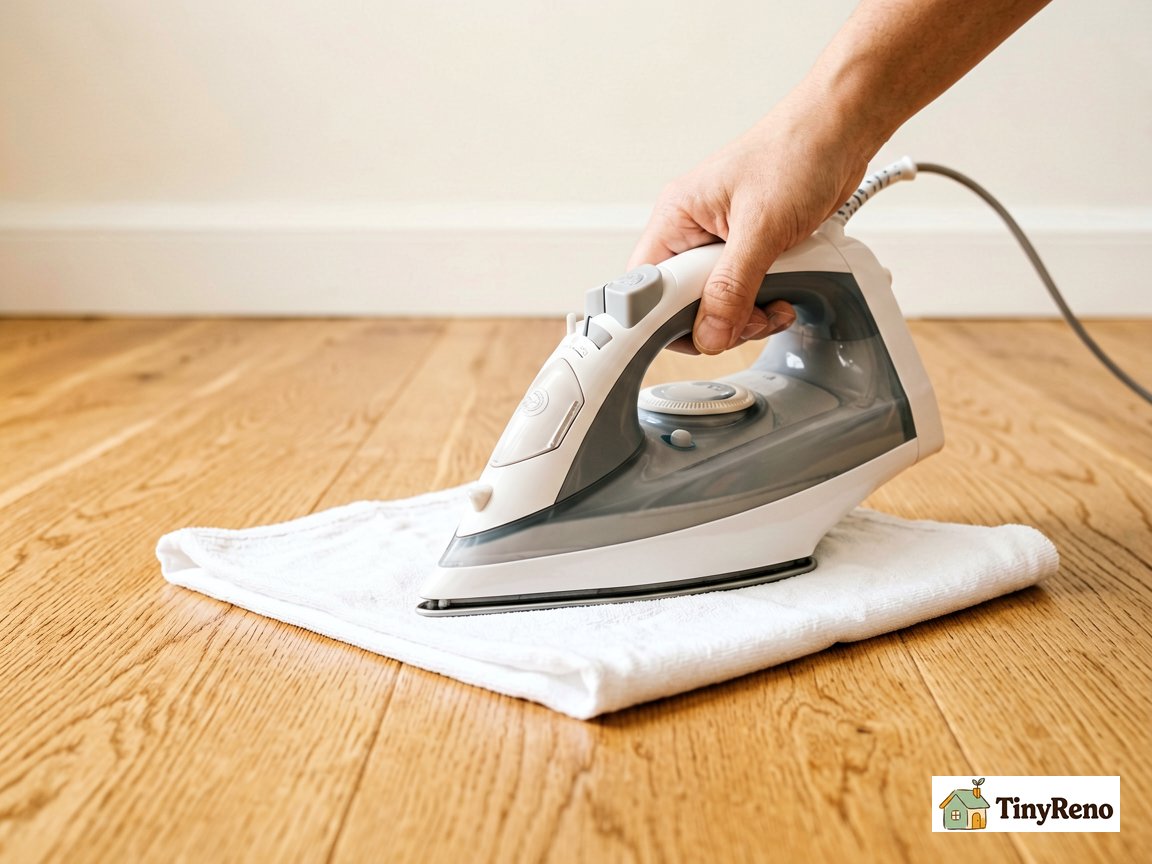
The method she used is the one that's been passed down in her family for three generations. You take a clean white cotton cloth — an old t-shirt works — fold it into a square slightly bigger than the stain, lay it flat over the stain, and iron it with a clothes iron on medium heat. The heat pulls the moisture from the wood up into the cloth. You do this three or four times, replacing the cloth each time as it absorbs the moisture. After the third pass, the stain is usually 90 percent gone. After the fourth or fifth pass, it's gone entirely.
The reason this works is that water stains are usually trapped moisture under the finish, not pigment that's penetrated the wood. The iron heats the wood, the moisture evaporates upward into the cloth, and the stain disappears as the moisture leaves.
This method only works for water stains. It does not work for wine, coffee, pet urine, or any stain that involves pigment or chemical residue. Those need a different approach.
My mother also offered a a thing I hadn't known: the iron method can also work for white water marks (the kind you get from a cold glass on a humid day). The white mark is moisture trapped in the finish. Iron pulls it out the same way.
Pet stains: the enzyme cleaner approach (my friend's method)
My friend across town has two cats. She's had four different pet stains on her floor over the past eighteen months. The first three she tried to clean with vinegar and water, which made the stain smell go away but left the discoloration. The fourth one she tried with an enzyme cleaner, and the enzyme cleaner actually removed the discoloration.
Enzyme cleaners work differently than vinegar or bleach. Vinegar and bleach attack the chemical residue of the stain — they break down the ammonia or the uric acid in the urine, which removes the smell but doesn't touch the pigment that's stained the wood. Enzyme cleaners actually digest the proteins that bind the pigment to the wood fiber. The pigment gets released and can be blotted up.
The procedure: saturate the stain with enzyme cleaner (she uses Nature's Miracle, which is fifteen dollars at any pet store). Let it sit for fifteen minutes. Blot it up with a clean cloth. Repeat the saturation, the wait, and the blot two more times. After the third round, the stain should be visibly lighter. After air drying for twenty-four hours, the stain is usually 80 to 90 percent gone.
For stains that have been sitting for months (like the urine stain under her older cat's favorite window spot), enzyme cleaner takes longer. She treated the worst stain three times — once a week for three weeks — before the discoloration faded enough to blend in.
The one thing not to do on pet stains is use ammonia or ammonia-based cleaners. The ammonia in the cleaner chemically resembles the ammonia in urine, which encourages the pet to remark the same spot. The instinct to use a stronger cleaner is the worst instinct for this particular problem.
Wine, coffee, and food coloring: the hydrogen peroxide method (the floor installer's method)
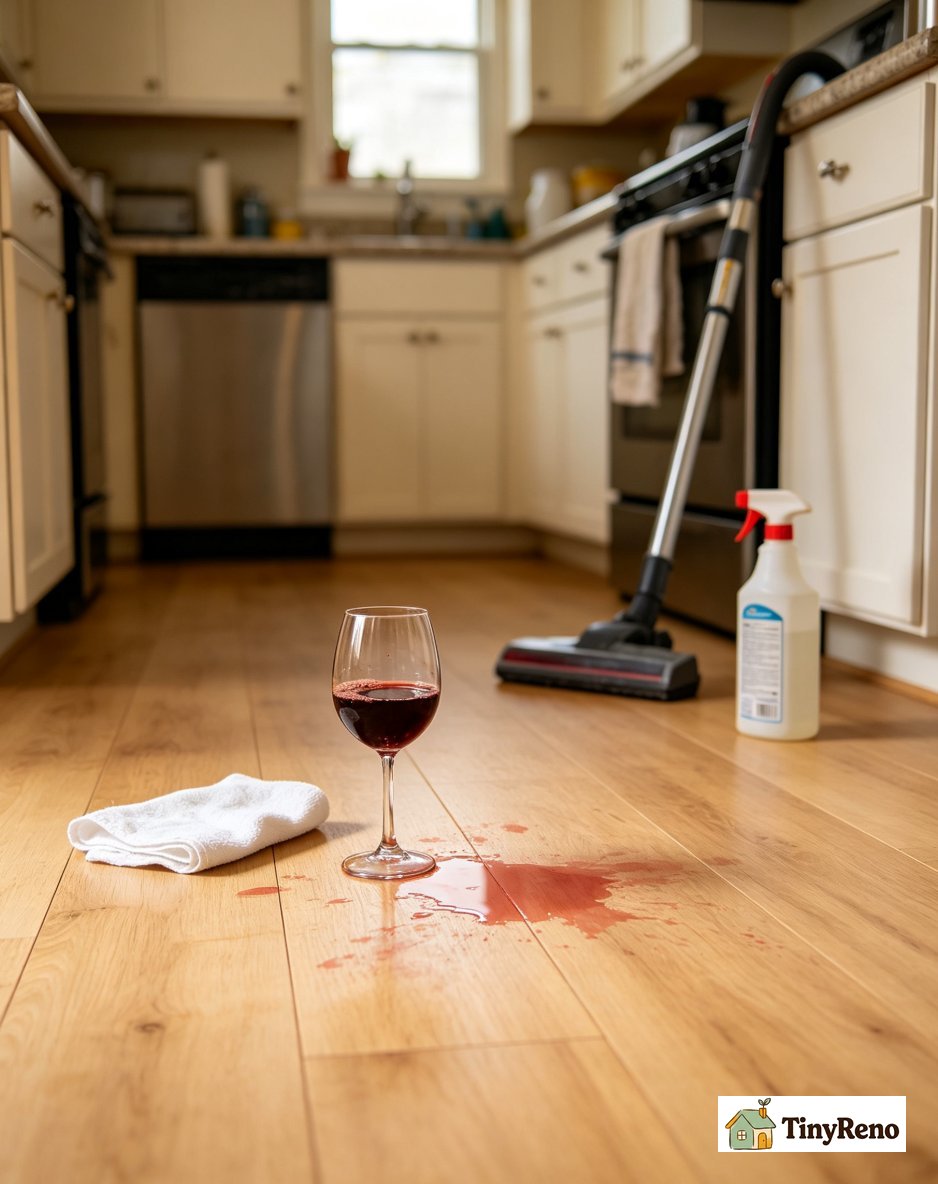
The floor installer my mother called was named Glen. He'd been installing and refinishing floors for thirty years. He told me that for any stain that involves a colored liquid — red wine, coffee, tea, juice, food coloring — hydrogen peroxide is what actually works. Not vinegar. Not bleach. Not a magic eraser. Hydrogen peroxide.
The procedure: soak a clean white cloth in 3 percent hydrogen peroxide (the brown bottle from the drugstore, three dollars). Lay the wet cloth over the stain. Cover the cloth with plastic wrap to keep it from drying out. Leave it for eight hours or overnight. The peroxide slowly bleaches the pigment out of the wood.
Glen said the procedure usually works on the first try for fresh stains. For old stains, you may need to repeat three or four times, with twenty-four hours between applications to let the wood dry and the peroxide dissipate. He also said that for very dark stains on very light wood, you may need to follow the peroxide with a light sanding and a matching stain to even out the color.
The catch with peroxide is that it bleaches everything, not just the stain. If you have a stained oak floor (a floor that's been stained to a specific color), the peroxide will lighten the stained area along with the stain. The result is a light spot where the stain used to be. The fix for this is to re-stain the area after the peroxide has done its work, which is a more involved repair than a simple hydrogen peroxide treatment.
For the engineered oak floor that my wine spilled on — a factory-stained oak with a satin finish — the peroxide lightened the wine stain by about 70 percent over three applications. The remaining 30 percent was a faint pink shadow that I couldn't get out without sanding through the factory finish. The floor installer said this is normal: factory finishes are very thin, and peroxide can't work without also damaging the finish. The remaining shadow is something I'll either live with or have a flooring company sand and refinish when I move out.
The stain I gave up on
That said, there's a difference between a fresh pet stain and one that's been sitting for a year or more. The enzyme cleaner works when the urine is still mostly in the wood's surface layers. Once urine has soaked deep into the wood and started breaking down the wood fiber itself — which takes months, not days — the stain isn't a stain anymore. It's damage. Cleaning it won't help because the wood itself has changed.
There is one stain that none of these methods will fix: a stain where the wood itself has been chemically changed by the spill. Cat urine that's been sitting for years can actually etch the wood — the ammonia in old urine breaks down the lignin in the wood fiber, and the damaged wood absorbs any stain differently than the surrounding wood. Hydrogen peroxide won't fix the absorption difference. Enzyme cleaner won't fix the lignin breakdown. Only sanding and refinishing will.
If you have a stain where the wood itself feels different — softer, rougher, more absorbent than the wood around it — you're looking at chemical damage to the wood, not a stain on the wood. None of the methods in this guide will fix it. The fix is to sand the damaged area down to bare wood, restain, and refinish. For a renter, this is a landlord conversation. For an owner, this is a service call.
For everything else — water marks, fresh wine, fresh coffee, even old pet stains — one of these four methods will work. When you are figuring out how to get stains out of hardwood floors, the first ten minutes matter more than anything that comes after. The fresher the stain, the easier it is to remove. The older the stain, the more applications you'll need, and the more likely you are to end up with a faint shadow even after the stain is gone. That's the persistent lesson I learned while figuring out how to get stains out of hardwood floors the slow way.
For stains on surfaces other than floors — like the water ring on a coffee table, or the wine spill on a wood counter — the same methods apply, but with one difference: most furniture and counters have thicker finishes than floors, so the peroxide has more buffer to work without damaging the underlying finish. The same stain that leaves a shadow on an engineered oak floor will usually come clean off a solid wood table.
For a related floor problem that none of these methods address — a scratch along the grain that exposes raw wood — the renter-friendly wood repair walkthrough covers the walnut trick and the pencil-pack method for shallow to medium scratches. And for the broader question of what belongs on the move-in inspection form versus what belongs as a renter repair, the deposit protection guide walks through the documentation strategy that kept me from being charged for the wine stain shadow I'm still living with.


Discussion (0)
Sign in to join the discussion