

Three weeks ago my neighbor's t handle garage door lock failed at 2 AM. A thief rattled the handle for a minute, then tried the side door, then left. Nothing got stolen — but the T-handle was the only thing standing between an unlocked garage and an attempted break-in. It didn't hold — but the noise it made probably saved my neighbor's bike.
That was the moment I started paying attention to the little T-handle on the side of my own garage door. Most renters ignore it. It's small, it doesn't move much, and it doesn't look important. But the T-handle lock is the single most common failure point on any garage door's t handle garage door lock, and when it fails, it fails silently — until the night someone tries the handle.
This is a t handle garage door lock decision tree. The fix for almost every T-handle problem is the same part (a fifteen-dollar universal lock), but how to you know whether that's actually your problem or something more expensive. The decision tree below sorts the four common failures by what you see, what you hear, and what you smell (yes, smell — one failure mode is unmistakable by smell alone).
Start here: is the handle loose when you turn it, or is it stuck?
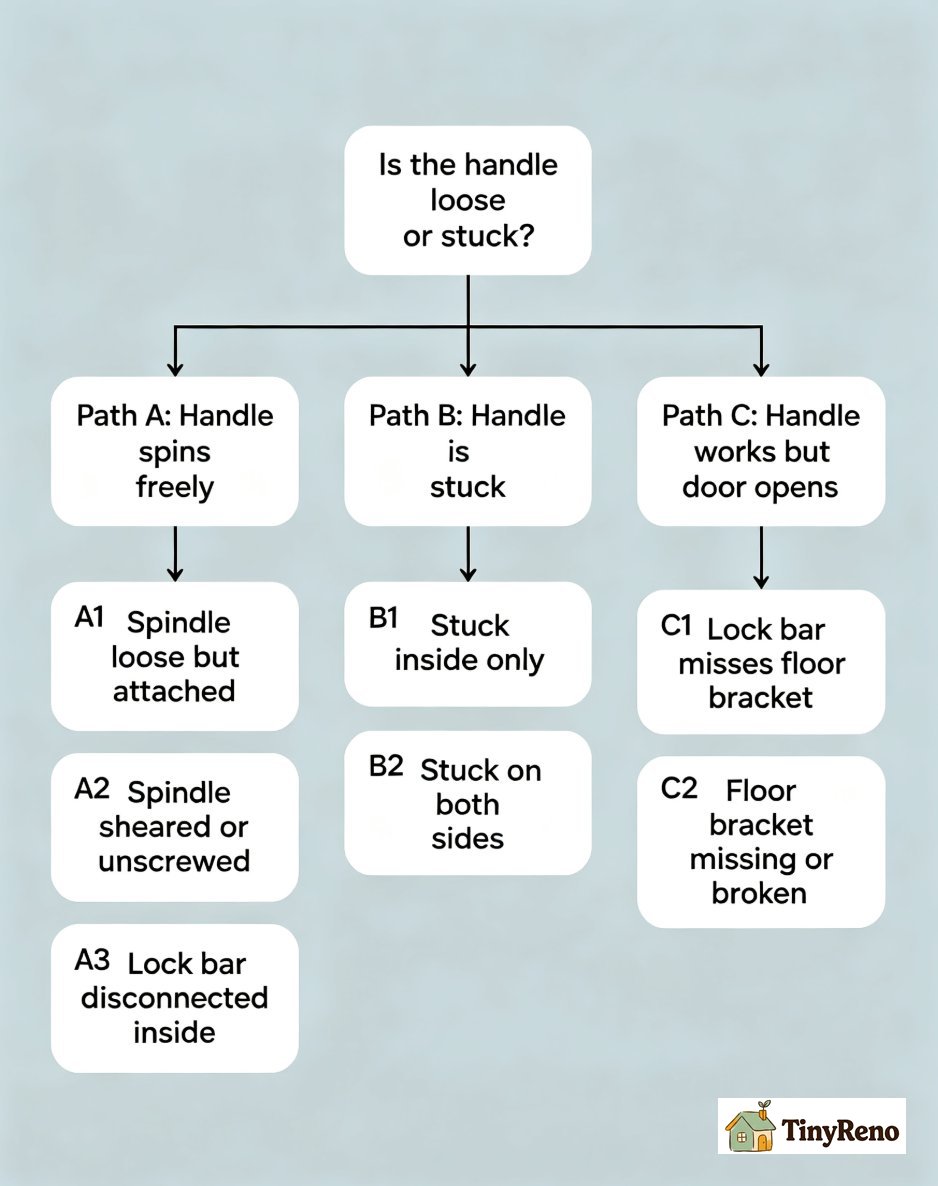
This is the single most useful question for diagnosing a t handle garage door lock problem. Stand inside your garage, close the door, and turn the T-handle.
If the handle is loose (spins freely with no engagement): The connection between the handle and the internal lock bar is broken. The most common cause is the square spindle (the metal rod that runs through the door from inside handle to outside handle) being worn down or coming unscrewed. This is a fifteen-dollar, twenty-minute fix.
If the handle is stuck (won't turn at all, or requires serious force): The mechanism is jammed, not disconnected. The most common cause is corrosion on the internal rods or the lock bar being misaligned with the floor track. This is usually a one-hundred-dollar service call.
The remainder of this guide splits based on your answer.
Path A: the handle spins freely (the cheap fix)
If your T-handle spins freely with no engagement, you have one of three sub-problems. They're all the same fix, but worth diagnosing because the parts differ.
A1: The spindle is loose but still attached.
Remove the inside handle (two screws). Pull the handle off. Look at the square spindle sticking out of the door. Is it loose? Can you pull it out with your fingers? If yes, the set screw that clamps the spindle inside the handle has loosened over time. Tighten the set screw with an Allen key (usually 3/32 or 1/8 inch) and reinstall the handle.
Time: five minutes. Cost: zero dollars if you have an Allen key, three dollars if you don't.
A2: The spindle has sheared or come unscrewed from one side.
Same symptom as A1 (spinning freely), but the spindle itself is broken or disconnected from one of the handles. Remove both handles (two screws each, four total). Pull out the old spindle. Take it to the hardware store for matching (1.5 inch or 2.5 inch length, 0.25 inch square cross-section). Buy a new universal T-handle lock kit (twelve to twenty-five dollars) — most kits include a new spindle and new mounting hardware.
Install the new spindle, mount the new handles, tighten the screws. Test the mechanism by turning the inside handle — the outside handle should turn in sync.
Time: twenty minutes. Cost: fifteen dollars.
A3: The lock bar inside the door is disconnected from the spindle.
This is the rare case. The spindle is fine, the handles are fine, but the metal rod inside the door that the spindle connects to has come loose from the lock bar. You'll usually see the lock bar sitting in the wrong spot inside the door (if you shine a flashlight through the gap at the top of the door). The fix is to remove the door panels to access the internal mechanism and reattach the rod. This is a service call, not a renter DIY project.
Time: a service call. Cost: between one hundred and one hundred and fifty dollars.
Path B: the handle is stuck or hard to turn (the more expensive fix)
If your T-handle is stuck or requires real force to turn, you have one of two sub-problems. The distinction matters because one is a renter DIY fix and the other is not.
B1: The handle is stuck but the door still locks from the outside.
Try the handle from outside. If the outside handle turns smoothly and locks the door, but the inside handle is stuck, the problem is corrosion on the inside spindle or handle mechanism. The outside half is fine because it's exposed to less humidity. The fix is the same as A2 — replace both handles and the spindle with a new universal kit. The new spindle won't be corroded. The new handles have fresh internal springs that won't bind.
Time: twenty minutes. Cost: fifteen dollars.
B2: The handle is stuck and the door won't lock from either side.
This is the bad case. The lock bar inside the door is jammed, almost always because the door itself has shifted (the tracks are misaligned, a panel has warped, or the foundation has settled slightly). The lock bar tries to drop into the floor track but the track is no longer where the lock bar expects it to be. Forcing the handle will bend the bar or strip the mechanism.
This is a service call. Don't try to fix it yourself. The garage door company will diagnose whether the issue is the tracks (a hundred to two hundred dollars to adjust), the panels (panel replacement runs two hundred to four hundred), or the foundation (a landlord issue, not yours).
Time: a service call. Cost: between one hundred and four hundred dollars depending on the cause.
Path C: the handle works but the door still opens (the misalignment case)
Sometimes the t handle garage door lock turns smoothly, you hear the engagement, but the door still opens. This is almost always one of two things:
C1: The lock bar isn't reaching the floor track.
Look at the bottom of the door when it's "locked." Is there a gap between the bottom of the door and the floor? The lock bar should drop into a hole or bracket in the floor (or into a track mounted on the floor). If the door has shifted slightly so the lock bar passes by the bracket without engaging, the door is unlocked even when the handle is in the locked position.
The fix is to adjust the floor bracket. Some brackets have two screws and a little play for adjustment. Loosen the screws, slide the bracket a quarter inch toward where the lock bar is missing, retighten, and test. If the bracket is bolted solid or has no adjustment slot, don't force it — that's a sign the door itself has shifted, and the real fix is track adjustment, not lock work.
Time: ten minutes. Cost: zero (unless you need a different bracket, in which case four to eight dollars).
C2: The floor bracket is missing or broken.
Look at the floor where the lock bar should drop into. Is the bracket there? If the bracket has been ripped out of the floor (a thief trying to pry the door open is one way this happens; the previous tenant's car is another), the lock bar has nothing to drop into. The door locks visually but doesn't actually engage.
The fix is to install a new floor bracket. Two screws into the concrete (you'll need a hammer drill and a concrete bit, or a strong adhesive-mount bracket that doesn't require drilling). Universal floor brackets run between four and ten dollars.
Time: fifteen minutes. Cost: eight dollars.
The 5-second test before you buy anything
Before you go to the hardware store, do this one check. It will save you the trip if your problem isn't the lock at all:
Close the garage door. From inside, try to lift it manually by the bottom panel. A properly sprung door should feel heavy and resistant — hard to budge more than an inch or two. If it lifts easily, or if the top section feels light while the bottom stays down, the springs may be broken or disconnected. That's a service call. Don't keep testing or try to lift it all the way — you can make a bad spring worse. That's a service call, not a lock problem. The lock could be perfect and the door would still open because nothing is holding it down.
If the door has normal resistance when you try to lift it, the springs are fine and the lock is the actual issue. Proceed with whichever path above matches your symptom.
What I'd actually buy
After watching three different T-handle failures in my building over the past two years — including the one where the handle just spun freely for six months before someone tried the door — I've landed on the universal T-handle lock kit as the only garage door part worth owning yourself. Twelve to twenty-five dollars, fits any standard 1.5 or 2.5 inch door depth, comes with new spindle and mounting hardware, takes twenty minutes to install.
The bigger repairs — track adjustment, panel replacement, spring replacement — are service calls. The T-handle lock and the floor bracket are the only renter-friendly pieces. Everything else wants a professional.
If you're troubleshooting other renter door problems at the same time — like a closet door that won't stay closed, or a front door with a sticking deadbolt — the renter door hardware walkthrough covers the broader picture of door hardware you can service yourself. And if the issue is actually your shower door, not your garage door (they have similar handle mechanisms), the shower door repair guide walks through the same spindle-replacement logic for glass doors.


Discussion (0)
Sign in to join the discussion