

Door locks repair wasn't on my mind last winter when my front door deadbolt stopped turning. The key still worked — but the thumb turn on the inside spun freely without locking anything. I'd push the deadbolt in from inside, and the thumb turn would spin freely without engaging the bolt. For two weeks, I locked the door from outside with the key, then climbed in through the side window and lay in bed wondering if anyone had noticed my clever workaround.
The deadbolt itself was fine. The issue was a five-dollar part called the tailpiece — a small metal piece that connects the thumb turn to the deadbolt mechanism. On many deadbolts it's a square rod, but it can also be a flat bar or a notched strip depending on the brand. The only way to know is to pull the broken piece out and bring it with you. It had sheared off. A new tailpiece costs less than a coffee, takes ten minutes to install, and doesn't require taking the lock apart. But I didn't know that for two weeks, because I didn't know there were different types of door locks that fail in different ways and have different fixes.
This is the guide I wish I'd had — a door locks repair cheat sheet that tells you which lock you have, what part is likely broken, and how to fix it without calling a locksmith for a one-hundred-dollar service call. Most door locks fall into one of five categories — and most door locks repair can be handled by a renter with a screwdriver and a parts run to the hardware store. The trick is knowing which part to ask for.
The five locks you'll actually find in a rental
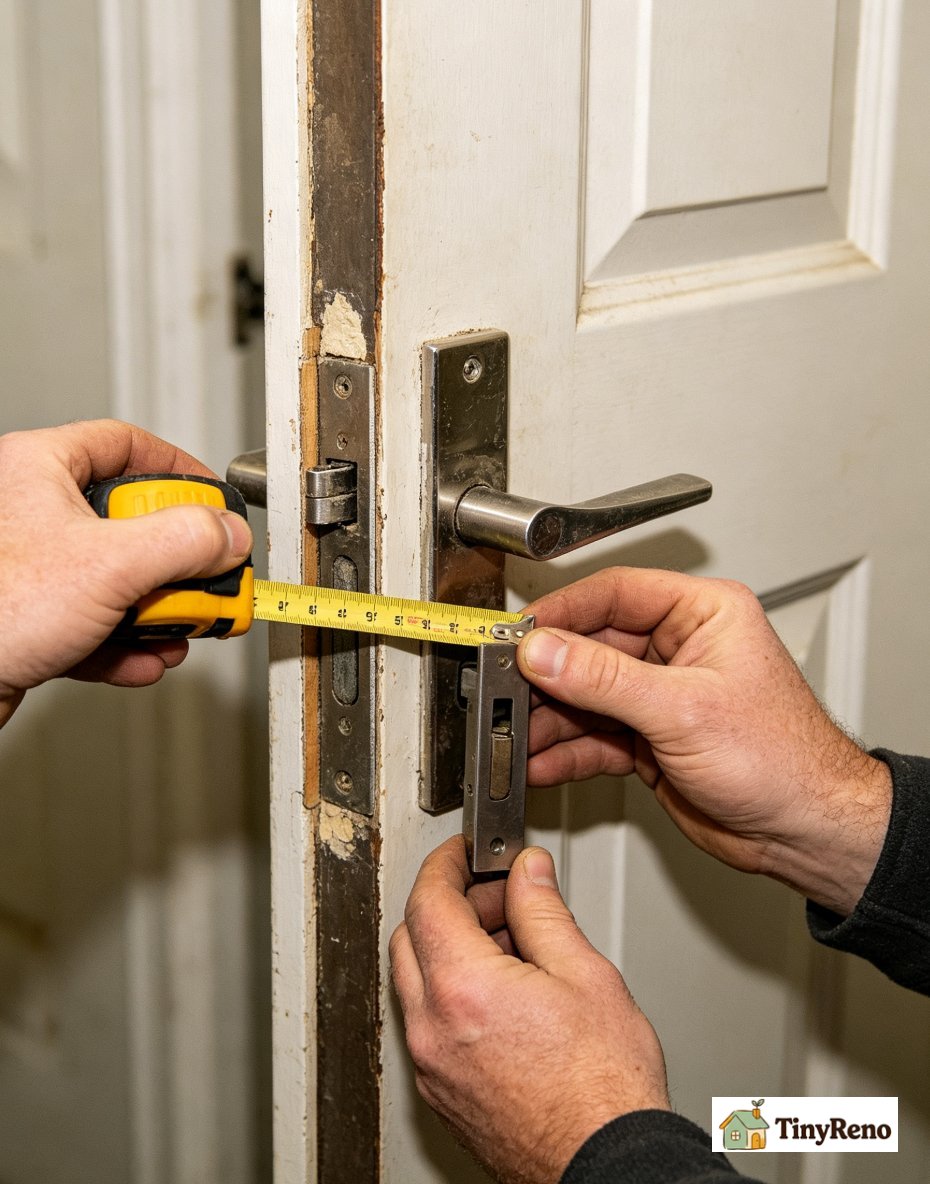
Almost every interior and exterior door lock in a rental apartment falls into one of five categories. Each one fails in its own way and has its own repair.
Look at the lock on the door you're trying to fix. Match it to the closest description below:
- Privacy lock (bedroom/bathroom) — round or lever handle, push-button or turn-button on the inside, no key on the outside. The cheapest lock type. Made by Kwikset, Schlage, Defiant, or dozens of no-name brands. Repairs run between three and ten dollars.
- Passage lock (hallway/closet) — round or lever handle, no lock at all, just a latch. Same internal mechanism as a privacy lock minus the lock button. The latch or handleset is what usually breaks.
- Entry lock (front door, keyed) — lever or knob, with a key cylinder on the outside and a thumb turn or another keyed cylinder on the inside. Has more parts than a privacy lock and more ways to fail. Repairs run between five and thirty dollars.
- Deadbolt (separate from entry lock) — single cylinder or double cylinder. The deadbolt itself is a separate mechanism from the entry lock above it. Most front doors have both an entry lock AND a deadbolt — they fail independently.
- Mortise lock (older buildings) — rectangular faceplate, often with a separate thumb turn above the handle. Common in pre-1980 buildings. The most expensive to repair (parts run twenty to eighty dollars) and the hardest to find parts for. If your building was built before 1980 and your lock has a rectangular faceplate, this is what you have.
If you're not sure which one you have, take a photo and bring it to the hardware store. The person at the locksmith counter will tell you in under a minute.
What's actually broken: the 7-part diagnosis
Each lock type has its own set of small parts that wear out. Here's the cheat sheet — what each part looks like, what fails, and what the fix costs. Every part number below is generic; your specific lock may use a slightly different name, but the function is the same.
| Part | What it does | Failure symptom | Replacement cost |
|---|---|---|---|
| Tailpiece | Square rod connecting thumb turn to deadbolt | Thumb turn spins freely without locking | $2-5 |
| Latch (bolt) | The angled metal piece that extends into the strike plate | Door won't latch, or latch doesn't extend fully | $5-15 |
| Spindle | Square rod connecting inside and outside handles | One handle turns but the other doesn't | $3-8 |
| Spring mechanism | Coil spring that returns handle to horizontal | Handle stays down after you let go | $4-10 |
| Strike plate | Metal plate on door frame the latch goes into | Door closes but doesn't catch | $3-8 |
| Key cylinder | The cylinder that turns when you insert a key | Key won't turn, or turns but doesn't unlock | $15-40 |
| Faceplate screws | The two long screws holding the lock to the door | Whole lock wobbles when you push on it | $2-5 |
Most door locks repair calls are actually one of these seven parts failing. Identifying which one is the difference between a ten-minute fix and a hundred-dollar locksmith visit.
How to actually do the repair without breaking anything
Every repair below starts from the same safe position: the door open, so you're never stuck on the wrong side of a half-removed lock. If the door is closed and you can't open it, that's a different problem — skip to the "call the landlord" section. The latch is the only thing keeping a knob-style lock attached to the door — once the screws are out, the lock can fall apart in your hand.
For a sheared tailpiece (the issue I had):
- Remove the two screws holding the deadbolt faceplate to the edge of the door.
- Pull the deadbolt out of the door.
- Look at the tailpiece — a small square rod sticking out of the back. If it's sheared, the broken end is still inside the deadbolt mechanism. Pull the broken piece out with needle-nose pliers.
- Bring the broken piece to the hardware store. Match the length (usually 1.5 to 2.5 inches) and the thickness (usually 0.15 to 0.25 inches square).
- Insert the new tailpiece into the deadbolt, slide the deadbolt back into the door, screw the faceplate back on.
- Test the thumb turn. It should engage the deadbolt within half a turn.
For a worn latch:
- Remove the lock per the steps above. The latch is the rectangular metal piece that sits in the edge of the door.
- Measure it: length (usually 2.25 to 2.75 inches from the faceplate to the angled tip), backset (the distance from the door edge to the center of the round hole in the door — usually 2.375 or 2.75 inches), and the shape of the faceplate (round corner or square corner).
- Bring the old latch to the store. The new one needs to match all three measurements.
- Installation is the reverse of removal. Test that the door latches cleanly.
For a broken spring or spindle (handle won't return to horizontal, or one handle works but not the other):
- This is the case where you actually need a universal repair kit — see the door hardware repair walkthrough for the kit contents and the step-by-step.
- The kit costs eight to twenty-five dollars and covers all five common handle-and-lock failures.
When to stop and call the landlord or a locksmith
There are three cases where door locks repair stops being a renter-friendly fix and starts being a call to someone with a license:
Security lockout. If you're locked out of your apartment because the deadbolt won't unlock from the inside and you can't get the door open, call your landlord. Trying to force a stuck deadbolt usually strips the mechanism and turns a hundred-dollar locksmith visit into a two-hundred-dollar lock replacement.
Bent or warped deadbolt. If the deadbolt itself is bent (visible bow in the metal when the lock is removed), or if the strike plate on the frame is bent inward, the door frame has likely shifted. That's a landlord problem, not a lock problem. The lock is fine. The building moved.
Mortise lock with broken mechanism. Mortise locks are old, complicated, and require specific parts that most hardware stores don't stock. If your building has mortise locks and the issue isn't one of the seven parts above (it's the internal mechanism that you can't see without taking the lock apart), call a locksmith. The parts alone run fifty to a hundred dollars, plus labor.
For most of the other door lock problems — the tailpiece, latch, spindle, spring, strike plate, and loose screws — the repair is renter-friendly. But if the key cylinder itself is broken, or the lock body is damaged, that's a locksmith or landlord job. And before you change any lock in a rental, make sure your lease doesn't require landlord approval for lock hardware. You need a screwdriver, a parts run, and ten minutes. The most expensive part on the list is forty dollars, and most fixes are under ten.
For a related renter repair — the handle that's stuck because the screws are loose rather than the lock being broken — the door frame fix walkthrough covers how to repair the wood around the screws so the lock has something to grip again. And for the broader picture of renter repairs that don't require a handyman, the shower head replacement guide is the same kind of twenty-minute fix with the same kind of universal kit.


Discussion (0)
Sign in to join the discussion