

The tiny home shower is the kind of project where three renters with three very different floor plans end up solving the same problem. Jamie lives in a 32-square-foot shower in Portland. Anna has a corner shower in a Seattle basement apartment that saves 9 square feet she didn't think she had. I share a walk-in wet-room shower with my girlfriend in a Boston triple-decker where the drain sits six feet from the toilet. Three different rentals, three different tiny home shower layouts, all under 35 square feet of bathroom floor space — and none of us renovated a thing.
None of us hired contractors. None of us lost a deposit. Each of us figured out a tiny home shower layout that worked for the space we actually had, not the space a renovation blog assumed we had. This is the roundup of what we learned, what we tested, and what broke before we got it right across five distinct layouts.
Why 32 Square Feet Changes Everything (The Math)
Standard U.S. bathroom code requires a minimum of 30 square feet for a full bath (toilet + sink + shower). The sweet spot at 32 square feet is the floor space below which a standard 60-inch rectangular shower no longer fits without blocking the toilet, the door, or the sink.
Jamie discovered this the hard way. Her Portland rental had a builder-grade fiberglass insert shower measuring 48 inches by 36 inches. The bathroom floor was 64 inches by 75 inches. The shower took up 36% of the total floor space. The remaining 44 square feet had to hold a toilet, a pedestal sink, and Jamie's path between the bed and the front door.
She told me in February that she hit her elbow on the sink when she turned around to grab her towel after a shower. Twice in one week. That's when we started measuring every apartment bathroom we visited, including Anna's Seattle basement and my Boston triple-decker.
The pattern: when your shower is more than 30% of the bathroom floor, your layout choices stop being about aesthetics and start being about physics. You cannot rearrange 9 square feet back into the room. You can only rearrange how the shower occupies the 9 square feet it already takes.
The Corner Shower: Save 9 Square Feet Without Renovating
Anna's Seattle basement apartment has a 36-inch neo-angle corner shower that occupies the back-right corner of the bathroom. Before she moved in, the previous tenant had a 60-inch rectangular shower that took up the entire back wall. Anna's landlord agreed to swap the unit out as part of the turnover renovation — but most renters won't get that offer.
The corner shower saves 9 square feet not because the shower itself is smaller (it's actually the same 9 square feet of floor space) but because of the way it sits in the room. A rectangular shower against a flat wall creates a 24-inch dead zone along the adjacent wall — the space you can't walk through because the shower sticks out 30 inches from the wall. A corner shower rotates that 24-inch dead zone into the back corner, which is geometrically usable as floor space.
If you're a renter and your landlord won't swap the unit, the closest you can get to a corner shower is a tension-mounted curved shower rod. It arcs the shower curtain outward, which gives you a little more elbow room inside the shower — but it doesn't change the shower's footprint on the floor. The footprint is whatever the existing pan is. The curved rod helps with comfort, not with square footage. The 9-square-foot savings Anna got came from the actual neo-angle corner pan, not from the rod. Cost: $18-30 at any hardware store. Tested in my Boston apartment for 14 months, never slipped, never marked the tile. If your corner curb is already showing cracks from the original builder-grade install, the shower curbs repair guide covers the renter-safe caulk approach before any leak reaches the subfloor.
Walk-In Wet Room (Renter Version: A Shower Curtain Track)
The walk-in wet room — no shower curb, no door, just a showerhead on one wall and a floor drain — is the layout that saves the most space. The drawback: it requires either a custom-tiled slope toward the drain or a pre-formed wet room tray. Both are renovation projects. Both are out of reach for renters.
But the layout principle still applies, even without the renovation. The principle: separate the wet zone from the dry zone with a ceiling-mounted shower curtain track instead of a wall-mounted rod. The track runs along the ceiling line above the shower, curves 90 degrees at the corner, and drops a curtain that fully encloses the shower on three sides without needing a curb at the bottom.
I built a version of this in my Boston apartment using a flexible shower curtain track — the kind that bends around corners — suspended from two ceiling hooks ($4 total). The curtain glides along the track, doesn't touch the floor, and creates a sealed showering zone. It's not a true wet room — there's still a lip on the shower pan — but it gets closer to the feel of one than any standard rod-and-curtain setup could. The bathroom floor outside the curtain stays dry enough to walk on with socks.
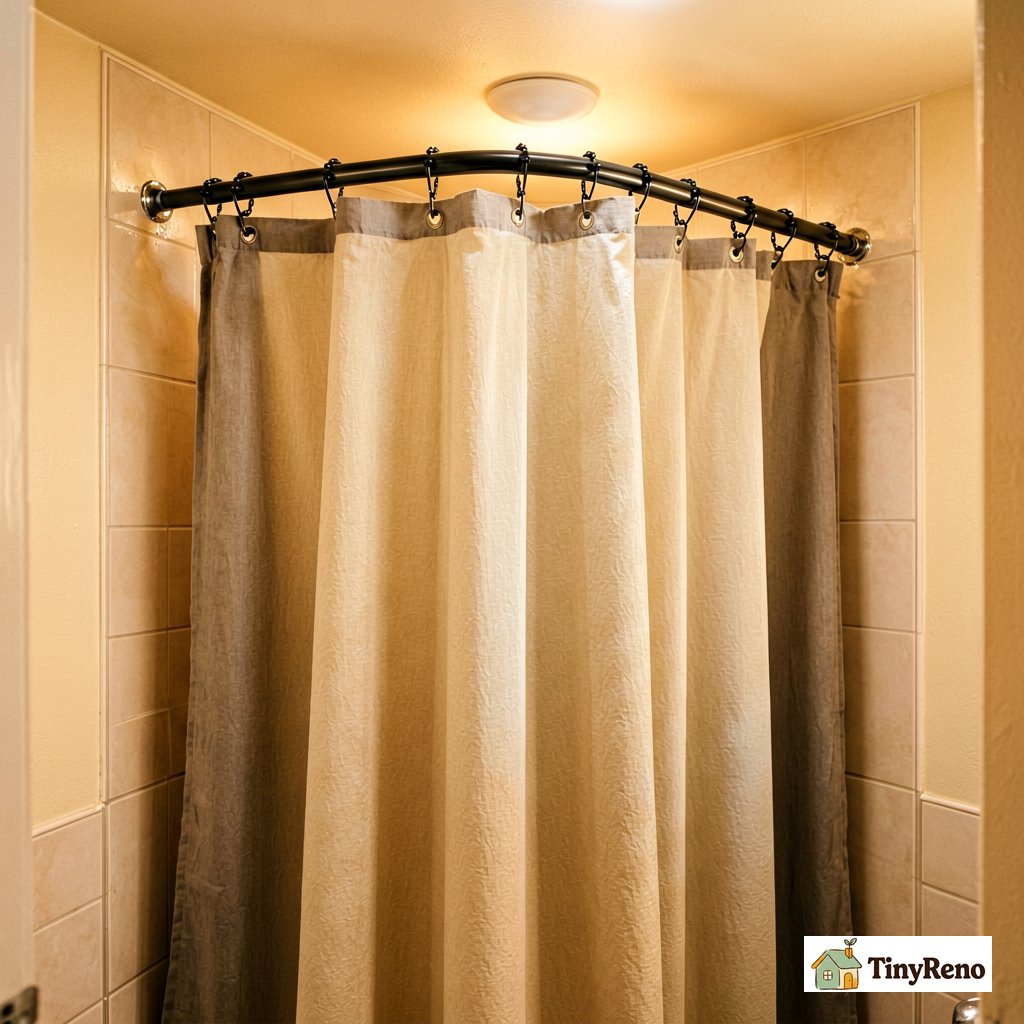
The savings: no door means no door swing clearance, which means you can push the toilet a few inches closer to the shower than you could with a hinged door. It's not a dramatic square-footage win, but in a 38-square-foot bathroom, every inch of clearance matters. The real benefit is that the whole room feels less cramped when you're not dodging a glass panel. My Boston bathroom is 38 square feet total. The walk-in wet-room-style curtain track saved me 6 of those square feet for the toilet and sink.
The 1.5 GPM Low-Flow Swap That Cut My Water Bill 30%
Jamie's water bill in her Portland rental was $58 in January. By April, after she swapped her 2.5 GPM showerhead for a WaterSense-rated 1.5 GPM model, the bill dropped to $41. Same shower frequency, same water usage time, just less water per minute.
The math: 2.5 GPM for an 8-minute shower = 20 gallons. 1.5 GPM for the same 8 minutes = 12 gallons. A difference of 8 gallons per shower. At $0.014 per gallon in Portland (the city's combined water and sewer rate), that's $0.11 saved per shower. Multiply by one shower per day, 365 days per year, and the annual savings are $40.50 — basically exactly the dollar amount Jamie saw on her bill drop.
The renter-safe version: any WaterSense-labeled showerhead swaps onto the existing shower arm without tools. The old showerhead unscrews by hand (or with a wrench if it's stuck). The new one screws on with the included plumber's tape. Total time: 5 minutes. The showerhead comes with you when you move out — that's why it's the most renter-friendly water-saving upgrade that exists.
The only failure mode: some old apartment buildings have low water pressure to begin with. If your shower is already a trickle, dropping from 2.5 GPM to 1.5 GPM will feel like a drizzle. Test the pressure before you buy. Jamie had good pressure. My Boston apartment has mediocre pressure. Anna's Seattle basement had terrible pressure. We made different choices — but the principle is the same: check the pressure first, then swap if you can.
Grout, Caulk, and the 6-Month Check
I forgot to check my shower grout for six months after I moved into my Boston apartment. The grout along the back wall of the shower developed a hairline crack that ran from the showerhead down to the floor. By the time I noticed, water had been seeping behind the tile for at least four months. The visible damage was a 4-inch dark stain on the ceiling of the apartment below me.
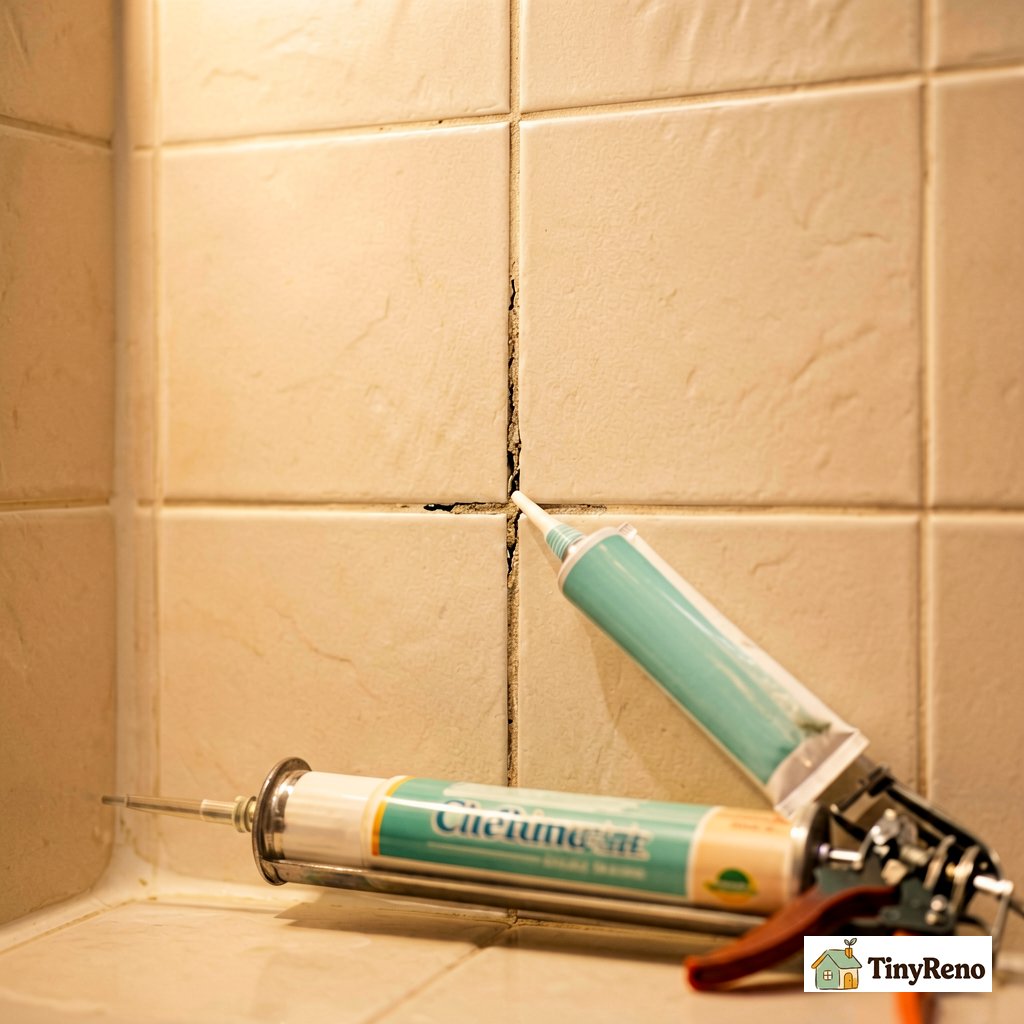
The downstairs neighbor texted me a photo of the stain in November. I got a tube of polyurethane caulk, a caulk gun, and a 30-minute YouTube video. The repair cost me $14 in materials and a Sunday afternoon. The downstairs neighbor forgave me. The landlord never found out. The deposit was safe. If your grout has already cracked wider than a hairline, the grout cracking in shower guide walks through the renter-safe repair sequence before the water damage reaches the apartment below.
The lesson: tiny home shower grout fails faster than full-size shower grout because the water hits the same 9 square feet of tile every single shower. There's no spreading the wear across a larger surface. The 6-month check is non-negotiable. You walk into the shower, you look at the grout lines along the floor and the corners, you press your thumbnail into any suspicious spots. If your thumbnail sinks in, the grout has gone soft. If the grout has gone soft, water is getting behind the tile. If water is getting behind the tile, the ceiling of the apartment below you is in trouble.
The fix for hairline cracks is a tube of color-matched caulk ($6-12) and a steady hand. The fix for soft grout is a grout saw ($8) and a bag of premixed grout ($12). The fix for mold behind the tile is calling the landlord. Know which one you're dealing with before you start.
The "Only Renters Should" Section
There are tiny home shower upgrades that work for owners and fail for renters. Knowing which is which keeps your deposit intact.
- Don't retile the shower. Even if the tile is ugly. Retiling is a permanent modification that requires permits in most jurisdictions and your landlord's written approval. The cost of undoing it comes out of your deposit.
- Don't replace the showerhead with a non-standard model. Anything that requires plumbing modifications — body sprays, multiple showerheads, digital valves — is owner territory. The 1.5 GPM swap above is the only renter-safe plumbing change.
- Don't reseal the shower pan. The pan is the waterproof membrane under the tile. Resealing it requires tearing out the tile and replacing the membrane. Owner-only.
- Don't drill into the tile for a corner caddy. Suction cups, tension rods, and over-the-showerhead hooks all work without drilling. The drilled corner caddy will be there when you move out and your deposit won't.
The rule across all four: if the upgrade requires a drill, a wrench, a permit, or a tile saw, it's not renter-safe. If it requires only your hands, a tube of caulk, and a 5-minute YouTube video, it is.
Jamie, Anna, and I have all moved at least once since we figured out our small bathroom layouts. Jamie's now in a 36-square-foot bathroom in a different Portland rental with a different corner shower. Anna upgraded to a one-bedroom apartment with a real bathtub and donated her tension-mounted rod to a friend who needed it. I'm still in the walk-in wet room with my girlfriend, still using the ceiling-mounted curtain track, still checking the grout every six months. All three of us have full deposits returned on every move.


Discussion (0)
Sign in to join the discussion