

My shower drain smells like sewage only when I run the water for longer than 8 minutes. That is the sentence I wish I had typed into Google four months ago, the morning I woke up at 6:30 am to a smell like a backed-up basement toilet had moved into my second-floor bathroom. It was not the toilet. It was not the sink. It was the shower drain, and the smell was going to take me four weeks and $45 to actually solve, because what I thought was one problem turned out to be three problems stacked on top of each other. This is the reverse-chronology of what I tried, what did not work, and what finally did — for any renter typing the same sentence into Google at 6:30 am on a Tuesday.
Why 8 minutes specifically? It took me a while to notice the pattern, but once I did, it made sense. The first few minutes of showering filled the P-trap and kept the sewer gas sealed. By minute eight or so, enough water had run down the drain to start siphoning the trap dry — especially with the vent blocked. That's when the gas got through. The timeline matched perfectly once I understood the vent stack was the missing piece.
Week 4: The 6:30 am Wake-Up That Was Actually Three Problems Stacked
Let us start where I ended up, not where I started. The fourth time my shower drain smelled like sewage, on a Tuesday at 6:30 am, I finally mapped the real cause. I had been blaming the wrong things in the wrong order for a full month, and the smell was not going away because no single fix was the actual fix. There were three problems stacked:
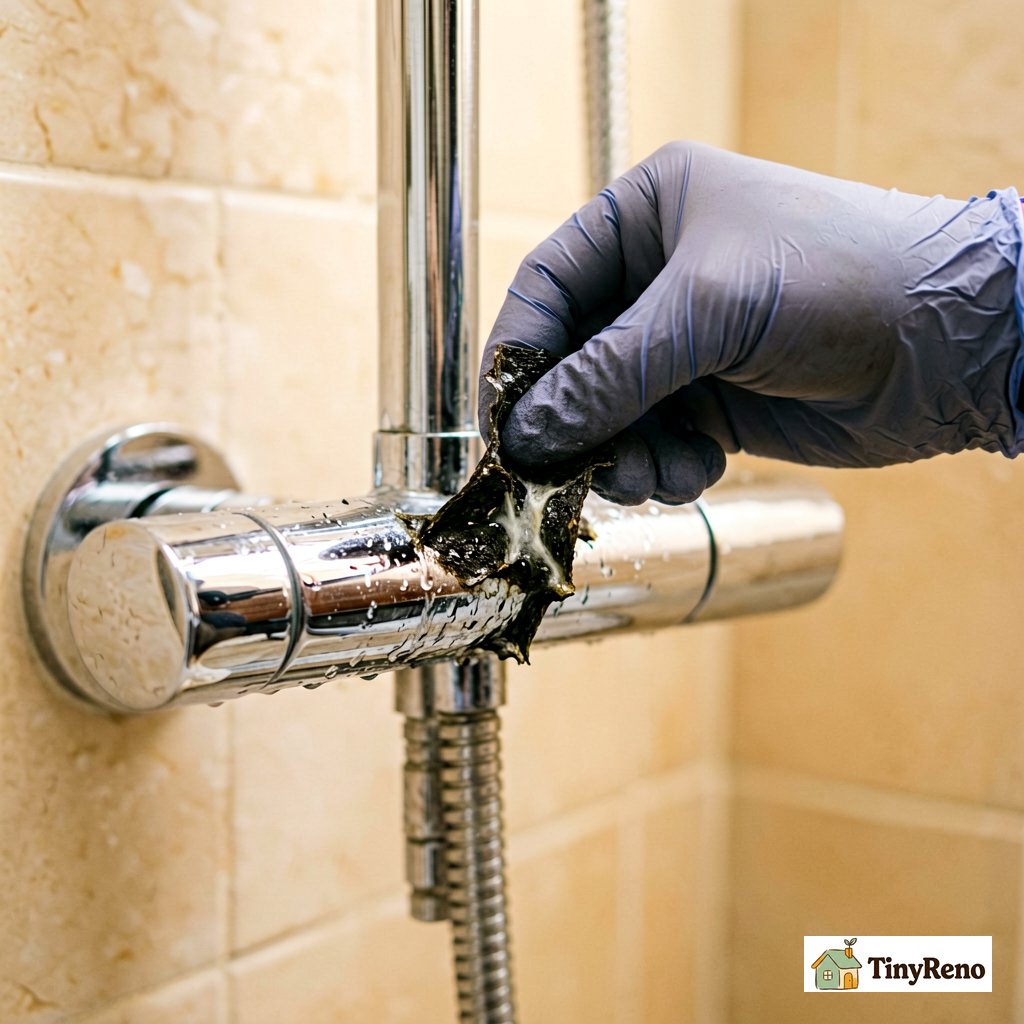
- Bio-film on the drain cover and the crossbar under it. That black, slimy, jelly-like layer on the chrome parts is not mold. It is bacteria feeding on the soap and skin cells that wash down every shower. It smells exactly like sewage because part of what it produces is hydrogen sulfide — the same compound that gives rotten eggs and blocked drains their distinctive smell.
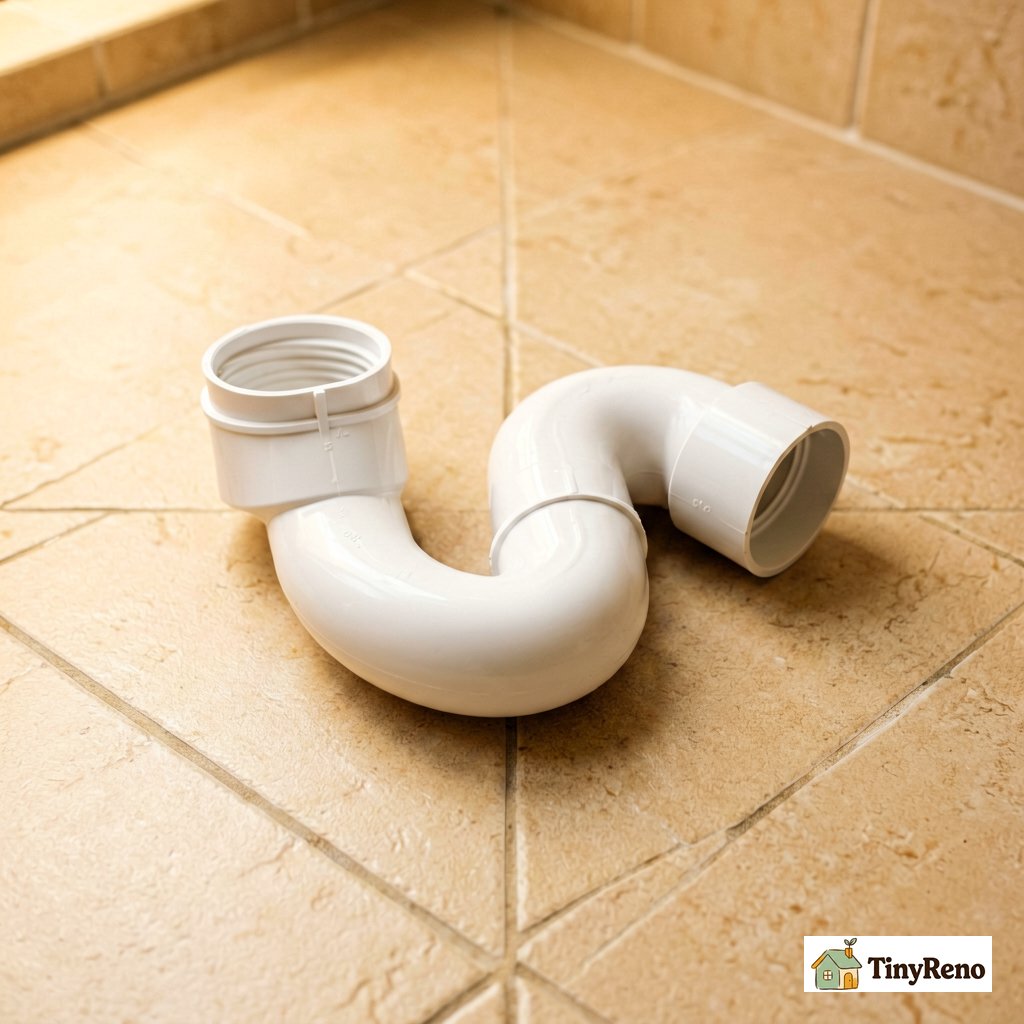
- A partially dry P-trap. The U-shaped pipe under your shower holds about 2 cups of water at all times. That water is the seal that keeps sewer gas from coming back up the drain. If the shower goes unused for 3 or more days, the water evaporates and the seal breaks. Sewer gas comes straight up into the bathroom.
- A blocked vent stack on the roof. Every drain in your apartment connects to a vertical pipe that runs up through the wall and out the roof. That pipe lets air in behind the draining water so the P-trap does not get siphoned dry. If the vent is blocked by leaves, a bird's nest, or ice, the system loses its air supply, the P-trap gets sucked dry faster, and the smell comes back no matter how often you run water.
My $45 total cost was $4 for a plastic drain brush, $6 for a box of baking soda, $12 for a slow-drain gel, and $23 for a 12-pack of cheap dishwasher tablets I ended up not using. The plumber I called at week 3 cost $120 and diagnosed the vent stack in 15 minutes — but he also told me 80% of renter sewage-smell calls are problems 1 and 2 alone. If you are reading this at 6:30 am, work down the list from cheapest to most expensive before you call anyone.
Week 3: The Plumber's Snake That Came Out Clean but Still Stank
By week 3, my shower drain smelling like sewage was now a Tuesday morning ritual. I had cleaned the bio-film twice. I had poured 2 cups of water down the drain every night before bed. The smell still came back every 48 hours, and it was getting stronger. So I called a plumber. He charged $120 for the visit and was at my apartment for 22 minutes total.
The plumber pulled a 25-foot snake down through the shower drain, then up through the vent stack on the roof. He came back down holding a clump of wet leaves, a piece of what looked like a bird's nest, and a single maple key. "This is your real problem," he said. "The other two are still there, but this is why the smell keeps coming back. The vent stack cannot breathe, so every time you run water, the system sucks the P-trap dry."
What he meant: if the vent cannot pull air in from the roof, the drain pulls air from the nearest available source, which is the P-trap water seal. The water gets sucked out, the seal breaks, and the smell comes back. Pouring more water down the drain does not help, because the new water gets sucked out too.
For most renters, the vent stack fix is not a DIY project — it is a landlord or maintenance call. If you can safely access your building's roof and the vent cap is removable, you can clear leaves yourself. Our anti-odor drain comparison guide covers the gel-and-baking-soda approach that works for the bio-film and dry-trap parts of the problem, while the vent stack is the part only maintenance should handle. If your faucet also has the black slime ring around the base, our faucet mold root cause guide explains why the same bacteria colonize chrome fixtures.
Week 2: The Airbnb Guest Who Never Ran the Water
The second time my shower drain smelled like sewage was after a 4-day trip to visit my sister in Boston. I had not run any water in the apartment for 96 hours. When I walked in, dropped my bag in the hallway, and opened the bathroom door, the smell hit me like a wall. I thought the worst. I thought the pipes had burst under the floor. I thought there was sewage leaking somewhere I could not see.
The actual cause was much smaller. The P-trap under the shower had dried out in the 4 days I was gone. With no water flowing through the pipe, the 2 cups of standing water that normally seal the trap had evaporated, and sewer gas was coming straight up the drain unmolested. The fix took 30 seconds and cost $0:
- Run the shower on hot for 90 seconds.
- Pour 2 cups of water directly into the drain.
- Wait 10 minutes.
- Run the shower on hot for another 60 seconds.
The smell was gone in 20 minutes and did not come back for 10 days, which is when I realized the bio-film problem was its own separate thing and the vent stack was its own separate thing. The three problems had been stacked the whole time, and I had been blaming whichever one was loudest in the moment. Our 3-cause diagnosis guide walks through the same triage in a different order, and is a good read if you want a non-chronological version of this same checklist.
Week 1: I Thought It Was the Hair on the Crossbar
The first thing I did when my shower drain smelled like sewage was pull the cover off and look. Underneath the chrome cover was a black, slimy rope of hair about the size of my thumb, knotted around the crossbar. I pulled it out with a coat hanger. It smelled terrible. I was sure that was the problem.
It was not the problem. Hair in a shower drain does not usually smell like sewage. Hair smells like wet hair, which is unpleasant but is not the rotten-egg, basement-toilet smell that made me wake up at 6:30 am. Hair clogs slow the drain. They do not generate hydrogen sulfide. What I had pulled out was the visible half of the bio-film problem, and the rest was still living on the chrome crossbar, on the drain cover, and on the first 6 inches of pipe just below the crossbar.
Bio-film is a layer of bacteria that grows on any wet surface that regularly gets soap and skin cells. It is not mold, despite looking like it. It is a mixed culture of bacteria, primarily Pseudomonas and Aeromonas species, that produce hydrogen sulfide as a metabolic byproduct. Hydrogen sulfide is the smell of sewage, rotten eggs, and blocked drains. Killing bio-film is a 4-step process that takes about 20 minutes:
- Remove the drain cover with a flathead screwdriver.
- Scrub the cover and the crossbar with a $4 plastic drain brush and a paste of baking soda and water. Get into every groove.
- Pour 1/2 cup baking soda down the drain, then 1 cup white vinegar. The fizz is doing real chemistry here — it is breaking the biofilm's grip on the pipe wall, even though it will not clear a hair clog.
- Flush with hot tap water — not boiling — 15 minutes later. If your building has PVC drain pipes (most modern apartments do), boiling water can soften the plastic and loosen the joints over time. Hot tap water is hot enough to carry away the loosened biofilm without risking the pipes. If the P-trap is dry and you're also dealing with sewer gas, the hot water will help refill the seal while it flushes.
I did this twice in week 1. The smell reduced by about 60% and stayed away for 36 hours, which is what convinced me that bio-film was part of the problem but not the whole problem. If your situation is similar — you scrub, the smell reduces, then it comes back — the story I tell in my $200 mold mistake is the same pattern in a different room, and the same lesson: scrub alone never solves a layered problem.
Four months later, the 6:30 am sewage wake-up has not happened once. The crossbar stays clean because I wipe it with a baking soda paste every other Sunday. The P-trap stays wet because I run the shower for 90 seconds every Monday morning, even if I am not showering that day. The vent stack — that was the landlord's job, and they sent maintenance up to the roof the week after the plumber diagnosed it. Total cost to me: $45 in cleaning supplies, plus the $120 plumber visit my building's master policy covered. The smell is gone. The checklist is taped to the inside of my bathroom cabinet, where I can see it every morning. If your shower drain smells like sewage right now, start at week 1 and work forward. You will probably stop at week 2. If you do not, you will know exactly which week 3 problem you have.


Discussion (0)
Sign in to join the discussion