

The first time I wondered can ceramic go in oven was a Thanksgiving in Astoria when my friend pulled a beautiful glazed ceramic baking dish out of the cabinet and asked me to put the sweet potatoes in it. I held the dish up to the light, looked for some marking on the bottom, and could not find anything definitive. I put it in a 400 degree oven and about forty-five minutes later heard a small pop and a hiss. The dish had cracked from the center outward — clean fracture, the kind that comes from thermal shock — and the sweet potatoes had to be transferred to a metal pan while the ceramic pieces cooled on the stovetop. We ate Thanksgiving dinner with one fewer dish than we started with, and I learned to never put an unmarked ceramic dish in a hot oven without checking first.
The question of can ceramic go in oven has a simple yes-or-no answer for most ceramics, but the practical answer is more nuanced. Some ceramics are designed for the oven and will survive decades of use. Some ceramics will crack the first time they see 350 degrees. Some are safe at lower temperatures but not at higher ones. Some are safe in the oven but cannot handle the thermal shock of going from fridge to hot oven. Knowing which is which saves you from losing a dish and possibly ruining a meal.
The Three Categories That Matter
Ceramic bakeware falls into three categories when it comes to oven safety, and the answer to can ceramic go in oven depends on which one you have. The first is oven-safe ceramic, which is specifically manufactured and labeled for oven use. Stoneware, porcelain-enameled cast iron inserts, dedicated ceramic baking dishes from major kitchen brands, and most restaurant-grade ceramics fall into this category. These are made from clay formulas that handle thermal cycling and are fired at temperatures higher than any home oven reaches. If you buy a ceramic baking dish new from a kitchen store and it has a label that says oven-safe, dishwasher-safe, microwave-safe, or any combination, you can trust it.
The second category is decorative ceramic, which includes most handmade pottery, most ceramics bought at craft fairs, ceramics from thrift stores without clear markings, and anything that has a glaze you cannot identify. Decorative ceramic is often beautiful and sometimes functional for cold or room temperature use, but it was not necessarily made to handle thermal cycling. The clay body, the glaze, and the firing temperature all affect whether it will survive the oven. Decorative ceramic might survive a low-temperature oven for a short time, but it is risky to assume so without testing.
The third category is suspect ceramic, which is anything where you cannot tell whether it was made for oven use. This includes unmarked dishes from estate sales, hand-me-downs with no original packaging, restaurant supply store finds without labels, and any ceramic where the markings have worn off. The default assumption should be that an unmarked ceramic is not oven-safe. If you want to use it, you have to either test it carefully or accept the risk.
The Markings to Look For
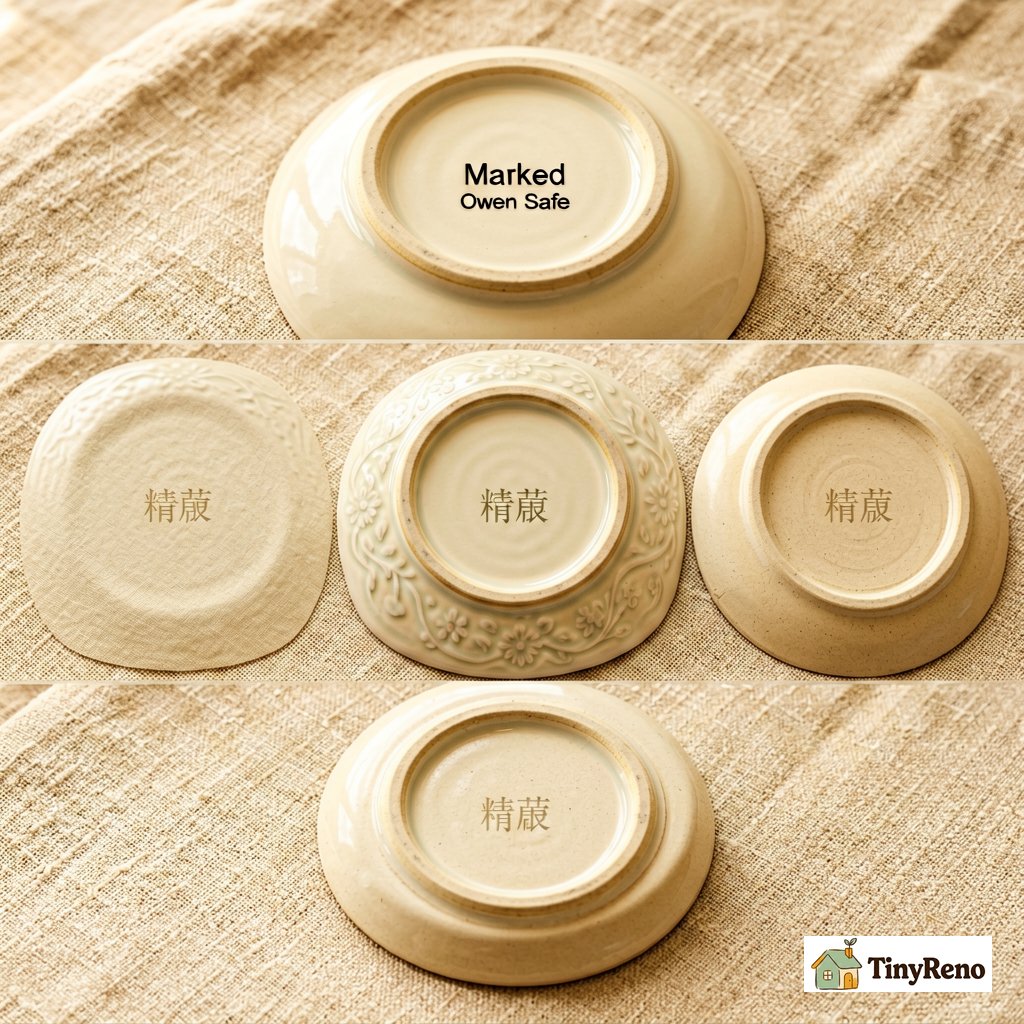
The most reliable indicator that a ceramic dish is oven-safe is a printed or stamped marking on the bottom. Major manufacturers use standardized symbols and text. The words oven-safe, dishwasher-safe, microwave-safe, or any combination indicate the manufacturer has tested the piece for thermal cycling. A symbol that looks like a small oven with wavy lines inside means the same thing. A temperature marking — for example, oven-safe to 500F or max temp 450F — tells you the upper limit.
The absence of any marking is not proof that the piece is unsafe. Many smaller manufacturers do not mark their pieces. Many older pieces have had the markings wear off from years of use and washing. What the absence of markings tells you is that you cannot verify the safety claim from the piece itself. If you do not know the manufacturer and cannot find a record of the piece online, you are working without a safety claim.
Some markings are actively warning signs. A symbol that looks like a microwave with an X through it means do not microwave — these dishes are usually fine in the oven but the manufacturer did not test them for microwave use. A symbol that looks like a dishwasher with an X through it means hand wash only, usually because the glaze is delicate. These markings tell you what the manufacturer did not test for, not what the piece cannot do. Most ceramic dishes that are marked microwave-safe are also oven-safe, and vice versa.
The Crack Test for Unknown Ceramic
If you have an unmarked ceramic dish and you really want to know whether it can go in the oven, the crack test gives you a rough answer without risking a good dish. Fill the dish with room temperature water. Put it in a cold oven. Set the oven to 250 degrees and let it heat up slowly with the dish inside. After 30 minutes, take the dish out (use oven mitts) and let it cool to room temperature on the counter. Do not put it on a cold surface or run it under cold water.
If the dish survived this low-temperature thermal cycle without cracking, it is probably safe for low-temperature oven use up to about 300 degrees. To test for higher temperatures, repeat the process but set the oven to 350 degrees. If it survives that, try 400. Each test takes about an hour and uses the dish itself as the test subject. This is not zero risk — the dish could still fail at higher temperatures even if it passed lower ones — but it is much lower risk than putting the dish in a 400 degree oven with food and discovering the failure mid-recipe.
The crack test does not tell you whether the dish is good for prolonged high-heat use. A dish that survives a one-hour 400 degree cycle might still crack after three hours at 400. The crack test is a screening tool, not a certification. For a dish you want to use for serious baking — casseroles, bread, roasts — start with shorter cooking times and check the dish each time you use it.
What Makes Ceramic Crack in the Oven
Ceramic cracks in the oven for two main reasons. The first is thermal shock, which is what happened to my Astoria friend dish. Thermal shock happens when one part of the ceramic heats up much faster than another part. The expanding section puts pressure on the cooler section, and if the pressure exceeds the strength of the ceramic, it cracks. This is why you should never put a cold ceramic dish directly into a hot oven — the part of the dish closest to the heat source expands faster than the rest.
The second is glaze failure. Some glazes contain materials that do not expand at the same rate as the clay body underneath. If the dish was fired correctly in the factory, the glaze and the clay expand together and the dish survives. If the firing was uneven or the glaze formula is not quite right, the glaze can separate from the clay at high temperatures, creating hairline cracks that let moisture into the clay body. The moisture turns to steam at oven temperature and the dish cracks from the inside.
Handmade pottery from craft fairs is more likely to have glaze failure issues than commercial ceramics because each batch is slightly different and quality control is harder. This is not to say handmade pottery is unsafe — many craft potters make excellent oven-safe pieces — just that the risk is higher and the markings are less standardized. When in doubt, ask the potter what temperatures the piece was fired to and whether it is food-safe and oven-safe. Most will know the answer.
Thermal Shock Habits That Prevent Cracks
Even with oven-safe ceramic, the way you handle the dish matters. The biggest habit is never putting a cold ceramic dish into a hot oven. If the dish has been in the fridge or on a cold counter, let it come to room temperature first. If you are in a hurry, put the dish in a cold oven and let them heat up together. The temperature difference across the ceramic is what causes the cracking, not the absolute temperature.
The second habit is not putting a hot ceramic dish on a cold or wet surface. The bottom of the dish contracts faster than the top when it hits the cold counter, and the resulting stress can crack even an oven-safe dish. Set hot ceramic dishes on a wooden cutting board, a dry towel, or a trivet. Never on a marble counter, a metal rack, or a cold stone surface.
The third habit is not adding cold liquid to a hot ceramic dish. If you take a casserole out of the oven and want to deglaze with cold broth, let the dish cool for ten minutes first or use warm broth. The thermal shock from cold liquid hitting hot ceramic can crack the dish the same way a hot oven can crack a cold dish.
When in Doubt, Use a Different Dish
The honest answer to can ceramic go in oven for any dish you are not certain about is to use a different dish. Metal baking pans are cheap and reliable. Cast iron handles any oven temperature and any recipe. Even if the ceramic dish might be fine, the risk of losing it, losing the meal, and dealing with ceramic shards in the oven is not worth the cost savings of using a questionable dish.
This is the rule I live by after the Astoria Thanksgiving incident. If I am not sure a ceramic dish is oven-safe, I use a metal pan or a cast iron pan instead. The ceramic dish can go back in the cabinet for cold service — salads, fruit, bread on the table. The few dollars saved by reusing the ceramic instead of buying the right pan is not worth the consequences.
For my own kitchen I keep two oven-safe ceramic dishes — a small oval baker and a large rectangular casserole — both marked and both bought new from kitchen stores. Everything else ceramic stays out of the oven. The marked dishes have been used weekly for two years without a single crack. The unmarked thrift store pieces look nice on the table but never see the inside of the oven. The Astoria Thanksgiving ceramic dish is in a landfill somewhere, and my friend now labels her cabinet with a Sharpie — "OVEN SAFE" on the ones that go in, blank on the ones that do not. That is the lesson the cracking ceramic dish taught us, and the rule we have kept since.


Discussion (0)
Sign in to join the discussion