

My dad ran the fry station at a diner for thirty-two years. Behind him, bolted to the wall between the deep fryer and the flat-top, was a stainless steel wire shelf he never replaced. I asked him once when he last cleaned it. He said never. He said it was the same shelf the previous owner had installed in 1987. It was pitted along the welds and stained from years of grease, but the wire was still there. Still holding bags of frozen fries and cone filters. That shelf lasted thirty-eight years in the hottest, greasiest corner of a working kitchen.
The shelf I bought online for my apartment kitchen lasted four months before it rusted through at the brackets. Same product category, same idea, completely different outcome. The difference wasn't the shelf. The difference was the grade of stainless, the environment, and what I'd been told about stainless steel that wasn't true.
This guide is about where this kind of shelf actually outlasts every other material, where it corrodes anyway, and how to tell if the one you're looking at will last four months or forty years.
What Makes Stainless Steel Different
I took a magnet to the rusted-through shelf in my kitchen. It stuck firmly. I took the same magnet to a shelf at a restaurant supply store. It didn't stick. Same label on both — "stainless steel." Different grades entirely.
Stainless steel is steel with chromium added. The chromium forms a thin, invisible oxide layer on the surface that prevents rust. As long as that layer stays intact, the steel doesn't corrode. If the layer gets damaged or chemically stripped, the steel underneath rusts like any other steel.
The grade determines how well that oxide layer holds up:
304 stainless — the most common food-grade. About 18% chromium and 8% nickel. Resists corrosion in most indoor and many outdoor environments. Used in restaurant kitchens, medical equipment, and most "good" kitchenware.
201 stainless — a cheaper alternative. Less nickel, more manganese. Resists corrosion in dry indoor environments but fails in humid, salty, or acidic conditions. Used in budget shelving sold online and at big-box stores.
430 stainless — even cheaper. Magnetic (304 usually isn't). Resists corrosion in dry indoor environments but fails quickly when wet. Used in budget appliances and trash cans.
A shelf made from 304 will outlast almost anything else in a home. A shelf made from 201 will outlast chrome-plated steel in dry indoor use, but will corrode within months in any humid environment.
Garage: Oil, Road Salt, and the Test of Time
My neighbor Jim has had a 304 stainless shelf in his garage for nineteen years. It has a thin film of road salt residue along the front edge but no structural rust. Across the street, another neighbor's shelf rusted through at the brackets in fourteen months. I was going to chalk that up to bad luck until I noticed the wall behind his shelf was stained from water dripping off a wet car parked inches away. Different shelves, different wall locations, different moisture exposure. The grade matters, but so does the position.
A garage is one of the best environments for this kind of shelving. Most garages stay dry, the temperature swings are moderate, and the shelf doesn't usually get wet. Road salt from a car in winter can splash onto it, but occasional splashes don't strip the oxide layer on 304.
A 304 shelf in a garage will last fifteen to twenty years with no maintenance. It will pit slightly along welds if road salt sits on it for weeks, but the structural integrity stays. For garage storage of paint cans, automotive fluids, tools, and sports equipment, this is the most durable option.
A 201 shelf in a garage will start showing brown staining at the welds and brackets in three to five years. It will still hold weight for years after that — the surface rust looks bad but doesn't immediately weaken the structure. If you only care about function and not appearance, a 201 shelf in a dry garage can last ten years. If the look of rust bothers you, spring for 304. For most garage uses, that's acceptable — the shelf doesn't need to look new, it needs to hold weight.
The one garage environment that kills even 304 is the wall directly behind a workbench where a wet car has been parked for hours. Road salt water drips off the car and onto the shelving. Over months, this strips the oxide layer and the rack pits through. If you park a wet car in the garage, mount the shelf on a wall that doesn't get dripped on.
Kitchen: Where Stainless Steel Actually Makes Sense
A friend moved out of her apartment after four years and sent me a photo of the stainless steel wire shelf she'd installed above the stove. The shelf was still holding spices. The welds were pitted brown where the steam from every pot of pasta had hit them. The brackets were fine. She was convinced the shelf had failed. It hadn't — it had just been the wrong grade for the location.
Inside a kitchen, this kind of shelving lasts decades if it's 304 grade. Most restaurant kitchens use 304 because it's the only material that survives daily cleaning with strong detergents and constant exposure to food acids.
For a home kitchen, the same setup works for:
- Pantry storage where humidity is moderate
- Above the counter for dry goods, spices, and small appliances
- Inside cabinets for canned goods and dry ingredients
- Above the sink for dish soap and sponges (if 304 and rinsed occasionally)
The shelf fails in a home kitchen when:
- It's mounted directly above a stove where steam and grease hit it daily
- It's mounted inside a closed cabinet where humidity stays high for days
- The grade is 201 or 430 and the environment has any humidity
For a kitchen, the safest choice is 304 stainless with welded (not spot-welded) brackets. Welded brackets don't have gaps where water and food particles collect. Spot-welded brackets collect moisture in the gap and corrode from the inside out.
Balcony and Outdoors: Where It Quietly Corrodes
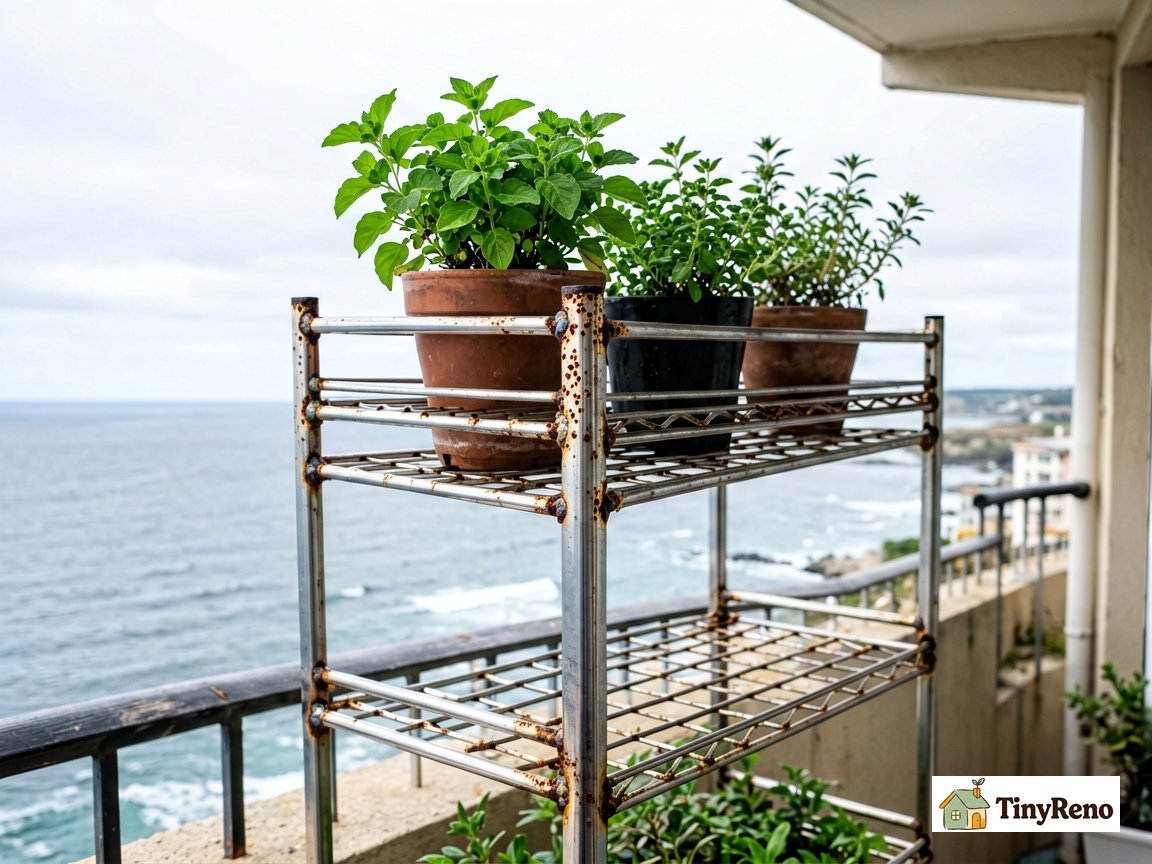
A cousin of mine lives in a beachfront condo, four blocks from the ocean. He mounted a stainless rack on his covered balcony to hold potted herbs. After two years the shelf looked like it had measles — small rust pits across every weld. He replaced it with the same shelf from the same brand. Two years later, same outcome. He replaced it a third time with a 316 marine-grade version. That one has been there for six years and looks new.
Outdoor environments are where stainless steel gets oversold. A 304 rack on a covered balcony in a dry climate will last fifteen years. The same shelf on a balcony near the ocean will pit and corrode within two years because salt air strips the oxide layer faster than it can re-form.
For outdoor use:
- Covered balcony, dry climate: any 304 rack will last fifteen-plus years
- Covered balcony, coastal climate: 304 lasts two to five years before pitting. 316 marine grade lasts fifteen-plus years but costs three times as much
- Open patio, any climate: 304 fails within two years from rain and UV. Use powder-coated steel or aluminum instead
- Open patio, coastal: nothing stainless lasts. Use aluminum or plastic
The pattern: the further from the ocean and the more covered the space, the longer stainless steel lasts. The closer to the ocean and the more exposed, the more stainless steel disappoints. For most apartment balconies, this kind of shelving works for years if the balcony is covered and the building isn't within a mile of the coast.
The Three Things That Make or Break These Shelves
A mechanic I know cut apart two failed "stainless steel" wire shelves from a customer's garage to see why they'd both rusted through at the brackets. One used 5mm wire and fully welded brackets — the steel itself was still bright underneath the surface rust. The other used 3mm wire and spot-welded brackets — the steel had corroded all the way through where the brackets met the frame. Same label. Different shelf.
Three details separate a stainless rack that lasts forty years from one that fails in four months:
The grade of stainless. 304 is the minimum for any environment with humidity. 201 is fine for dry indoor storage (closet, garage, dry pantry) but fails anywhere wet. 430 is budget-only and fails quickly.
The bracket construction. Welded brackets hold up. Spot-welded brackets collect moisture in the gap and corrode from inside out. Pressed brackets (where the wire is bent into shape) are weakest and fail first. Look for "fully welded" or "TIG welded" in the product description.
The wire gauge. Thicker wire holds more weight and resists bending. A 304 shelf made from 5mm wire or thicker will hold 50+ pounds without flexing. A rack made from 3mm wire flexes under 20 pounds and bends permanently under 30.
For a home kitchen or garage, a 304 stainless shelf with welded brackets and 5mm wire will outlast the building. For a budget dry-indoor use, a 201 shelf with spot-welded brackets and 4mm wire will last five to ten years.
Mounting Without Pulling Out a Stud Every Time
The first stainless steel wire shelf I mounted in my apartment fell down eight months later — pulled the plastic drywall anchors straight out of the wall and dumped a full shelf of dry pasta onto the kitchen floor. The shelf itself was fine. The anchors were the wrong hardware for the weight. I replaced them with metal toggle bolts. That shelf has been up for nine years.
Stainless steel wire shelving is heavier than chrome or painted steel. A 4-foot shelf in stainless weighs about 12 pounds empty. The mounting needs to support the shelf plus the load (which can be 50-100 pounds of stored items).
For drywall mounting:
- Use metal toggle bolts, not plastic drywall anchors. Plastic anchors fail under sustained load.
- Mount into studs whenever possible. A shelf held only by drywall anchors will eventually pull out.
- Use a level. Stainless shelves look obviously crooked when mounted unevenly.
- Pre-drill with a bit slightly smaller than the bolt threads. This lets the bolt threads bite into the wall material.
For concrete or brick mounting:
- Use concrete screws (Tapcon or equivalent). Don't use drywall anchors in masonry.
- Drill with a hammer drill and masonry bit. The hole should be the exact depth of the screw plus 1/4 inch.
- Vacuum the dust out of the hole before driving the screw. Dust left in the hole keeps the screw from seating fully.
For renters who can't drill:
- Freestanding stainless shelving units sit on the floor and don't require mounting. The downside is the unit takes up floor space and can tip if loaded unevenly.
- Tension-mounted stainless poles work in showers and between floor and ceiling but don't hold much weight.
How to Tell Cheap Stainless From Real Stainless
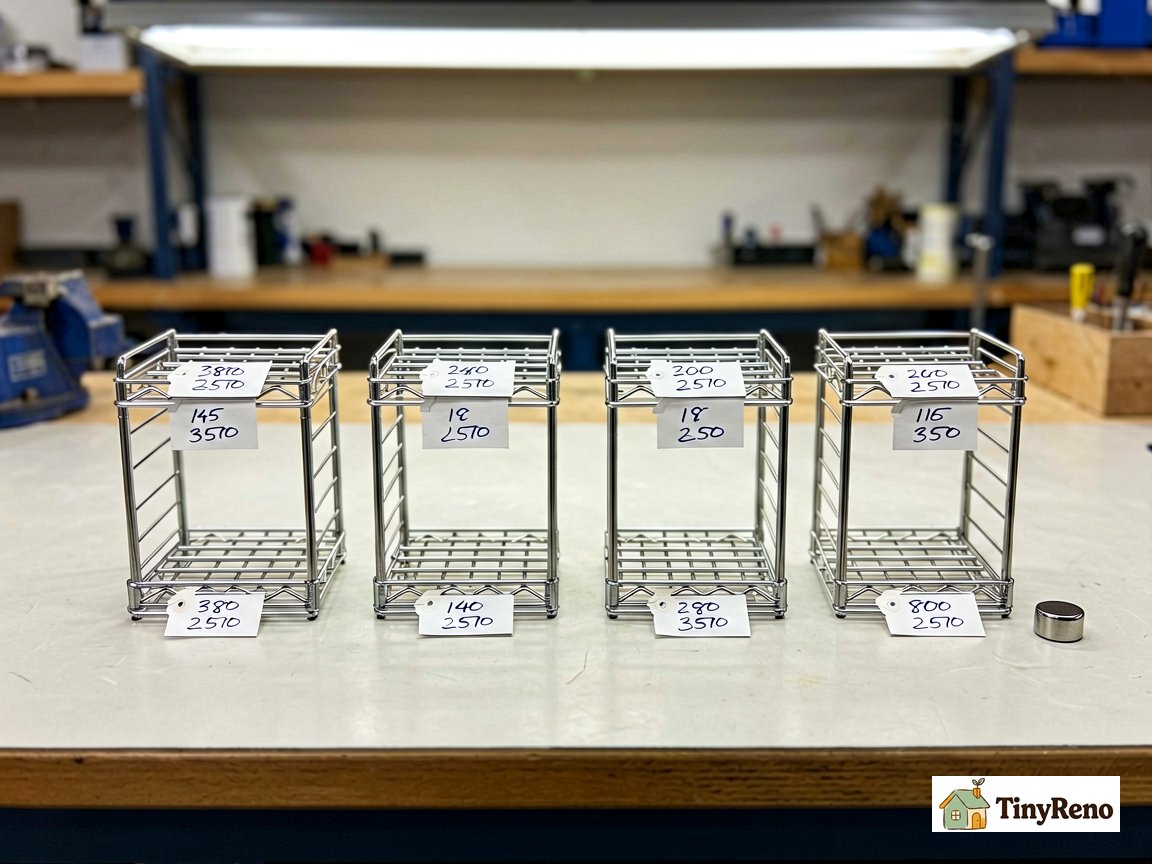
I keep a small neodymium magnet in my kitchen drawer for exactly one reason — to test stainless steel before I buy it. The first time I used it was in a big-box store, holding the magnet up to a "stainless steel" shelf marked down to half price. The magnet stuck like glue. I put it back. The shelf was almost certainly 430 stainless, not 304. The discount made sense once the magnet did its work.
A few ways to spot a 201 or 430 rack disguised as "stainless steel":
The magnet test. The magnet test is a rough sorting tool, not a guarantee. 304 stainless is usually non-magnetic, and 430 is strongly magnetic — so if a strong magnet sticks hard, it's almost certainly not 304. But 201 stainless can be either weakly magnetic or non-magnetic depending on how it was formed. So if the magnet doesn't stick, you still don't know for sure that you're holding 304 — only that you're not holding 430 or plain steel.
The price. A 4-foot stainless rack made from 304 costs $80-$150 from a restaurant supply store. The same shelf in 201 costs $30-$50 from a big-box store. If the price seems too good to be true, the grade is probably 201 or 430.
The paperwork. Restaurant supply and commercial-grade sellers list the grade in the specs. Consumer sellers often say "stainless steel" without specifying the grade. If the grade isn't listed, assume it's the cheapest one that still counts as stainless.
The weight. A real 304 shelf is heavy. A 4-foot model weighs 10-15 pounds. A 201 shelf of the same size weighs 8-10 pounds. If the rack feels light for its size, the wire is thin and probably the grade is budget.
For a shelf that will hold weight and last more than five years in any environment with humidity, buy from a restaurant supply store (Webstaurant, Katom, Restaurant Depot) and confirm the grade is 304.
How to Keep It Looking New for Years
A coworker scrubbed a brand-new 304 stainless shelf with steel wool to remove a sticker residue. Three months later, fine rust spots appeared exactly where she'd scrubbed. The oxide layer had been stripped and hadn't fully re-formed. She learned the rule the hard way: never use abrasives on stainless.
A 304 stainless rack needs almost no maintenance. Wipe with a damp cloth every few months to remove dust. For grease or food residue, wipe with a cloth dampened with white vinegar, then rinse with water and dry.
Don't use:
- Steel wool or abrasive scrubbers (scratches the oxide layer)
- Bleach or chlorine-based cleaners (strips the oxide layer)
- Hard water for the final rinse (leaves mineral spots that etch over time)
For a 201 shelf, the maintenance matters more. Wipe dry after any exposure to water. Don't let wet items sit on the rack. The shelf will still corrode eventually, but drying after each wet use extends its life by a year or two.
For coastal outdoor use, even 304 needs occasional cleaning. Wipe with fresh water every few months to remove salt deposits. The salt deposits are what strip the oxide layer, not the salt air itself. A wiped-down shelf lasts years longer than an unwiped one.
A Quick Buying Guide by Use Case
The first apartment I rented, I bought a stainless steel wire shelf without knowing any of this. I saw "stainless steel" on the label and assumed it would last. Four months later, brown water was dripping from the brackets onto the counter below. I'd bought a 201 shelf and mounted it in a kitchen with a poorly vented dishwasher. The rack rusted from the inside out. I replaced it with a 304 shelf from a restaurant supply store. That shelf is still in the same spot eleven years later.
A quick guide to picking the right shelving by environment:
| Use Case | Grade | Bracket | Wire Gauge | Expected Life |
|---|---|---|---|---|
| Garage (dry, indoor) | 201 or 304 | Spot-welded OK | 4-5mm | 10-20 years |
| Garage (humid or salt exposure) | 304 | Welded | 5mm | 15-20 years |
| Home kitchen (above counter) | 304 | Welded | 4-5mm | 20+ years |
| Home kitchen (above stove) | 304 | Welded | 5mm | 10-15 years |
| Covered balcony (dry climate) | 304 | Welded | 5mm | 15+ years |
| Covered balcony (coastal) | 316 | Welded | 5mm | 15+ years |
| Open patio | Aluminum instead | — | — | 10+ years |
| Closet (dry, indoor) | 201 or 304 | Any | 3-4mm | 15+ years |
| Pantry (humidity moderate) | 304 | Welded | 4-5mm | 20+ years |
| Commercial kitchen | 304 | Welded | 5-6mm | 30+ years |
The shelf my dad had at the diner was almost certainly 304 stainless with welded brackets and 5mm wire, mounted in a dry spot away from direct water exposure. That's why it lasted thirty-eight years. A shelf that meets the same specs in a similar environment will do the same.
Stainless steel wire shelving is sold as if all stainless is the same. It isn't. The grade, the bracket construction, and the wire gauge determine whether the shelf lasts four months or forty years. For most home uses, a 304 stainless shelf with welded brackets and 5mm wire is the right choice. For dry indoor storage, a 201 shelf works fine. For outdoor coastal use, only 316 marine grade holds up. Get those right and the shelf will outlast almost everything else in the room.


Discussion (0)
Sign in to join the discussion