

The first time I saw a tip out bin I was twenty-six and didn't understand what I was looking at. A friend's renovated kitchen had a small drawer at the base of the counter that, when you pulled the handle, tilted forward and dumped the contents into a tray. It was for trash. Or recycling. Or compost. I couldn't tell because there were three of them and they all looked similar.
The second time I saw a tip out bin I was in my own rental kitchen, with a swinging cabinet door that opened onto a trash can I had to step over and lean into the cabinet to swap the bag. I bought a single tip out bin, mounted it in the lower cabinet under the sink, and spent ten minutes installing it. The bin replaced two trash cans, freed up the floor space, and stopped the daily lean-into-the-cabinet fumbling for a bag.
Tip out bins are a specific solution to a specific problem. They work brilliantly when the problem matches. They work poorly — or not at all — when it doesn't. This guide walks through where they actually save space in a rental kitchen, where they're a waste of money, and the three things that determine whether one will fit in your cabinet.
What a Tip Out Bin Actually Is
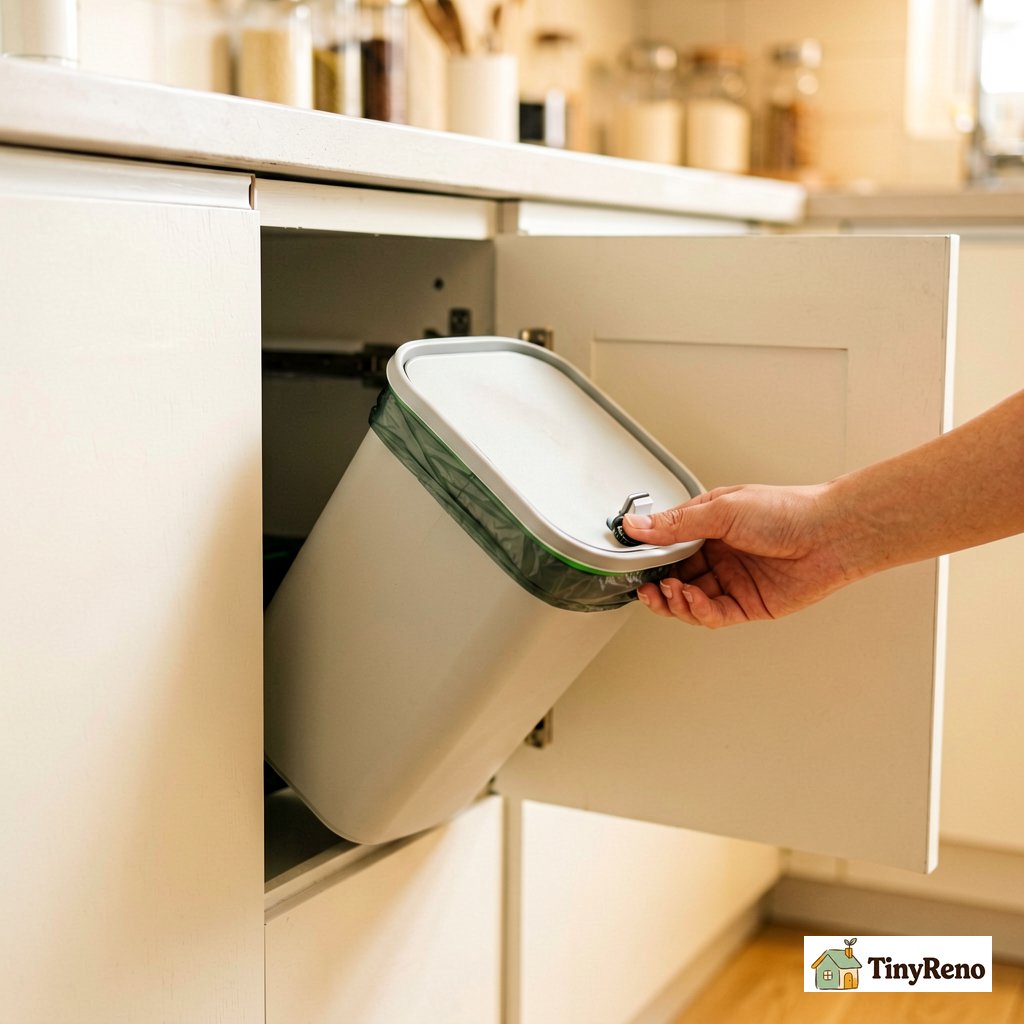
A tip out bin is a small container, usually plastic or metal, mounted inside a cabinet door or on a sliding rail inside a cabinet. When you open the door or pull the handle, the bin tilts forward so you can drop trash, recycling, or compost into it without opening the cabinet, bending down, or stepping around a freestanding can.
The simplest designs mount to the inside of a cabinet door with two screws and a hinge. When you open the door, the bin tilts out. These work for smaller cabinets and lighter loads.
More elaborate designs use a sliding rail system inside the cabinet. The bin pulls out and tilts forward when you pull the handle. These hold more, work for larger cabinets, and cost more.
Both styles take about 10-15 minutes to install. No special tools beyond a drill or screwdriver.
I've installed three of these now, in three different apartments. The first one was a no-name brand from Amazon for about $30 — it worked fine for a year but the hinge started creaking. The second was a better-known brand (Rev-A-Shelf, if you're wondering) for about $50 — that one is still mounted in my current kitchen and works like new. The third was a cheap one I helped a friend install from IKEA for $25 — it's fine for light trash but the plastic feels thin. My point: you don't need to spend a lot, but the $50 tier is noticeably better than the $25 tier.
The Five Places Tip Out Bins Work
The places where a tip out bin solves a problem you actually have:
1. Inside the Sink Base Cabinet (Trash and Recycling)
This is the classic use and the one most are designed for. Most kitchens have a cabinet under the sink that's awkward to access — the pipes take up half the space, and the rest is usually wasted. A tip out bin fits on the inside of the door or slides into the cabinet and turns dead space into working trash storage.
Why it works: the cabinet is right next to where you generate trash. The bin stays out of view. You don't have to step around a freestanding can. The door closes and the trash is invisible.
What to look for: a bin rated for at least 8 quarts (most kitchens generate 1-2 gallons of trash per day). A model that mounts on the door rather than sliding on rails is easier to install and works for most sink base cabinets.
One warning that never shows up on product pages: check the weight rating before you fill the bin. Most door-mounted bins are designed to hold 5 to 8 pounds total. That sounds like a lot until you fill it with wet coffee grounds, glass jars, and a full week of food scraps — then it's sagging toward the floor. If your cabinet door is thin particleboard, add a reinforcement plate behind the mounting screws, or the door will start to sag within a year.
2. Inside a Pantry Cabinet (Compost or Recycling)
If your kitchen has a pantry or tall cabinet, a tip out mounted on the inside of the door works for compost or recycling collection. The container stays out of sight, the door closes, and you don't have to remember to take the compost out daily.
Why it works: pantry doors are usually the right size for these mounts, and pantries are usually near where you generate food scraps. The container keeps the compost contained until you're ready to take it out.
What to look for: a smaller container (4-6 quarts is enough for compost). A door-mounted design rather than a slide-out, since pantry shelves often block slide-out rails.
3. Inside a Lower Cabinet (Pet Food or Cleaning Supplies)
A tip out mounted in a lower cabinet works for dry pet food, cleaning supplies, or anything you want to keep off the counter but want to grab quickly. The bin tilts out, you scoop what you need, the bin tilts back.
Why it works: it gets the pet food bag or cleaning supplies off the floor and out of sight. The tilt-out motion is faster than opening a cabinet and pulling out a box.
What to look for: an airtight container if you're storing pet food (the tilt mechanism doesn't seal perfectly, so dry food will go stale faster in an open bin than in a sealed container). A small size (4-6 quarts) unless you have a Great Dane.
4. Inside a Bathroom Vanity (Hair, Cotton Swabs, Small Trash)
The same principle works in a bathroom. The vanity under the sink is wasted in most bathrooms — pipes and dead space. A small tip out bin on the cabinet door turns it into working trash storage for hair, cotton swabs, dental floss, and other small bathroom waste.
Why it works: it gets small bathroom waste off the counter and out of sight. You don't have to fish into a cabinet for a tissue.
What to look for: a small bin (2-4 quarts). A door-mounted design. A model that won't leak — bathroom waste is often wet.
5. Inside a Mudroom or Entry Cabinet (Gloves, Hats, Pet Leashes)
A tip out bin in a mudroom cabinet works for items you grab on the way out the door — gloves, hats, dog leashes, small tools. The bin tilts out, you grab what you need, it tilts back.
Why it works: it gets the small items you need on your way out into a single accessible place. The tilt-out motion is faster than digging through a drawer.
What to look for: a larger bin (8-10 quarts) since the items are bulkier than kitchen scraps. A slide-out design if the cabinet is large enough.
The Three Places They're Overkill
Where a tip out bin is more trouble than it's worth:
1. A Cabinet You Rarely Use
If the cabinet you want to put a tip out mount in is in a corner you don't reach into often, the container will sit empty for weeks. These mounts are best when the access is part of a daily routine. A bin in a rarely-opened cabinet is just a bin in a rarely-opened cabinet.
2. A Cabinet With No Room
Door-mounted bins need at least 7 to 8 inches of depth from the inside of the door to the back of the cabinet. Slide-out models are worse — plan on 10 to 12 inches minimum, or the rails won't have room to travel. I found this out the hard way when my first slide-out model arrived and the drawer hit the sink drain before it was halfway open. A cabinet that's full of pipes (under a sink with a garbage disposal, for example) may not have room for the mechanism. Measure before you buy.
3. A Drawer You Want to Use for Something Else
Tip out bins take over a drawer or a door. If that drawer or door is currently useful for something else, the bin replaces that use. A kitchen with very few drawers will feel the loss of one more than a kitchen with many.
The Three Things That Determine Whether a Tip Out Bin Will Fit
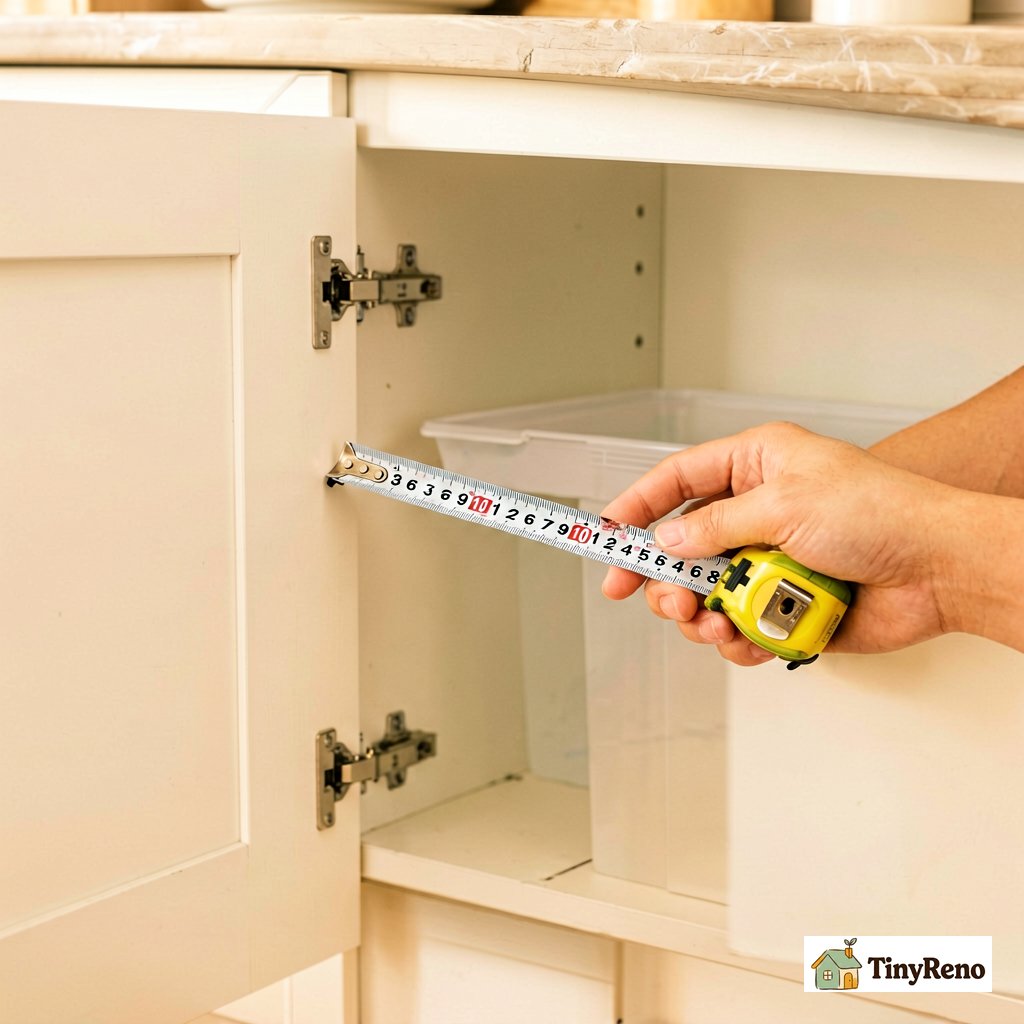
Before you buy, measure these three things:
The inside width of the cabinet door or cabinet opening. Most bins are designed for standard cabinet widths (12, 15, 18, 24 inches). Measure the inside of the door, not the outside of the cabinet.
The depth of the cabinet. The bin plus the tilt mechanism needs about 6-8 inches of depth. A shallow cabinet (under 12 inches deep) won't fit a slide-out model but may fit a door-mounted one.
The hinge clearance. The bin tilts forward. The bottom of the bin needs clearance from the cabinet floor when it tilts. If there's something in the way — a shelf, a pipe — the bin won't tilt properly.
How to Install One in About 15 Minutes
A basic door-mounted tip out bin comes with two brackets, two screws, and a bin that snaps onto the brackets. The install process:
- Empty the cabinet.
- Hold the brackets at the bottom of the cabinet door, level with each other.
- Mark the screw holes.
- Drill pilot holes (most kits include the right drill bit).
- Screw the brackets in.
- Snap the bin onto the brackets.
- Test the tilt.
- Put the trash bag in the bin.
That's it. No plumbing, no electrical, no special tools. A slide-out rail model is more involved — usually 30-45 minutes and requires more precise mounting — but it's still a renter-friendly project if you own a drill.
Renter note: can you take it with you when you move? Yes, if you used screws. The screw holes are a five-minute fix — wood filler, sand, a dab of paint. If you're worried about the deposit, use a metal bracket that spreads the screw holes along the bottom edge of the door where they're least visible. Or just ask the landlord first — mine said yes immediately because it meant the trash can stopped scraping the cabinet floor.
The Cost-Benefit of a Tip Out Bin
I've now had a tip out bin in three kitchens, and the one I think about most is the first one — the one that replaced that awkward freestanding can in my Astoria rental. Every time I opened the cabinet and the bin tilted out instead of me leaning in, I felt like I'd won a small victory over the apartment's terrible layout. That's what a good tip out bin does: it fixes a specific annoyance so completely that you forget the annoyance ever existed.
A door-mounted tip out bin runs $25-$50. A slide-out rail model runs $60-$120. The cost is moderate. The benefit depends on the cabinet:
- For a sink base cabinet, the benefit is high. The bin replaces an awkward trash solution and frees up floor space.
- For a pantry, the benefit is moderate. It depends on whether you generate enough compost or recycling to fill the bin regularly.
- For a bathroom vanity, the benefit is moderate to high. Small bathroom waste is annoying without a dedicated bin.
- For a mudroom or entry, the benefit depends on your routine. If you grab gloves and a leash every time you leave, the bin saves time. If you don't, it's just decoration.
A good rule of thumb: if the cabinet you're thinking about is one you open daily, a tip out bin will likely be worth it. If it's one you open weekly, the bin will likely sit half-empty.
What Tip Out Bins Don't Solve
A few things that look like good fits but aren't:
Big family trash. These mounts are typically 4-10 quarts. A family that generates a lot of trash will overflow a small container.
Recycling that needs sorting. Most are single-compartment. If your municipality requires sorting recycling into multiple categories, a single tip-out handles only one stream. Multiple containers, or a larger recycling station, are the right solution.
Permanent storage. These mounts are designed for items that get added to and emptied regularly. They're not designed for things you want to store long-term. The tilt mechanism has small parts that wear with heavy use.
The Quick Decision Tree
| Cabinet or Space | Tip Out Bin? | Why |
|---|---|---|
| Sink base, daily trash | Yes | Replaces awkward trash can, hides it |
| Pantry, compost or recycling | Maybe | If you generate enough to fill it regularly |
| Lower cabinet, pet food or cleaning | Yes | Gets bulk items off floor, easy access |
| Bathroom vanity, small trash | Yes | Hides small bathroom waste |
| Mudroom, grab-and-go items | Maybe | Only if you grab those items daily |
| Rarely-used cabinet | No | Will sit empty |
| Cabinet with no room | No | Won't fit |
| Big family trash | No | Too small |
| Recycling that needs sorting | No | Single stream only |
Tip out bins are a specific solution. They work when the problem is "I have a cabinet I open every day that I want to be more useful" and the answer is "yes, with a tilting bin." They don't work when the problem is "I want to replace my whole trash system" or "I want to store things I rarely touch."
For the kitchen under the sink, the right answer is usually yes. For anything else, measure first.


Discussion (0)
Sign in to join the discussion