

My upstairs neighbor had an a c unit fan not spinning. The indoor unit was the kind mounted above a window in a converted apartment — a deep white box that sucked air through the side and pushed cold air out the front. The fan inside the box was supposed to be a steady whoosh. Instead it was a quiet hum. Then nothing. Then a louder hum. Then nothing again. The compressor was running. The fan wasn't.
She spent two days assuming the whole unit was broken, scheduling a service call, dreading the bill. A tech came out, opened the front panel, looked at the fan blade, blew out a clump of dust and a small piece of plastic wrapper, and the fan spun up like new. Total cost: $85 service call. Total time the unit had been working fine in retrospect: two years before the wrapper got stuck.
Most "a c unit fan not spinning" problems are not as dramatic as a stuck wrapper. But they all follow the same pattern: the fan stops for a specific, identifiable reason, and most of those reasons are not "the unit is dead." This guide walks through the five causes — including a c unit fan not spinning from dirt, motor failure, broken blades, loose wires, and control boards — in order from most to least common, and tells you which ones you can fix and which ones are a landlord call.
Why the Fan Stops but the Compressor Keeps Running
The indoor unit has two electrical components doing two different jobs:
- The compressor — the heavy motor that pumps refrigerant between the indoor and outdoor coils. This is the part that makes the "small airplane" sound outside.
- The fan motor — the smaller motor that pushes air across the indoor evaporator coil and out through the front of the unit. This is the part that makes the "whoosh" sound inside.
When the compressor is running but the fan isn't, the issue is almost always one of five things:
- Dirt and debris on the fan blade or in the housing — most common, easiest to fix
- A failed fan motor — second most common, requires replacement
- A stuck or broken fan blade — third, usually visible
- A loose or disconnected fan motor wire — fourth, requires opening the unit 5. A failed control board or relay — rarest, requires a tech
The trick is figuring out which one you're looking at before you call for service. The first three are things you can sometimes fix or at least identify without taking the unit apart.
Cause 1: Dirt and Debris (Most Common, Easiest to Fix)
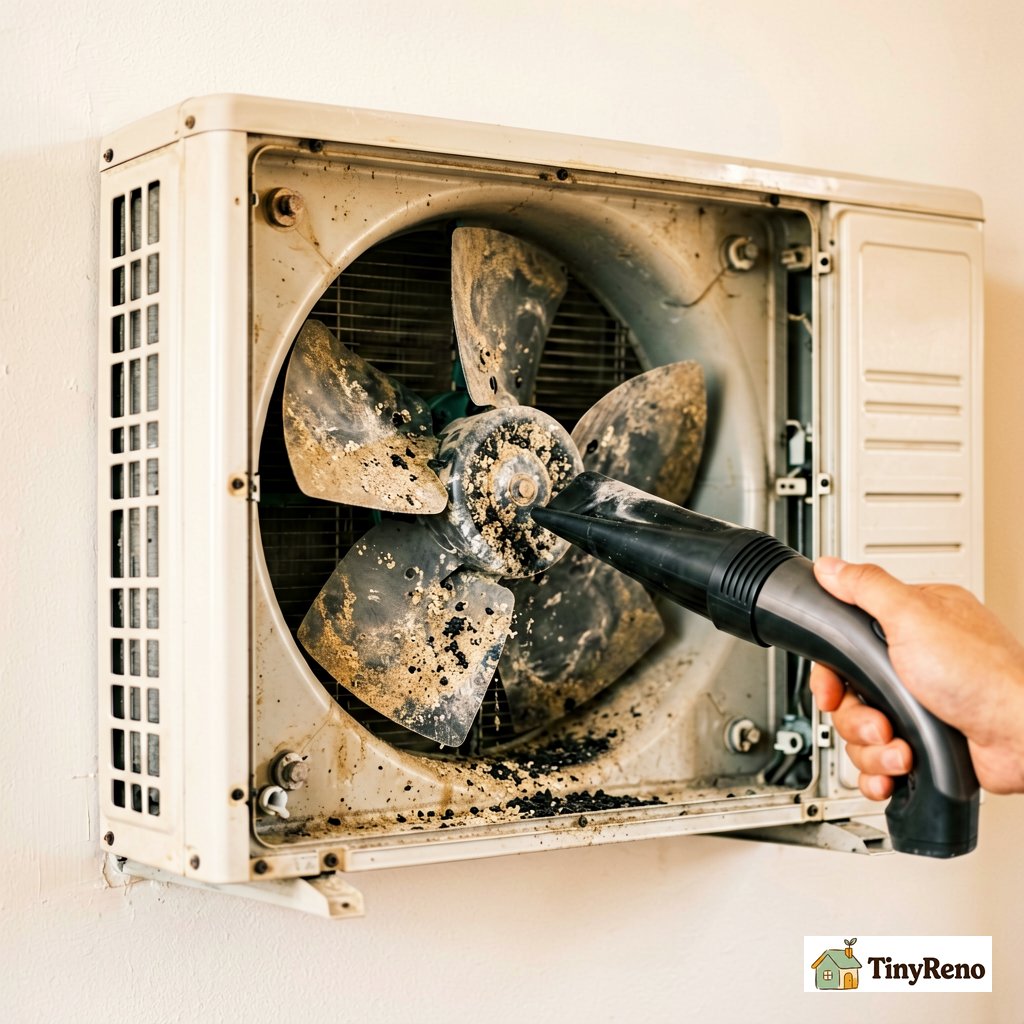
The indoor unit pulls air through a filter and across the evaporator coil. Over months, dust, pet hair, lint, and small debris accumulate on the fan blade and inside the housing. When enough of it accumulates, the fan can't spin freely. The motor has enough torque to start the hum but not enough to overcome the resistance.
How to check: turn the unit off. Open the front panel (usually a few plastic clips or screws). Look at the fan blade. If it's covered in dust, lint, or has visible debris stuck to it, this is probably your issue.
How to fix: with the unit off, use a vacuum cleaner with a brush attachment to clean the fan blade and the inside of the housing. A can of compressed air (the kind for cleaning keyboards) works well to blow debris out of crevices. Wipe down the blade with a damp cloth. Let everything dry before reassembling.
This fix takes 20 minutes and costs nothing. About half the "fan not spinning" service calls I hear about resolve with this step alone.
Cause 2: A Failed Fan Motor (Second Most Common, More Serious)
Fan motors wear out. Most residential fan motors last 10-15 years before the bearings start to go or the windings fail. When the motor is the problem, you'll usually hear one of these:
- A hum but no spin when the unit starts: the motor is getting power but can't turn the blade. The bearings are seized or the windings are failing.
- A brief spin then a stop: the motor starts, struggles, and stops. This is the motor drawing too much current and tripping an internal protection circuit. -
- A grinding or squealing sound before stopping: the bearings are going.
How to check: with the unit off, try to spin the fan blade by hand (gently, with the power off). It should spin freely for several seconds before slowing down. If it doesn't spin at all, if it spins stiffly, or if you hear scraping when you turn it, the motor is the issue.
How to fix: this is not a renter fix. The motor is integrated into the unit and replacing it requires a service tech. The repair typically runs $150-400 for the motor plus labor. The good news: a new motor usually lasts as long as the original.
If the motor is failing, take a photo of the data plate on the side of the unit (model number, serial number) and send it to your landlord along with a description of the sound. The tech can sometimes bring the replacement motor on the first visit if they know what they're looking at.
Cause 3: A Stuck or Broken Fan Blade
The fan blade is a piece of plastic with several fins that pulls air through the unit. Plastic blades can crack, chip, or develop small fractures, especially if something has hit the front grille. The blade can also get out of balance, where the weight distribution is uneven and the motor can't sustain the rotation.
How to check: with the unit off and the panel open, look at the fan blade directly. Spin it by hand. It should spin smoothly and stop gradually. If you see cracks, chips, or missing chunks — even small ones — the blade is the issue. If it wobbles noticeably when spinning, the blade is out of balance.
How to fix: a cracked or broken blade is usually not a renter fix. The blade is matched to the motor and the housing. Replacing it requires ordering the right part. Take photos of the damage and send them to your landlord along with the unit's model number. The replacement is usually a $50-100 part plus labor.
A slightly out-of-balance blade (no visible damage but it wobbles) is sometimes fixable by cleaning off any debris stuck to one side of the blade. But if the wobble persists after cleaning, it's a blade replacement.
Cause 4: A Loose or Disconnected Wire (Visible but Needs Care)
The fan motor has a small electrical connection — usually a plug that connects to the unit's wiring harness. Over years of vibration, this plug can work loose. It can also develop corrosion on the contacts if the indoor environment is humid.
How to check: with the unit OFF and ideally with the breaker to the unit off, open the front panel and locate the fan motor plug. It will usually be a small plastic connector with 3-5 pins. Check that it's fully seated. Look at the pins for green or white corrosion.
How to fix: if the plug is loose, push it back in until it clicks. If the pins are corroded, unplug, clean with a small wire brush or a cotton swab dipped in white vinegar, let dry, and plug back in.
⚠️ Important: do this only with the breaker off. The wiring carries line voltage, which can hurt you. Most breakers are labeled for the AC unit. If you can't find the right breaker or aren't confident about identifying it, stop and call the landlord.
Cause 5: A Failed Control Board or Relay (Rarest)
Modern AC units have a small control board that tells the fan and compressor when to turn on. If the relay that controls the fan has failed, the compressor gets the start signal but the fan doesn't. This is rarer than the other causes but it does happen.
Symptoms: - The fan doesn't spin at all — no hum, no brief spin, nothing - The compressor runs but no air comes out of the indoor unit at all - The unit is more than 10 years old and has had intermittent fan issues
How to check: there's no easy renter check for this. If causes 1-4 don't apply and the unit is old, this is the most likely culprit.
How to fix: control board replacement is a tech job, not a renter fix. The board itself is $100-300 and labor is another $100-200. Your landlord should handle this.
A Quick Decision Tree
| What You See | Likely Cause | Renter Action |
|---|---|---|
| Dust and debris on the fan blade | Dirt | Vacuum + wipe, retest |
| Fan hums but doesn't spin | Motor or blade issue | Try hand-spinning the blade |
| Fan spins briefly then stops | Motor failing | Photo of data plate, message landlord |
| Grinding or squealing sound | Bearing failure | Photo, message landlord |
| Blade cracked or chipped | Physical damage | Photo, message landlord |
| Wire plug loose or corroded | Electrical issue | Reseat or clean (breaker off) |
| No sound at all, compressor runs | Control board | Message landlord |
What to Tell Your Landlord
If you need to escalate to the landlord, the most useful message covers what you observed and what you've already tried. Here's a template:
Subject: Indoor AC unit — fan not spinning, compressor running
Hi [landlord/property manager name],
The AC in [unit number] is running the outdoor compressor but the indoor fan is not spinning. I turned the unit off, opened the front panel, and [describe what you saw — dust/debris, hand-spin test result, blade condition, wire connection state].
The unit is the [brand, if visible — Carrier, Frigidaire, Friedrich, etc.] model [model number, from the data plate on the side] installed [year, if known].
I have not made any repairs. The unit is currently off. Please let me know when a service tech can come out.
Thanks, [Your name]
The model number is the critical detail. With that, the tech can arrive with the right replacement parts if it turns out to be a motor or control board failure. Without it, they'll likely make two trips — one to diagnose and one to repair.
The Two Things You Should Not Do
A short list:
Don't keep trying to run the unit. If the fan isn't spinning but the compressor is running, the indoor coil is freezing up. Ice forms on the coil, drips down, and can cause water damage to the wall, the floor, or the unit's internal components. Turn the unit off and leave it off until the fan works.
Don't spray water or cleaning solution directly into the unit. A damp cloth on the fan blade is fine. A spray bottle of anything is a great way to get liquid into electrical components and trip the breaker or damage the motor. If you want to use a cleaning solution, apply it to the cloth, not the unit.
How Long to Wait for the Fix
A typical "a c unit fan not spinning" diagnosis takes the service tech 30-60 minutes once they're on site. Most fixes happen the same day:
- Dirt/debris: fixed on the spot, included in the visit fee - Loose wire: fixed on the spot, included in the visit fee - Failed motor: 1-3 days for the part, then a 30-minute replacement - Failed blade: 1-3 days for the part, then a 30-minute replacement - Failed control board: 2-5 days for the part, then a 1-hour replacement
The upstairs neighbor's $85 service call included the trip, the diagnostic, and the cleaning. The fan is still spinning two years later. Most "the fan stopped" problems are easier to fix than they sound. The hard part is knowing what you're looking at before the tech shows up.


Discussion (0)
Sign in to join the discussion