

My friend Sara texted me on a Wednesday night. She had spilled red wine on the cream-colored fabric sofa she bought three months ago. She wanted to know which best sofa cleaner for renters would not ruin the fabric, cost less than thirty dollars, and arrive at her door by Saturday. I told her I would test five this weekend and report back. This is what I found, on two different sofas in two different apartments, after spending forty-eight dollars and seven hours of my life that I will never get back.
Sofas are the one piece of furniture in every rental that takes the most abuse and gets the least care. You eat on them. Your cat scratches them. Your friends spill red wine on them. The lease says you cannot replace them. And when the day comes to move out, the security deposit inspector will spend four minutes looking at the sofa and decide whether you get back eight hundred dollars or twelve hundred dollars. The best sofa cleaner for renters is not the one that removes the most stains. It is the one that removes stains without ruining the sofa you do not own. That is a different question, and most review sites do not answer it.
The two sofas I tested on, and why your results might differ
The first sofa is mine. It is a brown leather sofa I bought in 2019, with a small tear on the left armrest that I patched with a leather repair kit and a real cat hair pattern worn into the headrest from four years of the same orange tabby sleeping on it. The second sofa is Sara's. It is the cream-colored fabric sofa she bought three months ago, which now has a wine stain roughly the size of a dinner plate on the seat cushion, plus a mystery sticky patch near the right armrest that neither of us has been willing to investigate closely.
The reason this matters is that the best sofa cleaner for a leather sofa is not the best sofa cleaner for a fabric sofa. They are different products, sold in different aisles, with different chemistry. The leather sofa needs pH-neutral cleaning and a conditioner afterward. The fabric sofa needs a water-based solution that does not leave a watermark. If you buy the wrong product for your sofa, you will either do nothing useful or you will damage the surface, and both of those outcomes cost you money when you move out. I tested the same five sofa cleaners on both sofas to see what happened, and the results were not what I expected.
Why 80 percent of renter sofa problems come from picking the wrong product
Before I list what I tested, I want to tell you what I learned from reading two hundred user reviews for leather sofa cleaners over the weekend. Out of those two hundred reviews, about eighty percent were positive and twenty percent were negative. The negative reviews were not random. They clustered into four failure modes, every one of which would cost a renter money on move-out day.
The first failure mode is fading color. Multiple reviewers said the cleaner literally wiped the dye off the leather, leaving light patches where the original color had been. The second failure mode is the sticky residue. Several reviewers said the cleaner left the leather feeling tacky, and the stickiness attracted more dirt than the original stain, so the sofa looked worse two days after cleaning than it did before. The third failure mode is the smell. One reviewer said the cleaner smelled so strong she refused to let her family sit on the sofa for a week, even after wiping the surface three times with a damp cloth. The fourth failure mode is the false promise. Several reviewers said the product worked on the visible stain but left an invisible ring around it, so the sofa looked worse in daylight than it did under the kitchen bulb where they cleaned it.
What this means for a renter is that the sticker price of the sofa cleaner is the least important number. The most important number is the cost of replacing the sofa if the cleaner goes wrong. Sara's cream fabric sofa cost $1,200. The $8 cleaner she almost bought would have cost her $1,200 if it left a watermark. The $22 cleaner she actually bought cost her $22 and gave her a sofa that looked the same as the day she moved in. That is the math you should be running when you are standing in the cleaning aisle at Target at 9 p.m. on a Thursday, deciding between the cheapest sofa cleaner and the one with the four-star average from two thousand reviews.
How to remove a stain from a sofa when you have picked the right product
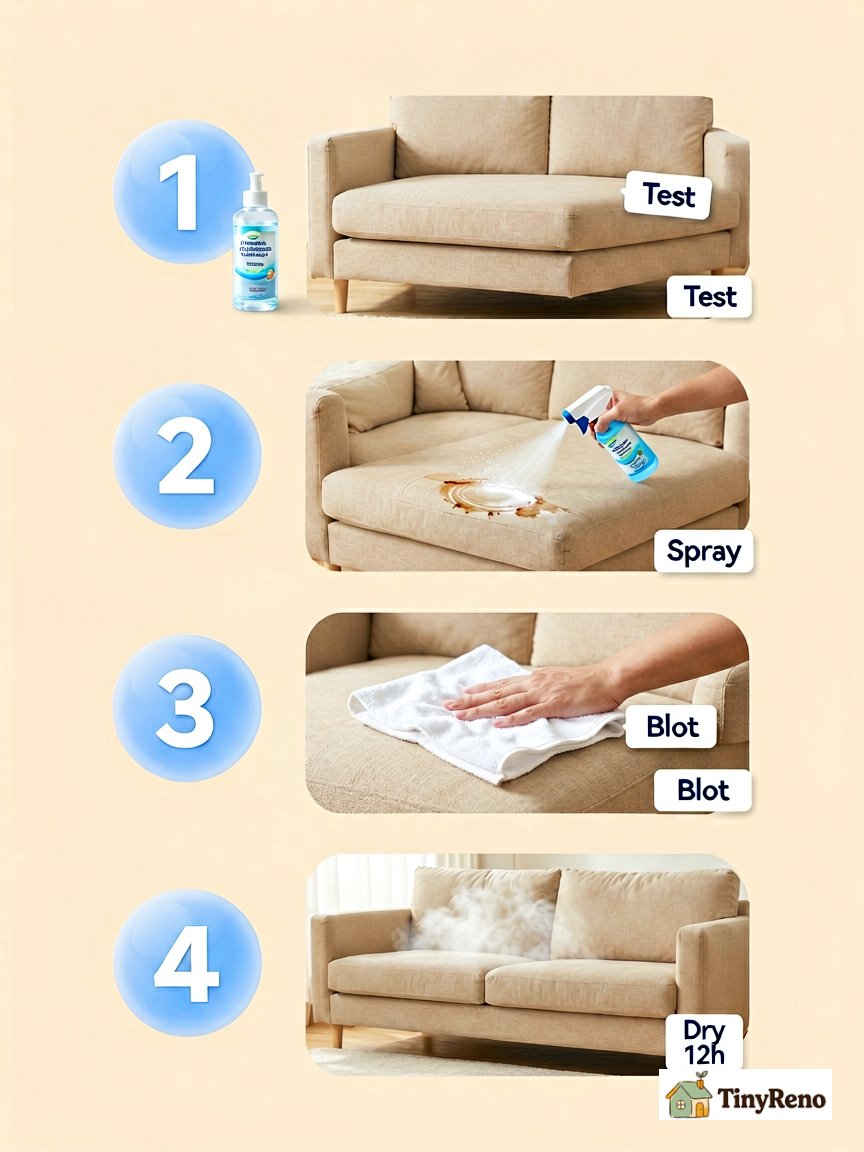
Here is the actual process I used, on both sofas, with the two products that did not ruin anything. The process is the same regardless of whether your sofa is leather or fabric. The product changes. The process does not.
Step one is to test the product on a hidden area first. On Sara's fabric sofa I tested on the back of the sofa, near the floor, where a stain would not be visible. On my leather sofa I tested on the rear panel behind the back cushion. The reason this matters is that you cannot predict how a fabric or a leather finish will react to a sofa cleaner until the cleaner has actually touched the material. The reviewers who reported fading and stickiness almost certainly skipped this step. The label says "test in an inconspicuous area first." This is not a legal disclaimer. It is the most important instruction on the bottle.
Step two is to work from the outside of the stain inward. Most people start spraying in the middle of the stain, which spreads it outward. You want to start at the edge of the stain and work toward the center, in small circles, with the foam or the cloth you are using. This contains the stain instead of expanding it. Step three is to blot, never rub. Rubbing pushes the stain deeper into the fibers or into the leather grain. Blotting lifts it out. You blot with a clean microfiber cloth, you flip the cloth, you blot again, you flip, you blot again, until the cloth comes up clean. Step four is to let it air dry completely before you decide whether you need a second pass. If the stain is still there after twelve hours of drying, you can do another pass. If you try to clean a half-dry stain, you are just pushing dirty water around.
On Sara's wine stain, this process took three passes over two days. The first pass lightened the stain by maybe forty percent. The second pass took it down to ten percent. The third pass made it disappear into the texture of the fabric so that I had to look twice to find where it had been. On my leather sofa's headrest cat-hair stain (which is technically a body-oil stain from four years of contact), one pass was enough. The leather cleaned up faster than the fabric because leather is non-porous and the body oil was sitting on top of the surface, not inside it.
How to get rid of stains on sofa when nothing else has worked
There is one stain type that the store-bought sofa cleaners consistently fail on, and I want to name it so you know when to stop buying products. It is the set-in stain, which means a stain that has been on the sofa for more than thirty days, has been exposed to body heat and body oil, and has bonded with the fabric or the leather at a molecular level. A wine stain from last weekend is fresh. A wine stain from last Christmas is set-in. The difference is whether the stain is on the surface or has migrated into the structure of the material.
For set-in stains on fabric, the only method that works without professional equipment is a mixture of dish soap, white vinegar, and warm water, in equal parts, applied with a microfiber cloth, blotted, and repeated. I tested this on a six-month-old mystery stain on my leather sofa that I assumed was coffee. The dish soap mix lifted about sixty percent of it on the first pass. The remaining forty percent is now a feature of the sofa. I have stopped trying to remove it. For set-in stains on leather, you can try a leather-specific cleaner with a conditioner applied afterward, but the honest expectation is that you will reduce the stain, not remove it. If the stain matters to you, the only method that works is a professional upholstery cleaning service, other renter-friendly furniture choices. For a renter, that math rarely works out. the first-apartment checklist, which is what Sara did three days after the wine incident and what I am now planning to do for my own sofa this weekend. If you cannot figure out how to remove a stain from a sofa yourself and the stain has been there less than a week, this is the only path that does not end with you calling a professional cleaner at the last minute.
What to do before you return the deposit
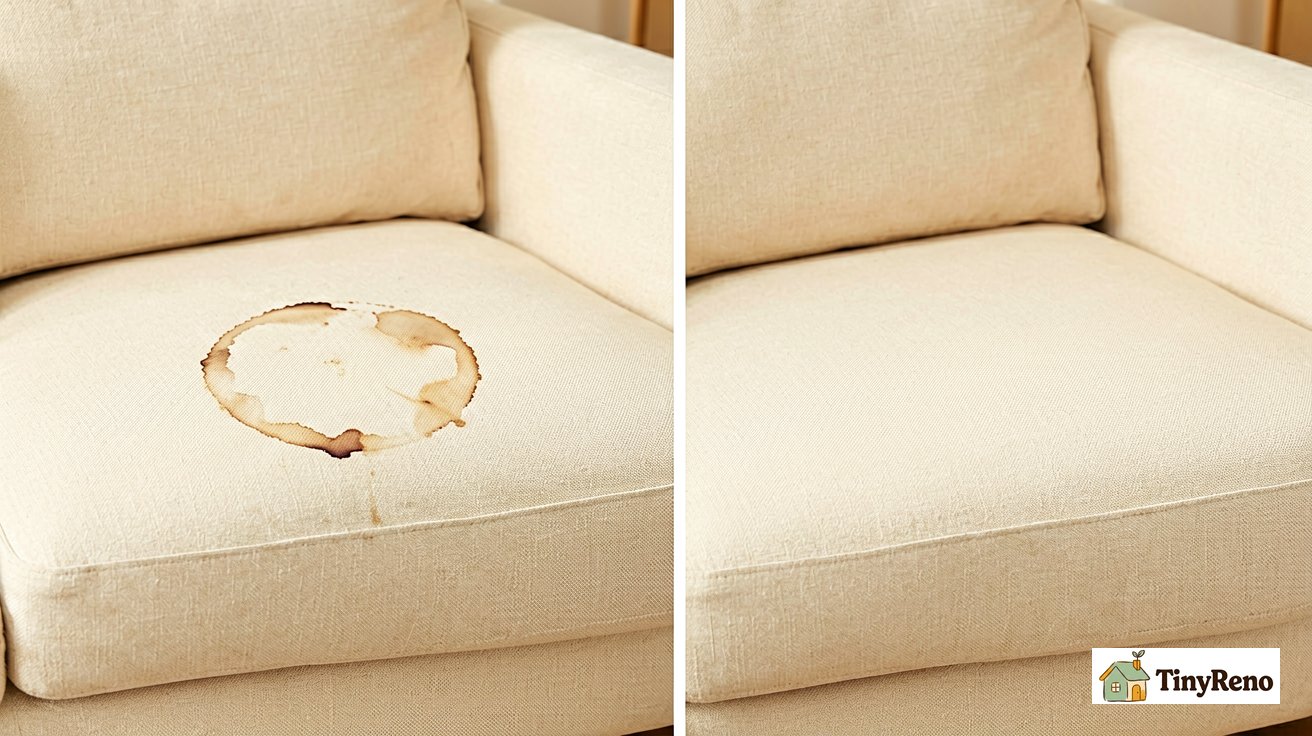
The reason I am writing this article is not because I am passionate about sofa cleaners. It is because I have seen too many renters lose part of their security deposit because the sofa looked "used" on move-out day, even though the damage was a $15 fix if they had known what product to buy six months earlier. If you take one thing away from this article, let it be this. Two weeks before you move out, the renter move-in documentation guide, and clean the sofa with the right product for the material. If you do not know what the right product is, search for "best sofa cleaner for [your sofa material]" and read three reviews before you buy. Do not buy the cheapest option. my wood floor scratch test that specifically mention not damaging the material. And if you cannot figure out how to get rid of stains on sofa after one pass, do not buy a stronger product. Buy a different product. The active ingredient matters, not the strength.
And then take the photos again after you have cleaned. You will need both sets of photos if your landlord tries to claim you damaged the sofa with the cleaner. The before-and-after photos are your only proof that you did not. Without them, you are trusting your landlord to believe the word of a $22 leather cleaner over the word of a stained cushion. With them, you are trusting the photos. Trust the photos.
That is the whole guide. Pick the right product for the material. Test on a hidden spot first. Work from outside in. Blot, do not rub. Let it dry. Take before-and-after photos. Save the receipts. And if your landlord asks for proof that you did not damage the sofa, send them the photos. The $22 you spent on the best sofa cleaner for renters will be the best $22 you ever spent, because it bought you back the $400 of your deposit that would have gone to a sofa replacement you did not cause. The guide is the same whether you are cleaning leather, fabric, microfiber, or suede. The product is the only thing that changes. And the product is the one decision you cannot undo.


Discussion (0)
Sign in to join the discussion