

The 3 drawers cabinet I bought in August 2021 was firewood by October 2025. I do not mean it was loose or wobbly or past its prime. I mean the bottom drawer face fell off in my hands on a Tuesday afternoon while I was looking for a sweatshirt, the side panel had separated from the back panel by about a centimeter, and the top drawer had developed a lean that no longer responded to the adjustment screws. I dragged the carcass to the trash room, came back upstairs, and sat on the bed for about ten minutes. Then I started writing down what had happened in those four years so I would not make the same mistakes twice.
This is that list, in reverse order. The mistake I made last week, the mistake I made in 2024, the mistake I made in 2023, the one I made in 2022, and the first one — the one I made before I even owned the piece, in the 20 minutes I spent choosing it. If you are looking at a 3 drawers cabinet right now and trying to decide whether to buy it, this is the article I wish I had read in 2021.
Mistake 5: I did not fix the leaning top drawer when it was still a $0 fix
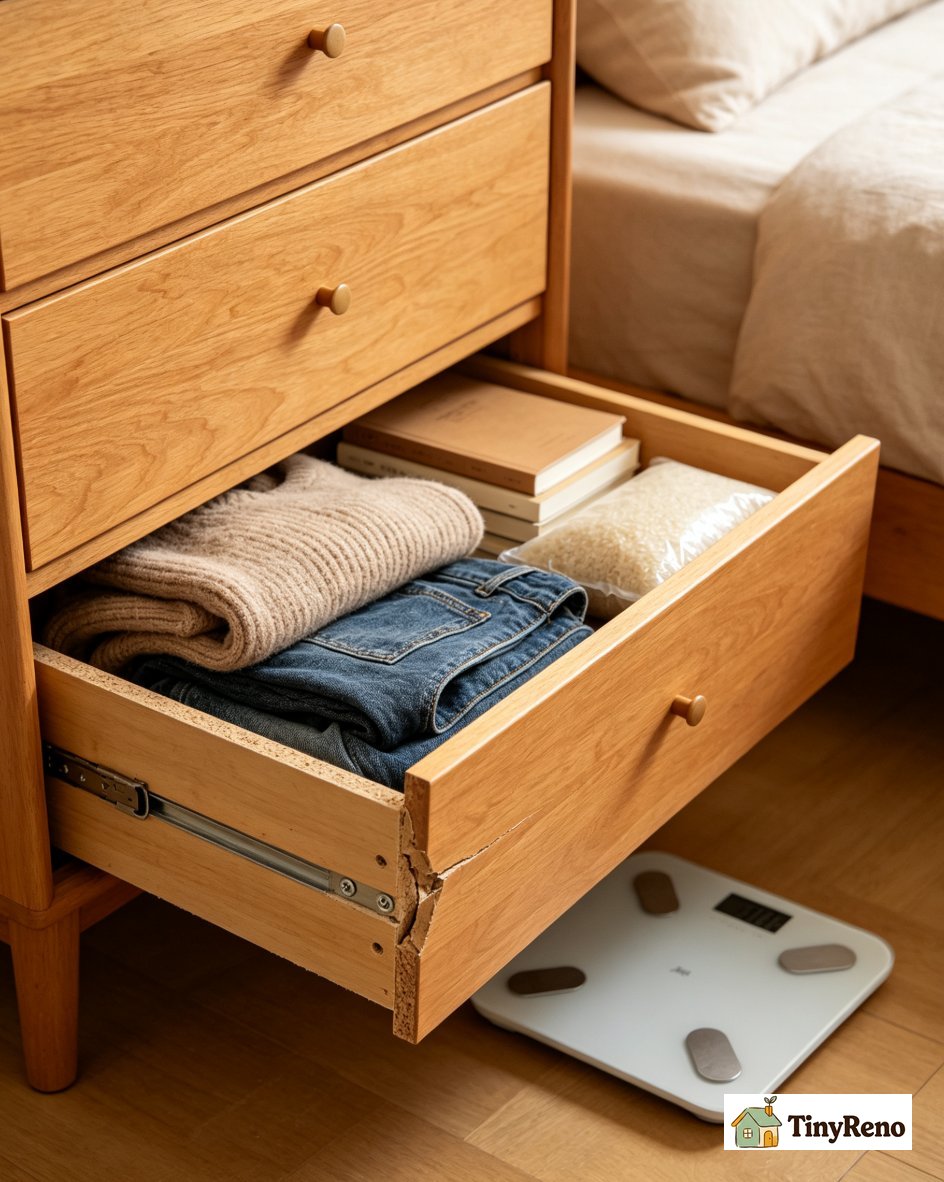
The top drawer of my unit started leaning in February 2024, about two and a half years in. It was a small lean — maybe 3 millimeters — and the drawer still opened and closed, so I left it alone. By August 2024 the lean was 8 millimeters. By January 2025 it was 15. The adjustment screws on the runner were supposed to compensate for this, but they had been screwed all the way in and the lean kept growing. By July 2025 the drawer would no longer stay closed unless I pushed it hard enough that the whole cabinet rocked on the floor.
Here is what I now know. A 3 millimeters lean at month 30 is a $0 fix. You take the drawer out, you unscrew the face, you shift it 3 millimeters on the mounting brackets, you re-screw. It takes 90 seconds. A 15 millimeter lean at month 42 is a $0 fix that has become a $25 fix because you also need to replace the runners, which are now bent out of spec. A 30 millimeter lean at month 50 is a firewood fix, because by then the particleboard drawer box has cracked along the screw line and will not hold a new runner.
If your unit has a drawer that leans, fix it this month. Not next month. Not when you have time. This month. The screws are still good. The drawer box is still good. The runner is still good. The only thing that is wrong is the alignment, and alignment is free.
Mistake 4: I left it 18 inches from the heating vent
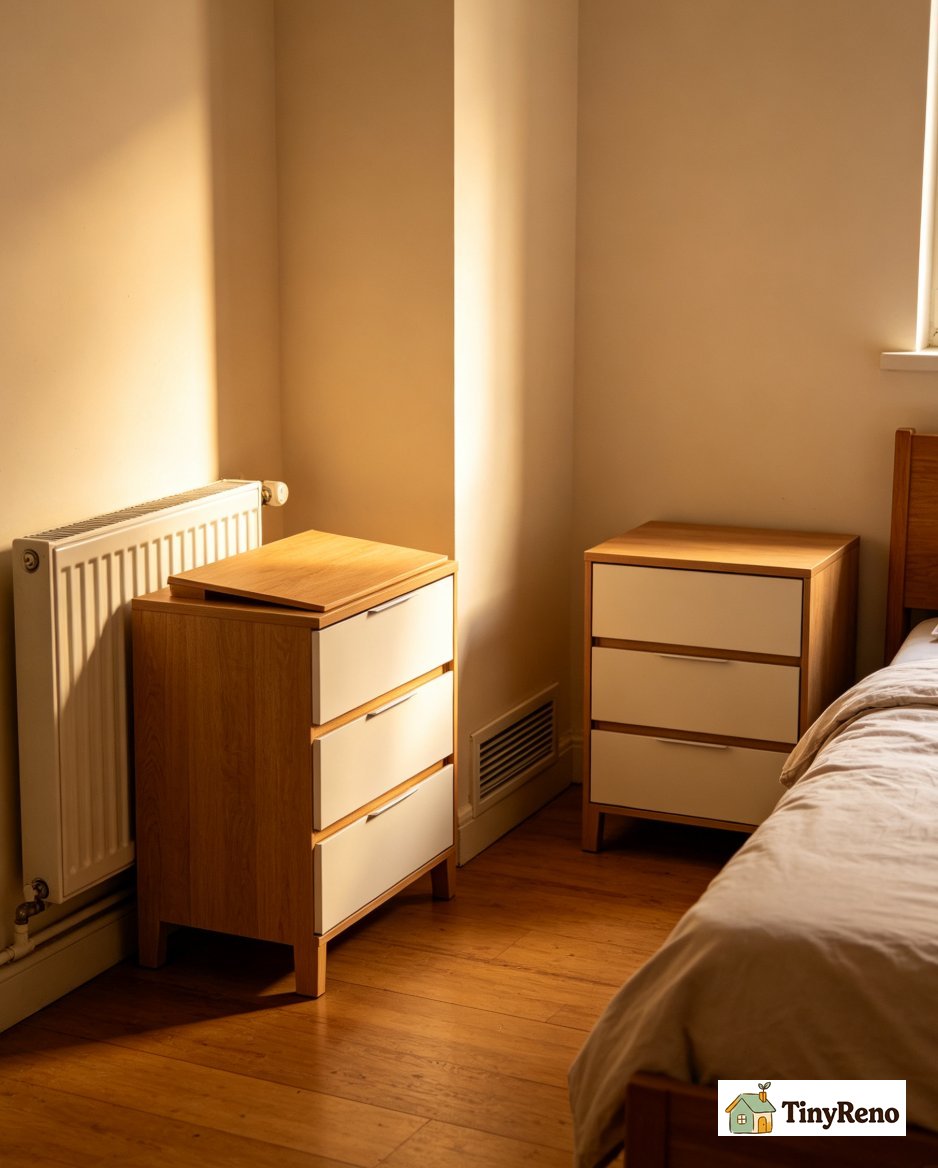
The heating vent in my last bedroom was on the wall behind the bed. The unit lived 18 inches from that vent, on the same wall. The vent ran from November through April. By March 2023 — about 18 months in — the top drawer face had warped enough that it would not close flush against the frame. There was a 2-millimeter gap along the right edge that I could see from across the room if the light hit it right.
This is the mistake I am most embarrassed about, because Margaret told me the four-foot rule in 2021 and I applied it to the bookshelf with cabinets and forgot to apply it to this piece. The bookshelf with cabinets survived. The smaller cabinet did not. The wood moved at the same rate in both pieces of furniture; only one of them was close enough to a heat source for the movement to matter.
The fix would have been $0 and 60 seconds. Move the unit to the other side of the bed, 6 feet away from the vent. The drawer face would have stabilized by the next heating season. Instead, I lived with the gap for two more years and the warp got worse every winter. By October 2025 the drawer face was sticking out so far that I could not close the drawer at all without lifting the corner.
If you have one of these in a bedroom, check where your heating vent is. If it is within 4 feet of the unit, move it. If the cabinet is too heavy to move by yourself, move everything else. The four-foot rule is not a recommendation. It is the only number that works.
Mistake 3: I overloaded the bottom drawer to 35 pounds
The bottom drawer is the one you load with the heaviest stuff. In my case that meant winter sweaters, three pairs of jeans, a stack of books I was pretending I would read, and a 12-pound bag of rice I had decided to store in the bedroom for some reason. The bottom drawer, by my best estimate, was carrying 35 pounds by mid-2023.
The rated capacity for the bottom drawer of a budget unit like this is 25 pounds. I knew this. I had read the manual. I had looked at the rating. And I had put 35 pounds in the drawer because the drawer closed and the cabinet did not tip and the runners did not bend, so I assumed everything was fine. The drawer bottom sagged by about 4 millimeters over the course of a year, which I also ignored, because a 4-millimeter sag is invisible when the drawer is closed.
What I did not notice until the autopsy in October was that the sag had pulled the drawer box away from the front face by enough that the screws holding the face were now carrying weight they were not designed to carry. By month 38 the screws had started to pull through the particleboard. By month 48 the face was held on by two screws instead of four. By month 50 the face was in my hand.
If you have one of these, weigh your bottom drawer once with a bathroom scale. If it is over 25 pounds, take something out. The rated capacity is the rated capacity. The cabinet does not know that you are a renter who has run out of closet space. The drawer bottom is particleboard. The face is particleboard. The screws are into particleboard. Everything is particleboard.
Mistake 2: I never anchored it to the wall
The piece lived in three apartments with me between 2021 and 2025. None of them had a child, a large dog, or a cat. I never anchored it to the wall. The L-bracket that came in the hardware bag went into a kitchen drawer and stayed there until I threw out the cabinet with the bracket still in the kitchen drawer.
I never had a tip-over. The unit never fell on anyone. The unit never fell on anything. So I will never know for sure whether anchoring it would have extended its life. But I will tell you what I do know. In October 2025, when I was dragging the carcass to the trash room, I had to lean the cabinet sideways to get it through the bedroom door, and the entire frame flexed like a piece of wet cardboard. It should not have done that. A properly assembled and never-overloaded cabinet should not flex when you lean it sideways.
What I think happened is that the years of small lean adjustments, the drawer face removals and reinstallations, and the gentle daily use added up — the same maintenance issues I see in my first-apartment furniture list to a piece of furniture that was no longer rigid. An anchored cabinet is held square by the wall. An unanchored cabinet relies entirely on its own joints. My joints were tired by month 50.
If you have one of these and you have not anchored it, anchor it this weekend. It takes two minutes. The bracket is in the bag. The wall anchor for a rental is a Command strip or a picture nail — the same method I broke down in the renter walls guide. You do not need to drill. You do not need to be a handyman. You need to be a person who has two minutes and a wall.
Mistake 1: I bought the $69 cabinet instead of the $89 one
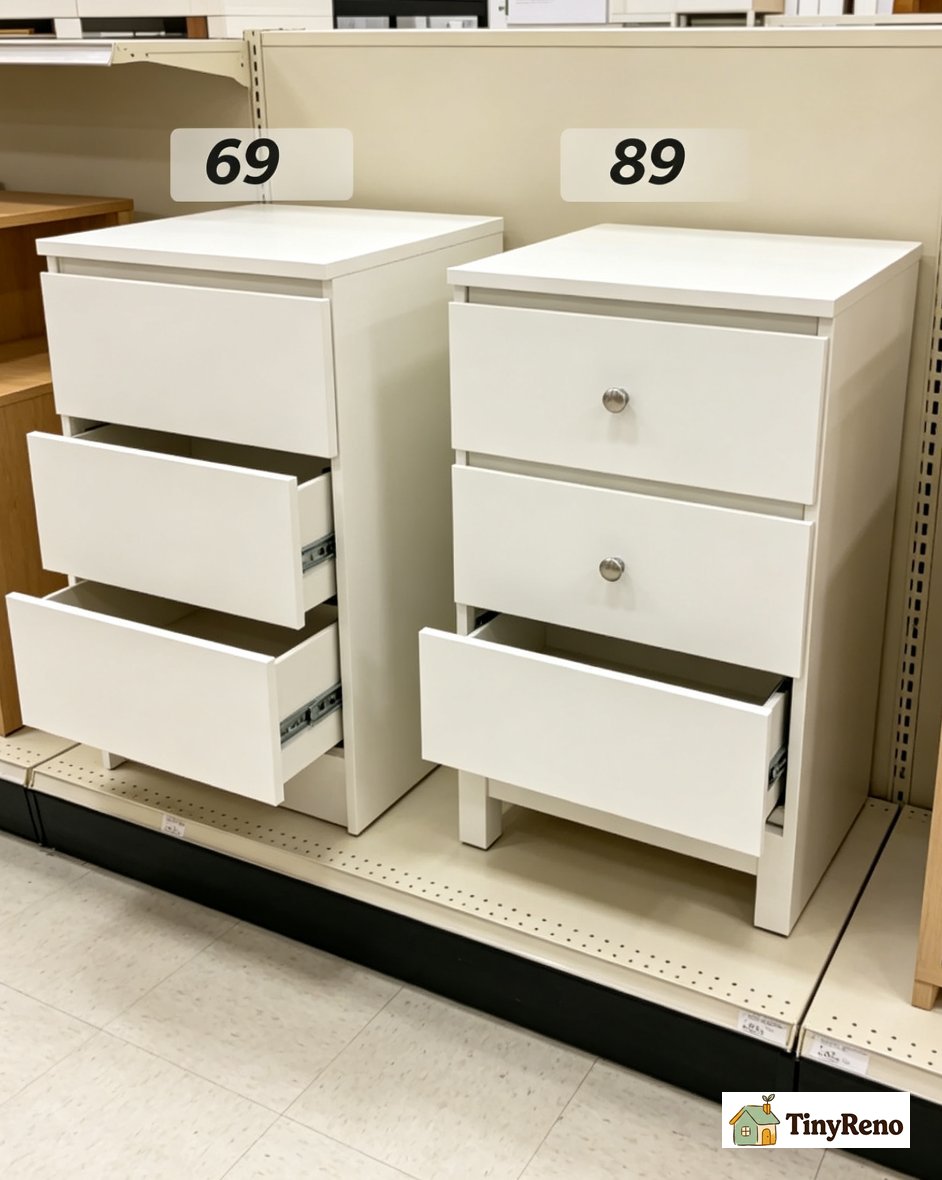
The first mistake happened before I owned the piece, in the 20 minutes I spent choosing between two units at the big box store. The first one was $69, the second one was $89. They looked almost identical. The $69 one had plastic runners. The $89 one had metal runners with ball bearings. I bought the $69 one because I was saving $20 and I did not think the runners mattered. The runners are the only thing that matters.
Every other mistake on this list — the leaning drawer, the warped face, the overloaded bottom, the unanchored frame — was made worse by plastic runners. Plastic runners wear out faster than metal runners. Plastic runners bend under weights that metal runners do not even notice. Plastic runners start to stick at month 12; metal runners start to stick at month 36 or later. I had plastic runners. I had 48 months of plastic-runner consequences.
If you are standing in a store right now looking at a $69 3 drawers cabinet and an $89 one, and you are trying to decide, the answer is the $89 one. The $89 one is not $20 more expensive. The $89 one is $20 more expensive up front and approximately $200 less expensive over the life of the cabinet, because you will not have to replace it in four years. The $89 one will give you six years minimum. The math is not close.
What I will do differently next time
The next one I buy will be the $89 version, or the $129 one if the $89 is sold out. It will be anchored to the wall on day one, with the L-bracket that comes in the box. It will live at least four feet from the heating vent. The bottom drawer will be weighed at the bathroom scale and kept under 25 pounds. The top drawer will be checked for lean every six months with a 30-second visual inspection. If it leans, I will fix it that week.
None of these rules are difficult. None of them are expensive. All of them would have given me two more years with the unit I just threw out, which is roughly $30 a year of cabinet life that I lost by being careless. The 3 drawers cabinet is a tool, not a friend. Tools work better when you take care of them, and they fail faster when you do not.


Discussion (0)
Sign in to join the discussion