

"Hand me that allen wrench, the small one, not the medium." Margaret was on her knees in the hallway, halfway inside the bookshelf with cabinets we had bought three hours earlier. I was holding two allen wrenches. The medium one and the small one. I handed her the medium.
"Wrong one," she said, without looking up.
"You said not the medium."
"I said not the small one. The medium one is the medium. The small one is the bookmark shelf bracket. Different thing."
Margaret has built this exact piece three times in the eight years I have known her. First in her old studio. Then in the one-bedroom she shared with her partner. Now in the hallway of the building she manages, which is where it lives because it has nowhere else to go. Every time she builds it, she learns something she forgot from the last time. This is a Saturday conversation about what she has learned and what I learned from watching her. It is not a step-by-step assembly guide. Margaret does not trust step-by-step assembly guides. She does not trust IKEA's own assembly guide, which is why she has done it three times instead of asking for help.
"You can't lift it alone. Don't try."
The first lesson came before we opened the box. Margaret had measured the hallway three times and told me the new shelf would fit. I had measured once and told her it would not. She was right. But the part neither of us had measured was the stairwell turn on the third floor. Fully assembled, this piece is 79 inches tall and 31 inches wide. The stairwell turn at the third floor is 36 inches wide on the outside corner and 28 inches on the inside. The arithmetic did not work.
"We are not lifting this up the stairs," Margaret said. "We are building it in the hallway. The pieces come up. The unit comes up already built. Two different problems."
This was lesson one. If you rent an apartment with a tight stairwell, a furniture order that arrives flat-packed is not the same problem as a furniture order that arrives assembled. The flat-pack saves you $80 in delivery fees and costs you four hours of assembly in the hallway. Margaret has decided, after three builds, that the four hours is worth the $80. I would have decided the same way by the second build.
If you are buying a piece like this for a walk-up, ask the seller if the assembled dimensions will clear your stairwell turn. Most people forget this until the new shelf is on the second floor landing and they are swearing. Margaret does not forget anymore. She has a piece of masking tape on her front door frame that says "36/28" because she measures every new piece of furniture against it before she orders.
"The instructions are wrong on step 14. Skip it."
IKEA's assembly guide for the BILLY / OXBERG combination has 24 steps. Step 14 says to attach the cabinet door hinges to the cabinet frame before mounting the frame to the unit. Margaret has built this combination three times. The first time, she followed step 14 in order. The door hinges did not line up.
"Step 14 is aspirational," she said, on her back under the unit, reaching up to the hinge mount with the small allen wrench. "The cabinet door will not hang right if you do it before the bookshelf is upright. IKEA assumes you are building it on the floor and lifting it. We are building it standing up because the hallway is too short to lay it flat. So we skip step 14, mount the unit first, then come back and do the door hinge. Step 14 becomes step 19. The book does not know this. We do."
This is lesson two. The assembly guide in the box is written for the average buyer who has a workshop and an empty afternoon. The average renter has neither. Read the guide before you start, identify the three or four steps that depend on having the piece lying flat, and plan to do those first or last depending on your space. Do not follow the steps in order if your space is wrong. Margaret has the order of operations for this exact combination memorized. I learned more from watching her skip step 14 than I have ever learned from following an instruction manual.
"The wall anchors are not optional."
The third lesson was about the L-bracket that comes in the hardware bag. It is a small piece of metal, bent at a right angle, with one screw for the furniture and one screw for the wall. Margaret pulled it out of the hardware bag, looked at it, and handed it to me.
"This is the most important piece in the box," she said. "If you do not put this in, the unit will tip the first time a kid climbs the lower shelf. If it tips, it falls. If it falls, it takes the cabinet doors with it. If the cabinet doors come off the hinges, the whole thing is firewood."
"I am not going to have kids climb it," I said.
"You are going to have a cat. Or a friend with a kid. Or a cleaning person who leans on the wrong shelf. Anchor it. It takes two minutes. The two minutes are not optional."
She was right, of course. In a rental, the wall anchor is a small picture-hanging nail or a 3M Command strip — the same technique I broke down in the renter walls guide rated for the weight of the loaded unit. Fully loaded with books, the piece weighs about 110 pounds. A child climbing the lower shelf applies roughly 40 pounds of lateral force at the top. Without the anchor, the lever arm is enough to tip the whole thing. With the anchor, it does not move. Margaret has anchored every bookshelf with cabinets she has ever owned. She has never had one tip. The two minutes is the entire difference between a renter who keeps their deposit and a renter who does not.
"The cabinet doors will warp if your apartment is humid."
I asked Margaret, about two hours into the build, whether she had ever had problems with the cabinet doors after assembly. She put down the allen wrench and made a face I had not seen before.
"One time," she said. "In the first studio. I had it against the radiator wall. The radiator ran all winter. By February, the cabinet doors would not close. The wood had absorbed the humidity and expanded by maybe 2 millimeters on each side. Not enough to see with a measuring tape. Enough to feel when you tried to close them."
"What did you do?"
"Moved it three feet away from the radiator. The doors dried out over the summer. By August they closed again. Now I never put a piece like this within four feet of a heat source."
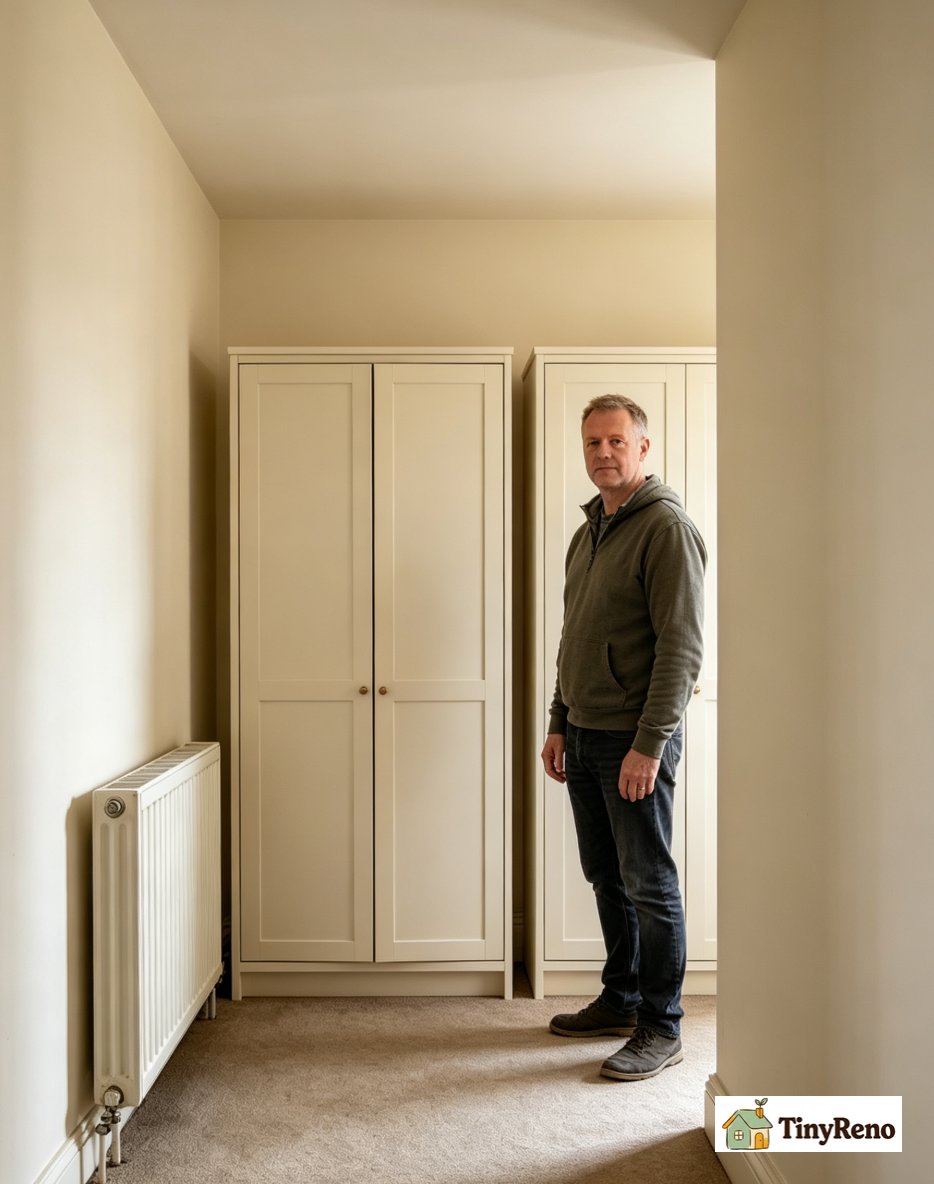
This is lesson four. Wood moves. The cabinet doors are made of MDF with a paper veneer or of particleboard with a wood-look wrap. Both materials absorb humidity. In an apartment with a radiator, a heating vent, a baseboard heater, or even a sunny south-facing window, the cabinet doors will expand and contract with the seasons. This is not a defect. This is wood. Margaret's rule is four feet from any heat source. She has not had a cabinet door warp in seven years.
"The lower shelf has to be 4 inches off the floor or you will lose things."
The fifth lesson was the one I had not thought about before this Saturday. Margaret was measuring the height of the lowest shelf before she slid the cabinet into place. She measured, marked the bracket height with a pencil, and showed me the measurement.
"Four inches," she said. "If you set the lowest shelf at 2 inches, you will lose TV remotes, the dog leash, the small screwdriver, and every sock the dryer eats. If you set it at 6 inches, the empty space looks wrong and the cabinet doors hang unevenly because the visual weight is off. Four inches is the number. The shelf sits at 4 inches. The cabinet sits at 4 inches. Everything that is supposed to be visible is visible. Everything that is supposed to be hidden is hidden."
I thought this was Margaret being particular. By the end of the day, when we had slid the cabinet into place and were loading the lower shelf with the things that had been living on the hallway floor for a week, I understood. The 4-inch gap was exactly the right height for the rolled-up dog leash to lean against the wall without being visible from the living room. The 4-inch gap was exactly the right height for the small flat-head screwdriver to slide under the cabinet where it could be felt but not seen. Margaret had measured this in three apartments over eight years and 4 inches was the number. Lesson five.
What I took home from Margaret's hallway

We finished the build at 4:40 p.m. The bookshelf with cabinets now lives in Margaret's hallway because she manages the building and the hallway needed one more piece of furniture to make the front entrance feel like a home and not a lobby. I helped because Margaret is my neighbor and she had bought it for me to borrow next weekend when I do the same thing in my apartment.
I am going to do it next weekend. I am going to do it in a different hallway, on a different floor, in a different apartment. I am going to follow Margaret's five lessons — the same way I approached the first apartment move, which I wrote up in the first-apartment checklist. I am going to measure my stairwell turn before I order. I am going to skip step 14 and mount the cabinet door hinges after the unit is upright. I am going to anchor it to the wall even though I do not have a kid, because Margaret is right about cats and leaning friends. I am going to put the piece four feet from the radiator. I am going to set the lower shelf at 4 inches off the floor, not 2 and not 6.
And I am going to text Margaret a photo when it is done. She asked for that. She said it is the only way she knows the lessons are sticking.


Discussion (0)
Sign in to join the discussion