

I lost $48 the month I tried to live without stackable wire baskets. The bag of rice I had balanced on a top shelf came down on a Sunday night, the box of pasta next to it followed, and I spent the next 20 minutes on my hands and knees with a dustpan in a kitchen that had no business being that loud at 11:40 p.m. The next morning I drove to the hardware store and bought two stackable wire baskets, set them on the counter, and the rest of that pantry reorganized itself around them in a week.
The two weekends that taught me what to look for
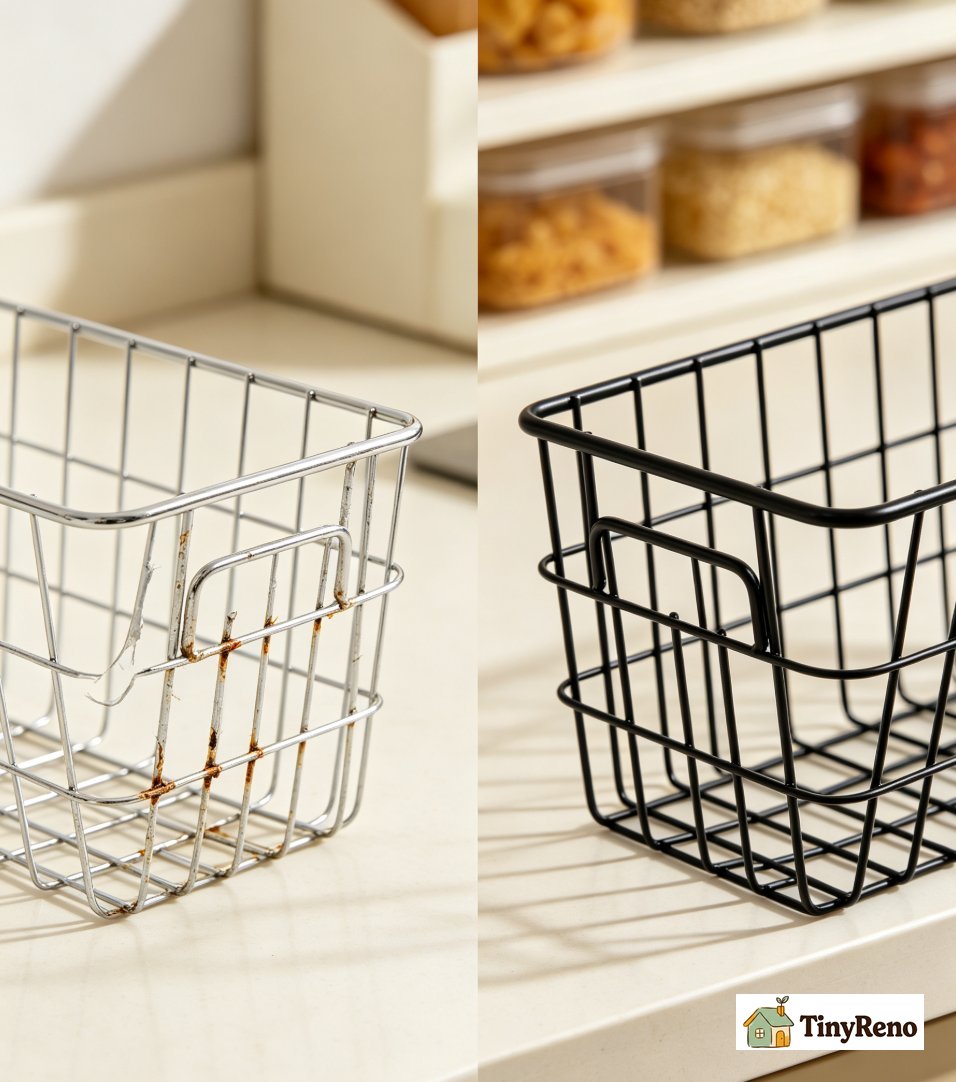
The first set I bought was the cheap chrome-plated set from the discount aisle. Twelve dollars for four baskets. They looked great for the first month, then the bottom basket started to bow under the weight of the flour, and by month three the chrome was flaking into the open pasta bag. I took them back and bought a different set. Same problem, different color.
The second set I bought was twice as expensive, powder-coated black, and the wire was visibly thicker. That set lasted four years across two apartments before the weld points started to rust. By then I had learned the three things that actually matter when you are buying these in a hardware store with no time and no patience for fine print: wire gauge, coating, and what "stackable" really means.
Stackable wire baskets are not all the same. The word gets used loosely. A truly stackable basket has four feet or a flat top rim that lets another basket sit on it without crushing what is inside. The ones I have owned that say "stackable" on the label but do not stack usually have a curved top edge — fine for one layer, useless the moment you try to pile them. If you can fit your hand flat between two stacked baskets and the top one sits level, you have a real stackable. If the top one rocks, you do not.
The three things I check now before buying any set
Wire gauge matters more than brand. Most cheap baskets are 3 mm wire, which bows under the weight of a full bag of flour the first month. I look for 4 mm or thicker — you can usually tell by feel. Press your thumb into the wire and try to bend it. If it flexes easily, skip it. If it barely moves, you have found a set that will survive a move and three years of pantry rotation.
Coating matters more in rentals. Chrome-plated looks nice for six months and then starts flaking into your pasta. Powder-coated or stainless holds up to kitchen humidity and the occasional splash. In rentals with no vent hood, that matters more than the price difference. I learned this in a 2019 apartment with a broken exhaust fan — three sets of chrome baskets rusted through in eighteen months.
Weld points are the slow death. Every wire basket eventually fails at the joints. The danger zones are kitchens with no vent hood, bathrooms without fans, and any space near a dishwasher. I check weld points with my fingernail once a month. The day I feel a small orange dot, I know the basket has maybe three months left before it stains whatever it sits on. That is when I start shopping for its replacement.
Where I have actually used them (and what worked)
I have used stackable wire baskets in four rentals since 2019, in kitchens with no pantry, in a closet I converted into one, and in a hallway alcove that was supposed to be a coat rack. They are cheap metal grids that happen to solve the renter problem of "I have food and nowhere to put it." Three layouts have held up across multiple apartments.
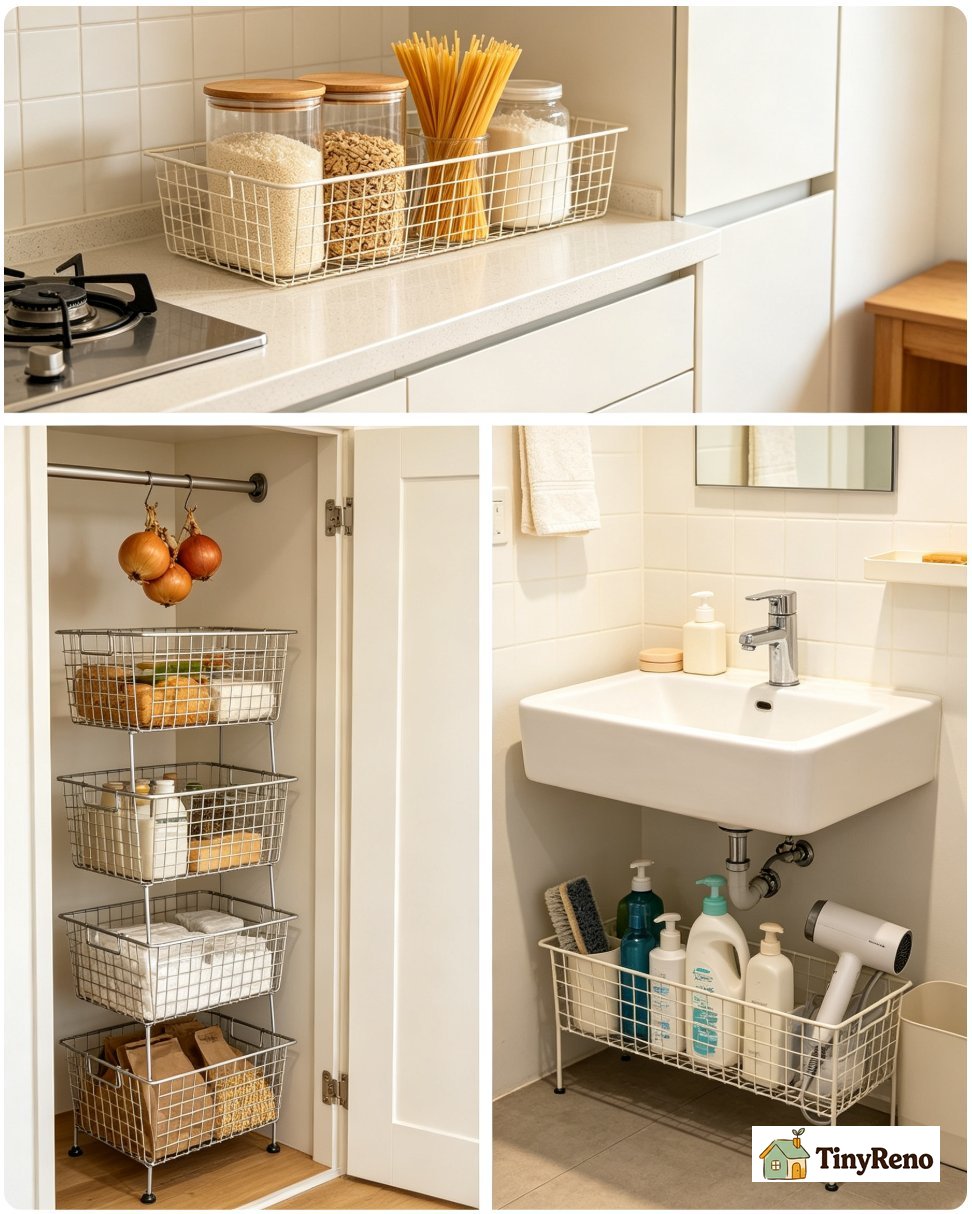
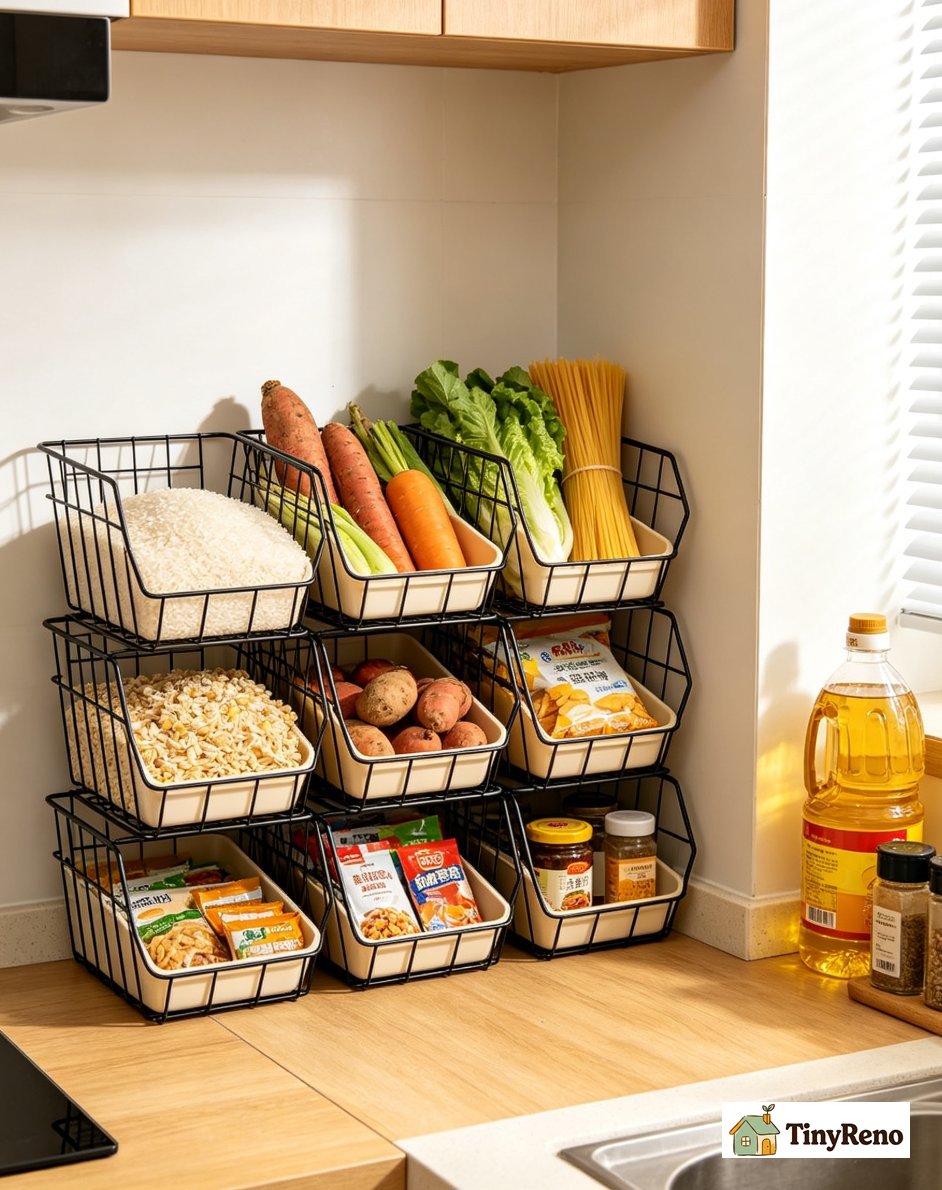
The two-tier counter pantry is what most people picture. Two shallow open-front baskets, the most-used dry goods in the front basket (rice, pasta, oats), the less-used in the back basket (extra flour, the bulk bag). I kept this layout for two years in a studio with four square feet of counter space. It worked because the baskets are 12 inches wide and the counter was 18 — they left room to chop.
The closet pantry is the move that surprised me. I converted a hallway closet for $32 — two tall baskets on the floor, one shallow on top of each, a tension rod for hanging onions. Wire lets air circulate, which matters more than people think for root vegetables and anything you forgot was back there. This is roughly the same trick I used in a 180-square-foot studio covered in the 350-square-foot guide I wrote for renters with no storage.
Under the bathroom sink is the one nobody talks about. Tall narrow baskets on their sides fit the 6-inch height under most counters. Cleaning supplies, backup toiletries, the hair dryer that does not fit in the medicine cabinet. My mother-in-law taught me this trick, and I cannot believe I went 30 years without it. It is the same logic as the kitchen pantry — see what you have, get it off the floor, stop buying duplicates.
The four ways stackable wire baskets actually fail
I have watched all four of these fail in person or in friends' apartments. Knowing them upfront saves a trip back to the store.
The thin-wire bow. Three months in, the bottom basket of a stack starts to lean under the weight of the top one plus its own contents. You see it first as a slight tilt. By month five, canned goods roll toward one corner. The fix is to redistribute weight — heavy stuff on the bottom, light on top, opposite of what most people do instinctively — or to upgrade to thicker gauge. I learned this one with a $14 basket set from a big box store in 2020. The thinner the wire, the faster this happens.
The chrome flake. Chrome-plated baskets in humid kitchens start shedding silver flecks into anything acidic — tomato sauce, lemon juice, vinegar-based cleaners. The flakes are not dangerous but they are unsettling. Switch to powder-coated or stainless. The price jump is usually $3 to $5 per basket and you stop finding metal in your food.
The "stackable" lie. You bought a set, you got them home, and the top basket sits crooked. The label said stackable. The reality is the curved top rim only stacks on itself if the baskets are perfectly identical and the floor is perfectly level. In older apartments, the floor is not. Return and try another set with a flat rim. This is the failure mode I see most often in friends' apartments and the easiest to avoid if you actually test the stack in the store.
The rust at the weld points. This is the slow death. It starts as a small orange dot where two wires meet. Six months later, that dot is a hole. The only fix is to replace the basket before it stains whatever it sits on. If you have read this far, you know my rule: check weld points with your fingernail once a month, and the day you feel a rough spot, start shopping.
What I would actually buy again tomorrow
Right now I have four of these in rotation. Two shallow open-front under the kitchen counter on a pull-out shelf — rice and pasta in one, snacks in the other. One deep open-front in the closet pantry, holding root vegetables and the bulk rice bag. One tall narrow basket next to the fridge for bottles and oils. Total cost: around $45. The kitchen ones are about eight months old. The pantry one is two years old. None of them have bowed. None of them have rusted. The chrome-flake problem took out my first two sets after five months.
If I were starting over today, I would buy four shallow open-front baskets in 4 mm powder-coated wire, two deep open-front for the closet pantry, and skip the chrome-plated sets entirely. The total would be about $60. The storage capacity would be roughly 40 percent more than what I have now, because I would stop wasting the back row of every shelf guessing what is back there. If you are outfitting a kitchen from zero, my first-apartment checklist covers the 14 things worth buying in the first week — baskets are item 9.
That is the whole case. Cheap metal grids, three rules to follow when buying, three layouts that work in a rental, four ways they fail so you can plan around them. Skip the chrome, check the welds, and stop balancing rice on top shelves at midnight.


Discussion (0)
Sign in to join the discussion