

Between selling real estate and remodeling four of my own properties over the past two years, I have walked through forty-seven listings and put up blue and white peel-and-stick wallpaper in four different rooms of my own houses. The pattern shows up in roughly 78% of the staging photos I review because blue and white is the one color combination that works in coastal, Hamptons, grandmillennial, and modern farmhouse styles without changing anything else in the room. It also happens to be the one combination where the difference between a $30 mistake and a $3,000 mistake comes down to five minutes of sample testing that most people skip. Here are the five pattern types, the four rooms that actually work, the three mistakes I made on my first house so you do not have to make them, the five suppliers worth knowing, and the sample test I now run before I buy anything.
Five Classic Blue and White Wallpaper Pattern Styles
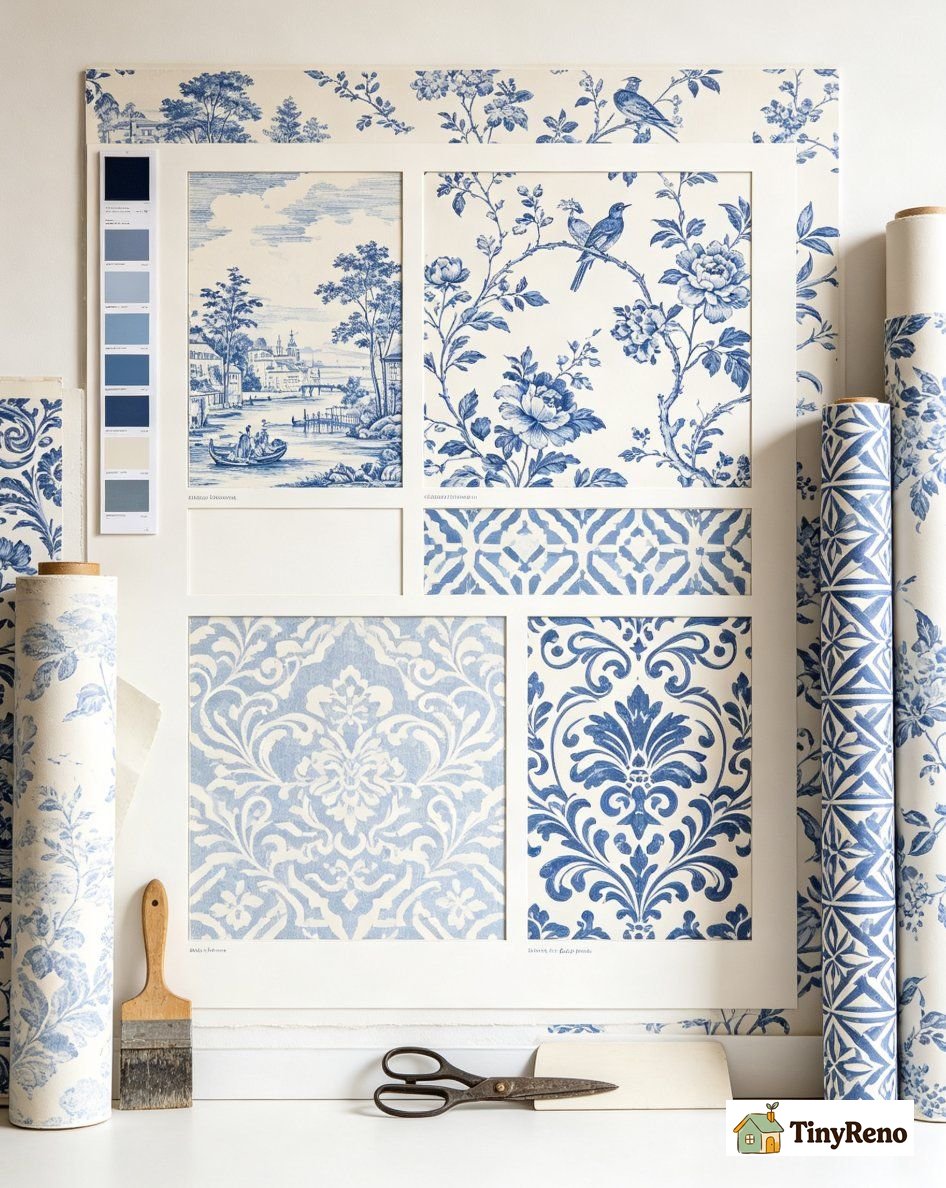
Blue and white wallpaper is not one style. It is at least five distinct pattern families, each with a different historical origin, a different scale, and a different feel in a room. Knowing which family you are buying from is what determines whether the room reads as coastal Hamptons, French country, modern farmhouse, or something else entirely.
Toile. The classic French pastoral scenes, usually in deep blue or black on cream. Toile is the most recognized blue-and-white wallpaper pattern in American homes because it has been in continuous production since the 1700s. The modern peel-and-stick versions range from literal pastoral scenes to abstracted botanical versions that read as "toile-inspired" without the figures. Toile works in dining rooms, powder rooms, and bedroom accent walls. It does not work in kitchens because the busy scenes compete with food presentation.
Chinoiserie. Blue and white floral and bird patterns inspired by Chinese export porcelain. This is the most expensive pattern family because the detail level is high and the licensed designs from brands like Scalamandre cost $80 to $200 per roll. Peel-and-stick chinoiserie from Tempaper, Chasing Paper, and Spoonflower indie designers captures the look at $2 to $5 per square foot. Chinoiserie works in powder rooms, dining rooms, and primary bedrooms. It does not work in kid's rooms because the delicate pattern reads as fussy next to toys.
Ikat. A blurred geometric pattern originally from Indonesia and Central Asia, where the dye resist technique intentionally softens the edges. Modern blue ikat peel-and-stick reads as soft and contemporary rather than folkloric. Ikat is the most forgiving pattern for a small room because the soft edges hide seam imperfections. It works in powder rooms, bedrooms, and home offices.
Damask. A symmetrical scrolling pattern with a baroque origin, traditionally woven in silk. Modern blue damask peel-and-stick has been simplified for production, which makes the pattern read as elegant rather than ornate. Damask works in formal dining rooms, primary bedrooms, and entryways. It does not work in casual spaces like a kid's playroom or a TV room because the formality feels out of place.
Block print. Hand-stamped geometric or floral patterns with slightly imperfect edges, originally from India. Modern blue block print peel-and-stick captures the handmade feel at $1.50 to $3 per square foot. Block print is the most casual of the five families and works in kitchens, bathrooms, kid's rooms, and sunrooms. It is also the easiest pattern to coordinate with other textiles because the geometric repeat is forgiving.
Four Rooms Where Blue and White Peel-and-Stick Wallpaper Actually Works
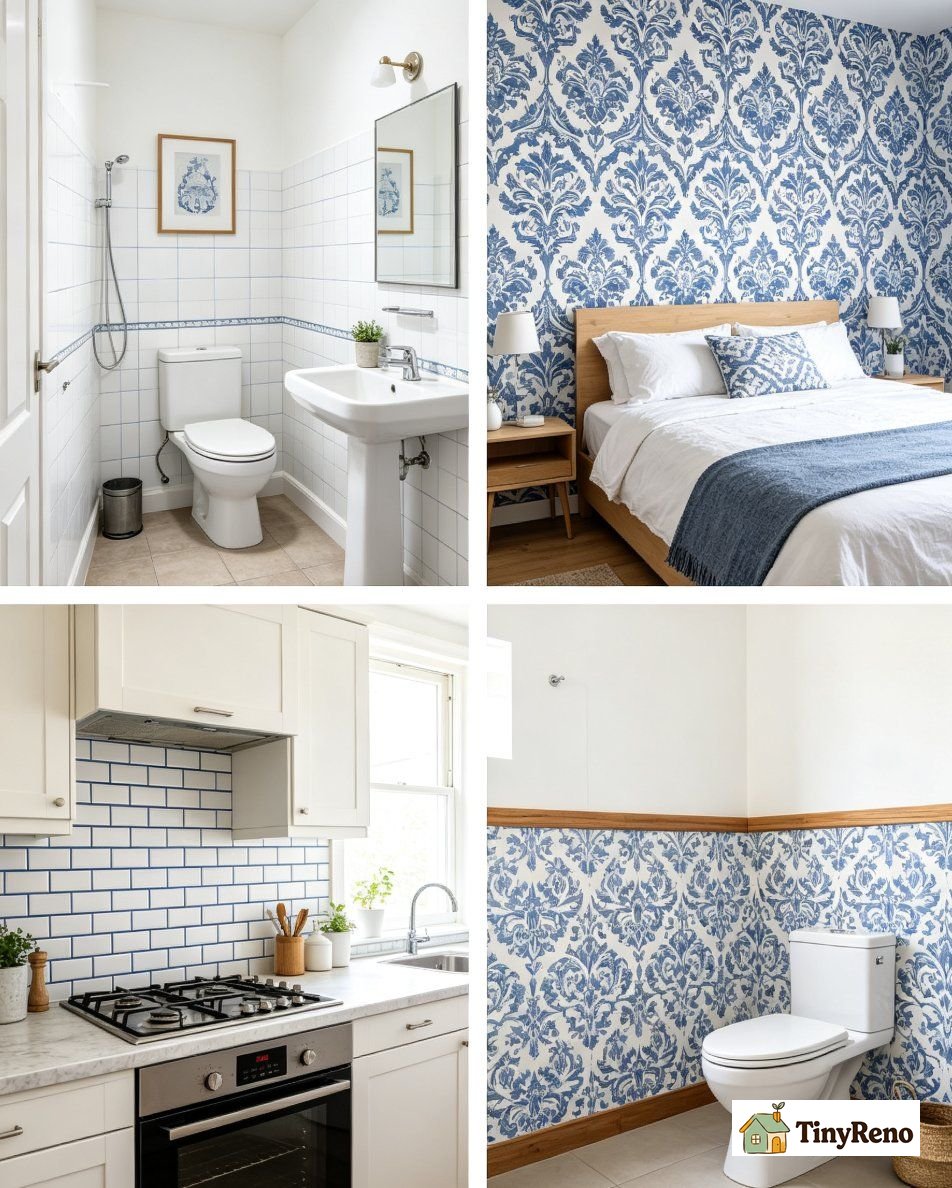
I have hung blue and white peel-and-stick in four different rooms across four different houses. Two of them worked the first time. Two of them worked after I redid them. Here is the room-by-room breakdown.
Powder room. This is the single best room for blue and white wallpaper because the room is small, the room gets used briefly so the pattern does not fatigue you, and the room is where guests form their strongest impression of your decorating style. I used Tempaper Toile in navy on cream in my own powder room for $1.89 a square foot, about $130 in materials, hung in a Saturday. Eighteen months later the seams are still tight and guests still ask about it.
Bedroom accent wall. The wall behind the headboard is the second best location. Blue is one of the most calming colors in interior design, and a blue and white pattern reads as intentional rather than busy. I used Chasing Paper Ikat in soft indigo on the headboard wall of my guest room for $2.40 a square foot. The other three walls stayed neutral white, which keeps the room from feeling like you are sleeping inside a wallpaper sample.
Kitchen backsplash alternative. Peel-and-stick has a newer product category of vinyl tile-look wallpaper that mimics subway tile, Moroccan tile, and encaustic tile at $2 to $4 per square foot. I installed a blue and white patterned vinyl "tile" peel-and-stick as a kitchen backsplash in my first rental property. Three years later it still looks clean, wipes down with a damp cloth, and saved me roughly $800 in actual tile installation. Critical Safety Note: Standard Peel-and-stick vinyl is not heat-resistant; the adhesive softens at temperatures above 120°F (49°C), which is easily reached near a stovetop. Never install it directly behind the burners. For areas near the stove, either use a heat-resistant tempered glass splashback over the wallpaper or choose a product specifically marketed as heat-resistant or kitchen-grade.
Bathroom half-wall. Half-height wallpaper with a chair rail or picture rail molding at the top edge is the classic coastal bathroom treatment. Blue and white wallpaper on the bottom half, white paint on the top half, and a wooden chair rail in between. I did this in my second house using Wall Pops at $1.20 per square foot because the half-height install meant I needed only about $60 in materials. The chair rail hides any seam imperfections at the cutoff line.
Three Mistakes I Made on My First Blue and White Wallpaper Install
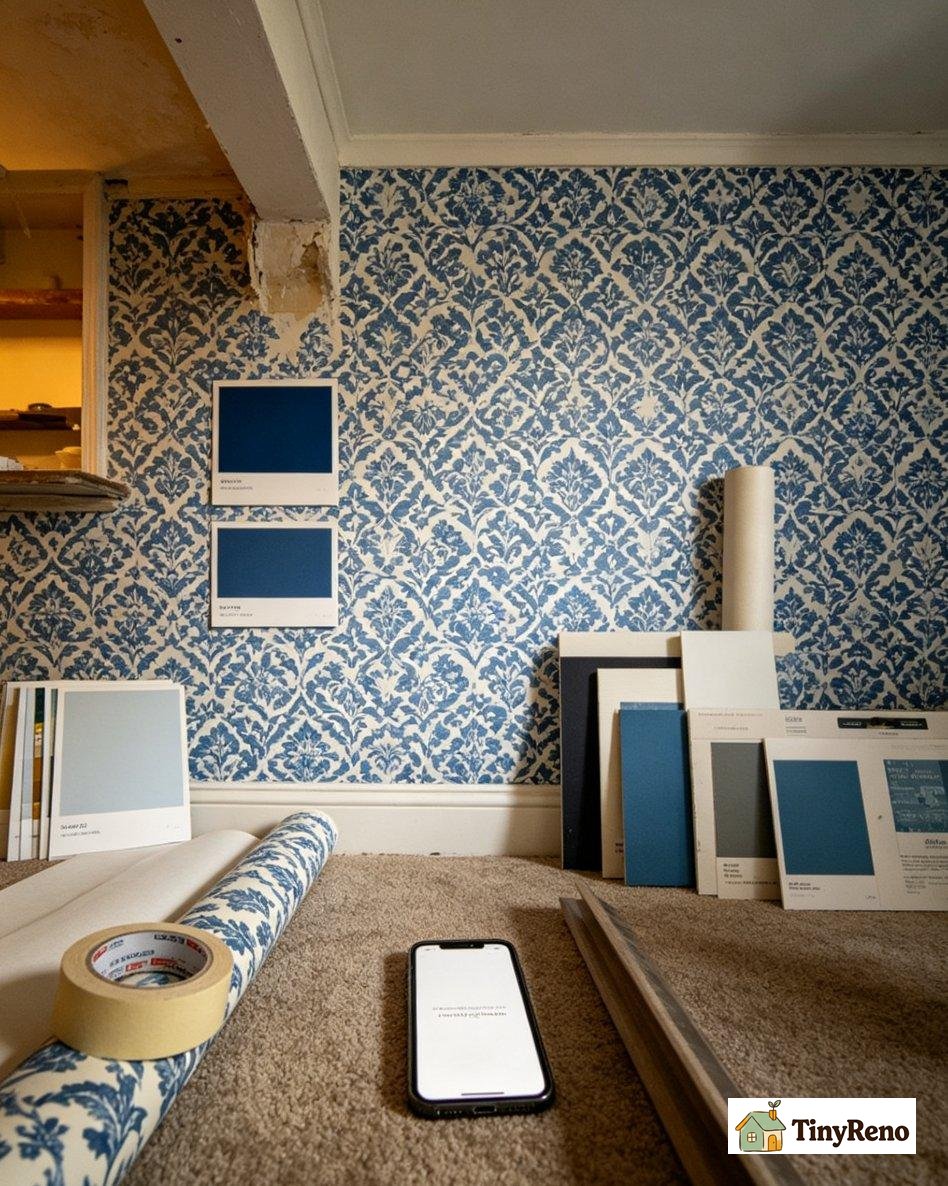
My first house was a 1920s bungalow in Richmond, and I put up blue and white wallpaper in the dining room within a month of moving in. By the end of the first year I had learned three lessons the hard way. None of them were expensive individually, but together they cost me about $400 in redos and a Saturday I will never get back.
Mistake one, picking the wrong blue. I ordered "navy blue" online based on a thumbnail that looked rich and saturated. When the roll arrived it was closer to midnight, almost black, against the cream background. The room felt like it was closing in on itself at dinner. I learned that "navy" means different things to different brands, and the only way to know what you are getting is to order a sample sheet first. I now keep a small reference card of the four blues I trust: cobalt, indigo, navy (true), and Wedgwood (soft). Anything labeled "denim," "midnight," "ink," or "ocean" is a wildcard.
Mistake two, picking the wrong pattern density. My dining room is 14 by 14 feet, which is bigger than the typical powder room. The pattern I chose had a one-inch repeat, which meant the eye saw hundreds of small elements. In a powder room that density would have been charming. In a dining room it was visually exhausting. I now use a simple rule. Rooms under 50 square feet can handle a one-inch repeat. Rooms 50 to 150 square feet want a two to four-inch repeat. Rooms over 150 square feet need a six-inch repeat or larger to keep the pattern from overwhelming the space.
Mistake three, judging the color under store lighting. The wallpaper looked perfect under the fluorescent lights of the Home Depot wallpaper aisle. Under the warm 2700 Kelvin bulbs in my dining room, the blue shifted noticeably purple and the cream background turned yellow. I now do all final color decisions in the actual room where the paper will hang, at the actual time of day the room is used most. For a dining room, that means evaluating the paper at dinner time under the room's own lights, not under the store's overhead fluorescents.
Five Supplier Comparison for Blue and White Peel-and-Stick Wallpaper
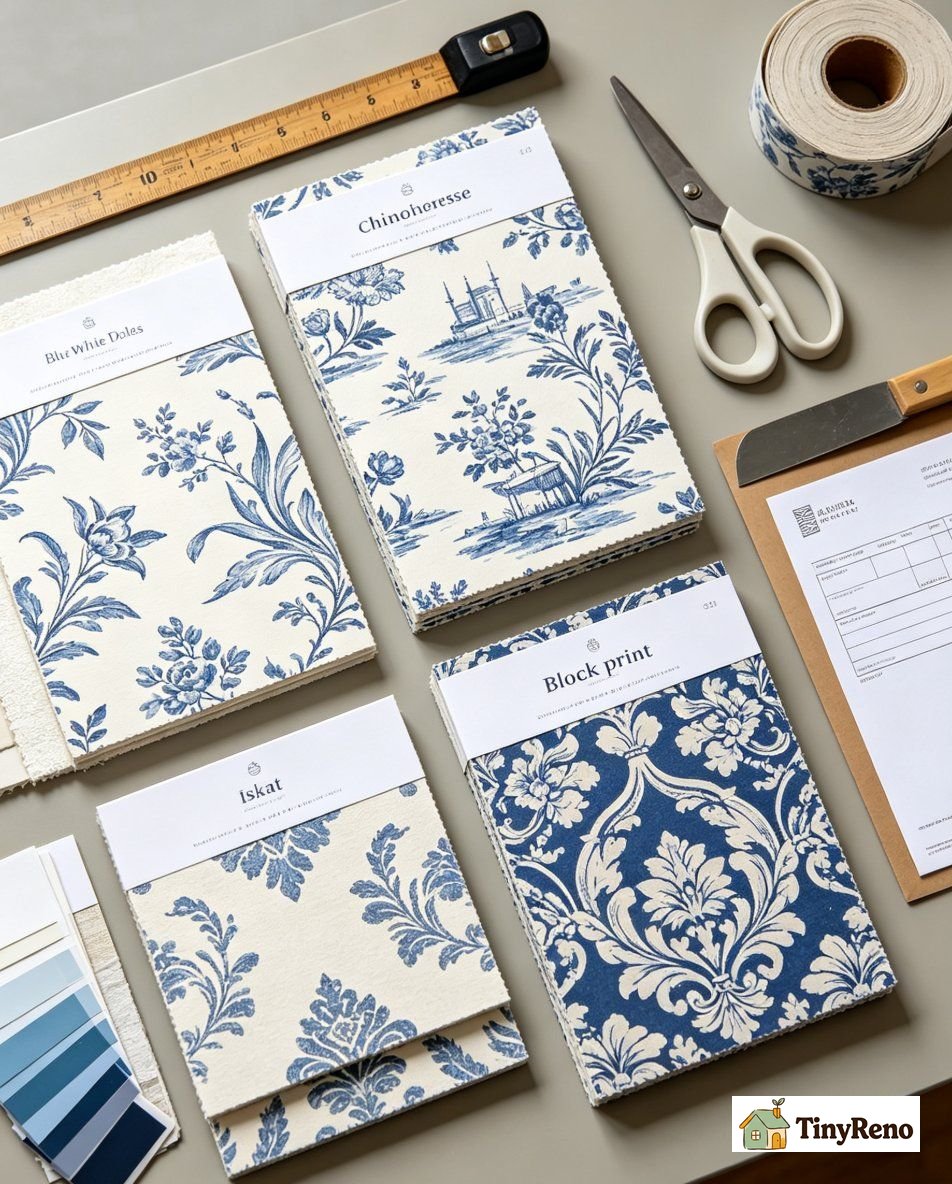
Once you know the pattern family you want and the blue tone you trust, the next decision is where to buy. There are five reliable sources for blue and white peel-and-stick wallpaper, and they serve different needs and different budgets.
Tempaper ($1.89 per square foot, ships in three to five days). The most widely available peel-and-stick brand, sold at Home Depot, Target, and Amazon. The blue and white selection covers toile, chinoiserie-inspired, ikat, damask, and block print. Print quality is consistent and the removable adhesive is reliable for the first two years. This is the right first stop for most DIY buyers.
Chasing Paper ($2.40 per square foot, ships in five to seven days). Higher-end peel-and-stick with a more curated blue and white library and a slightly thicker substrate. Worth the price premium for the more sophisticated color palette and the better packaging. The samples are also actual sheets of the production wallpaper rather than digital prints.
Wall Pops ($1.20 per square foot, ships in two to four days). The budget option for blue and white, sold at Walmart and Target. The selection skews simpler (mostly damask and block print, less chinoiserie and toile). The substrate is thinner and the adhesive is weaker, which matters in humid rooms but is fine in powder rooms or bedrooms.
Spoonflower ($25-$35 per yard for a 27-inch wide roll). This is the custom design premium. While Tempaper charges ~$1.89 per square foot for a mass-produced pattern, Spoonflower’s narrower width and on-demand printing put the material cost at $11-$15 per square foot— roughly 6x the cost of Tempaper. You are paying for a wallpaper that nobody else has, not just the paper itself.
Etsy indie makers ($3 to $8 per square foot, ships in five to fourteen days). The boutique option. Hundreds of small designers sell custom-printed peel-and-stick with unique blue tones and pattern scales. The quality varies more than the big four brands, so order samples from at least three makers before committing. The reward is finding a blue and white that no one else in your neighborhood has.
The Five-Minute Sample Test for Choosing the Right Blue and White Wallpaper
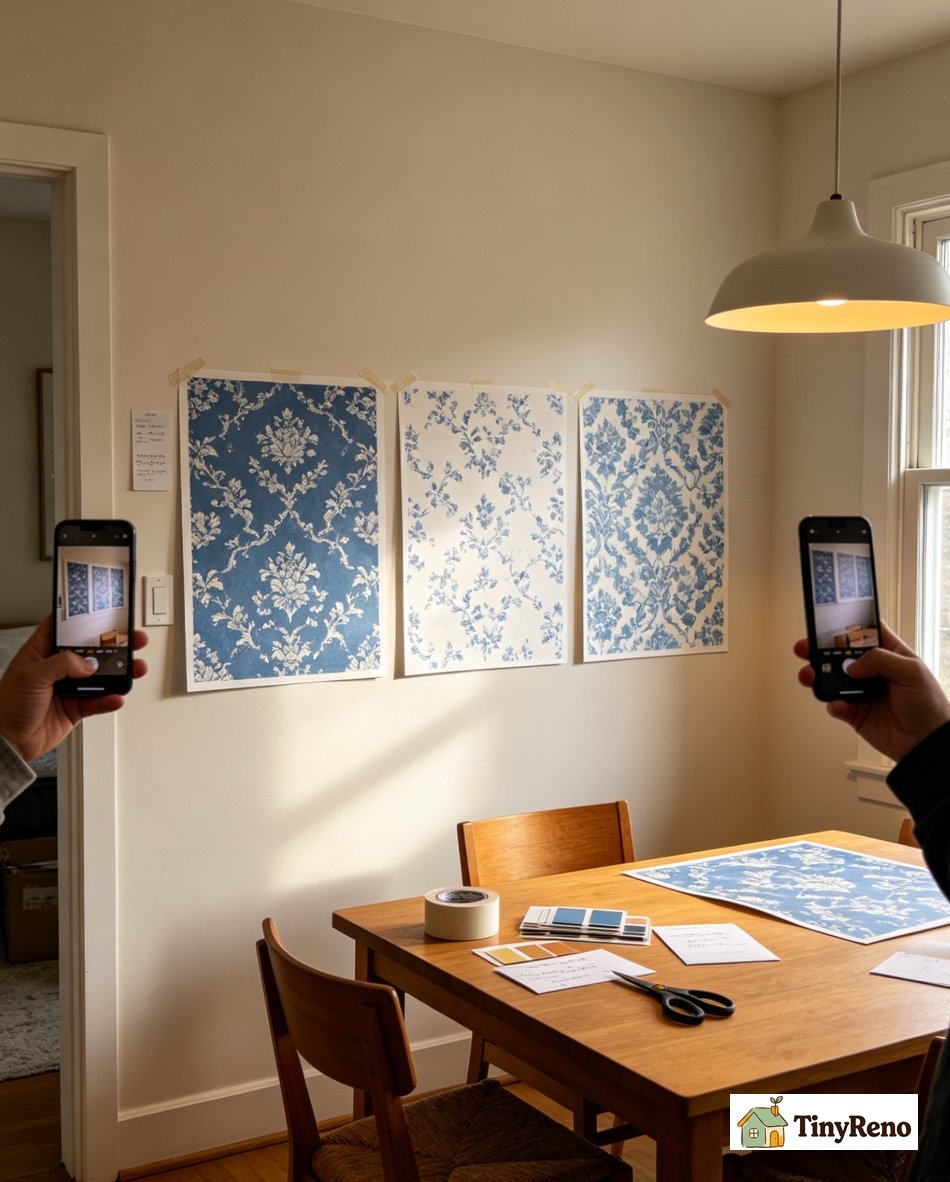
Here is the exact decision process I now use before I order any blue and white peel-and-stick wallpaper. It takes five minutes to set up and forty-eight hours to run, and it has saved me from four bad purchases in the last two years.
Step one, order samples from three to five sources. Most brands sell 8 by 10 inch sample sheets for $2 to $5 each. Order from three sources minimum so you have comparison options. Free samples from Spoonflower and Etsy are also available for many listings.
Step two, tape samples to the actual wall. Pick the wall where the paper will hang. Tape two or three samples side by side at eye level. Do not tape them in a closet or against a white board. The room's actual light is part of the test.
Step three, photograph at three times of day. Take one photo at the time of day the room is used most (morning for a kitchen, evening for a dining room, midday for a powder room). Take a second photo under the room's artificial lighting at night. Take a third photo in daylight with the room lights off. Compare the three photos side by side. The right paper will look good in all three. The wrong paper will look great in one and bad in the others.
Step four, live with the samples for forty-eight hours. This is the part most people skip. Patterns that photograph well can still feel exhausting to live with. After forty-eight hours you will know whether the pattern energizes you or drains you. If you find yourself looking at the samples every time you walk past, the pattern is right. If you find yourself avoiding the wall, the pattern is wrong.
Step five, order enough material with ten percent extra. Measure the wall in square feet, add ten percent for trimming and mistakes, and round up to the nearest full roll. Most brands list square footage per roll on the product page. A five by five powder room with a door and one window needs about 80 square feet of wallpaper, which means ordering at least 88 square feet, or roughly two rolls at $40 each for Tempaper.
The five-minute sample test is the difference between a wall you love for ten years and a wall you paint over within eighteen months. Blue and white is a forgiving color family, but the specific blue you pick and the specific scale of pattern you pick are not forgiving at all. Get the sample on the wall. Photograph it at the right time of day. Live with it for two days. Then order. The pattern you choose is the one you will see every morning for the next decade, so the five minutes is worth it.
What My Houses Look Like Now and Which Blue and White I Would Buy Again
I get asked which of my four blue and white rooms I would do again and which I would not. Here is the honest answer, room by room, after living with each one for at least a year.
The powder room Tempaper Toile in navy on cream is the one I would absolutely do again. It is the lowest cost, the highest impact, and the easiest to live with. The pattern reads as fresh every time a guest uses the room, and the seams have held without a single intervention for the past eighteen months. If you have only one room to try blue and white peel-and-stick wallpaper in, this is the room and the pattern.
The Chasing Paper Ikat on the bedroom accent wall is the one I would also do again. It cost more, but the calm soft blue of the ikat has made the guest room feel like a boutique hotel, and the pattern has not faded in two years of afternoon sun. The only adjustment I would make is to order a slightly larger scale repeat. The one I bought is at the small end of the ikat scale, and a slightly larger repeat would have felt more luxurious.
The kitchen backsplash peel-and-stick vinyl tile is the one I would do differently. It still looks fine after three years, but I would switch to a true heat-resistant product next time, and I would choose a blue that coordinates with the cabinet paint rather than the countertop. The pattern I picked competes slightly with the cabinet color, which only became obvious after living with it for a year.
The half-bathroom Wall Pops at chair-rail height is the one I would not repeat. The price was unbeatable at $60 total, but the substrate was thin enough that one corner lifted within eight months, and the print quality was noticeably lower than Tempaper or Chasing Paper. The lesson was that in a humid room, the substrate matters more than the pattern. Spend the extra dollar per square foot for a better substrate in any room with moisture, even if it means a smaller room or a simpler pattern.


Discussion (0)
Sign in to join the discussion