

When my friend Sasha called me from her DC apartment last October, she was standing in her living room staring at a six-inch crack running across the ceiling. She'd already spent three days on Reddit, and she had five different answers: settling, paint cracking, truss uplift, water damage, or structural failure. She didn't know which one she had. The truth is most cracks in ceiling are cosmetic, but a few are emergencies, and the difference is what you measure, not what you guess. Over the years between the two of us, we've fixed four of them ourselves and called a pro for four more, and the rule we use now is simple. Here is exactly what we did, what we learned, and how you can tell which kind you have in under five minutes.
Three Ceiling Cracks I Fixed Myself in an Afternoon
Sasha's six-inch line turned out to be three separate problems masquerading as one. The first was a hairline paint crack above her bedroom doorway, the kind that looks like a spider drew a straight line. I told her to run a fingernail across it. If the crack does not catch a fingernail and there is no brown stain, it is almost always a paint-only problem from seasonal humidity. She picked up a $5 tube of paintable latex caulk, ran a thin bead along the line, smoothed it with a wet finger, and repainted the spot with a small foam brush in matching flat white. The whole job took thirty minutes and looked invisible when dry.
The second crack was different. It ran along the seam where two drywall sheets met, and it had that classic "straight as a ruler" look that means the paper drywall tape underneath has loosened. This is the most common cracks in ceiling repair a renter will ever face, and it does not require a pro. Sasha bought a $7 roll of self-adhesive fiberglass mesh tape, a $8 small tub of premixed joint compound, and a four-inch putty knife. She pressed the mesh over the crack, spread a thin layer of compound over it, let it dry four hours, sanded smooth with150-grit, and applied a second coat. The next morning she spot-primed and repainted, and the seam disappeared for under $15 in materials and two hours of work.
The third one was the easiest. Sasha had a small round dimple near the hallway, no crack at all, just a tiny shadow. That is a drywall nail pop, where the nail behind the drywall has loosened and the joint compound over the head has cracked. She drove a fresh drywall screw an inch away to pull the drywall tight, then spackled the old dimple, sanded, and painted. Five minutes, $3 in spackle, gone. These three are the ones any renter can fix on a Saturday with a putty knife and a $20 material run to the store.
The Fourth Crack Sasha Didn't Touch and Why You Shouldn't Either
The fourth crack was in the corner of the living room, and it was nothing like the other three. It was three feet long, roughly a quarter inch wide at its widest point, and it ran diagonally from the wall corner up across the ceiling toward the light fixture. Along the crack there was a faint brown discoloration that Sasha had not noticed at first because the ceiling is off-white. When I asked her to send a photo, I told her to stop and call her landlord immediately. Here's why.
Any cracks in ceiling that pair a width over an eighth of an inch with brown staining is a water signal until proven otherwise. Brown staining means liquid has been carrying tannins, dust, or rust through the ceiling material and drying on the surface. The water could be from above (a slow leak from the upstairs bathroom, a roof issue, an HVAC condensate line), but it could also be from a pipe inside the ceiling cavity. Sasha did not know which it was, and neither did I, and that is the whole point. You cannot diagnose the cause from below. You can only diagnose that there is a problem, and that someone with a moisture meter and a flashlight needs to open the ceiling or the floor above to find the source.
Her landlord sent a handyman the next morning, the handyman cut a six-inch inspection hole in the ceiling, and they found a slow drip from the upstairs neighbor's washing machine supply line that had been wetting the drywall from above for weeks. The repair was not the crack. The repair was the supply line, plus a new drywall patch, plus repaint. Total bill was covered by the upstairs neighbor's renter's insurance. Sasha's "crack" was a symptom. That is the lesson. If you can see color in the crack, you are looking at water, and water is not a DIY problem.
The Four Signals That Mean Call a Pro Today
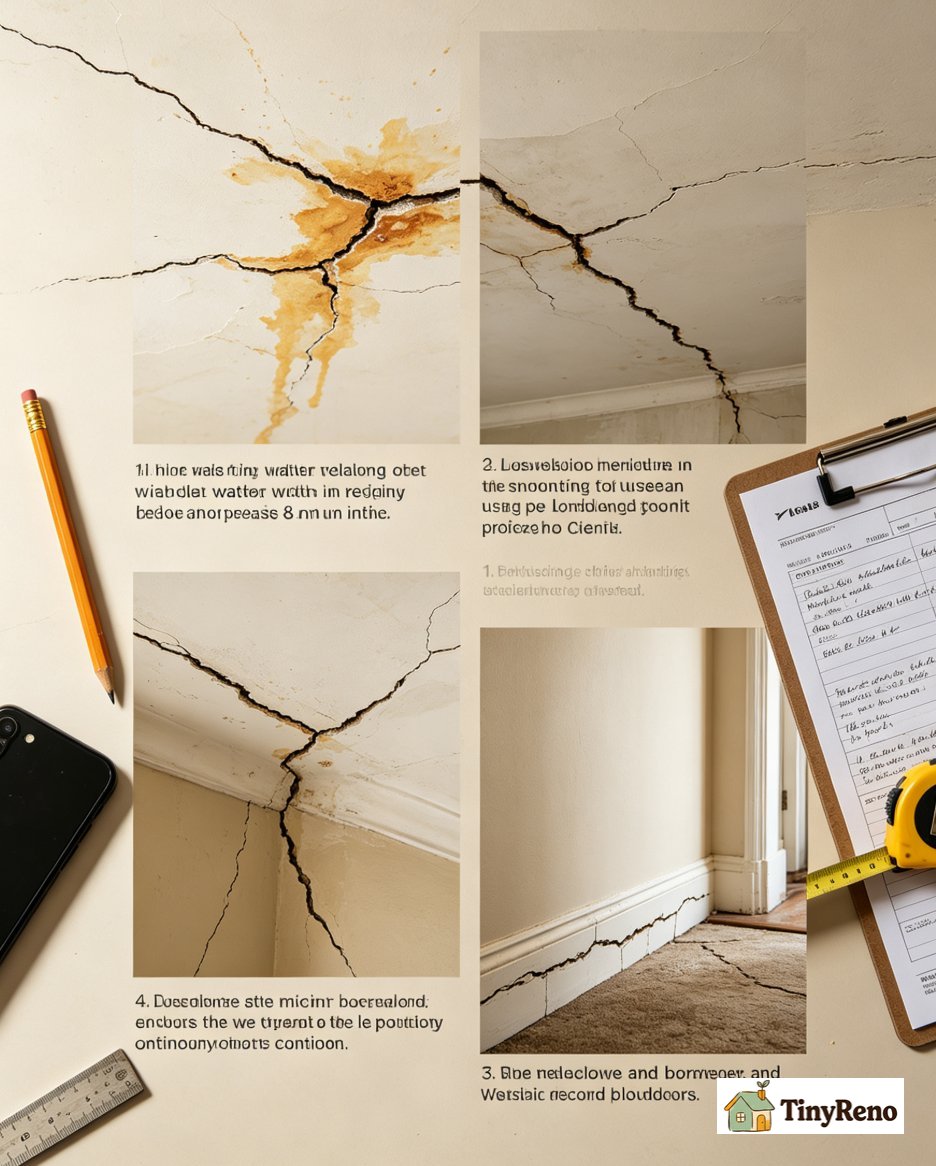
After Sasha's episode we sat down and wrote ourselves a one-page cheat sheet, because the day you find a ceiling crack is not the day you want to be reading five Reddit threads trying to remember what matters. We boiled it down to four signals. If any one of them is present, you stop and you call a pro. If none of them is present, you are almost certainly looking at one of the three DIY repairs above.
One, water staining. Any yellow, brown, or rust-colored tint inside or along the crack. This means liquid has passed through the ceiling material, and the source needs to be found before the ceiling is repaired. Patching over it without finding the source is how you end up with a mold problem three months later.
Two, width over an eighth of an inch. Hairline cracks (under 1/16 inch, do not catch a fingernail) are paint. Cracks between 1/16 and 1/8 inch are usually tape joint or seasonal settling. Anything wider than 1/8 inch is a structural conversation, not a cosmetic one, even if there is no staining. The ceiling may still be holding, but the force that opened the crack is bigger than drywall can absorb on its own.
Three, sagging or bowing. If the ceiling surface dips, swells, or feels spongy when you press it gently with a broom handle, the drywall is wet or the framing above is failing. Either way, this is a same-day call. A sagging ceiling is what a ceiling looks like right before it does not look like a ceiling anymore.
Four, a matching crack on the floor below or the wall below. If the same diagonal line continues down the wall, or if the hardwood floor below the crack has a matching ridge or gap, the cause is the building shifting, not the ceiling finishing. A contractor or structural engineer is the right call. These four are non-negotiable. If you see one, you do not finish reading this article. You pick up the phone.
The Six Types of Cracks in Ceiling and Which You Can Fix Yourself

Once Sasha knew the four danger signals, the rest of the cheat sheet fell into place. We ended up with six common types of cracks in ceiling, ranked from "Saturday project" to "call today." Knowing which one you have is what tells you the next step.
Hairline paint cracks are the most common. They look like a strand of hair, do not catch a fingernail, and have no discoloration. Cause is seasonal humidity expansion and contraction of the paint film. Fix is paintable caulk or a light sanding and repaint. Fifteen minutes, $5.
Drywall tape joint cracks run in a straight line along the seam between two drywall sheets, usually down the center of a room. Cause is the paper tape under the joint compound letting go, often from a past humidity event or a house settling. Fix is mesh tape plus joint compound, as I described above. Two hours, $15.
Drywall nail pops are small round dimples or short cracks with a tiny bump in the center. Cause is the nail behind the drywall losing its grip and the drywall shifting slightly. Fix is a fresh screw plus spackle. Five minutes, $3.
Corner bead cracks run along the outside corner where two walls meet the ceiling, often in a stair-step pattern. Cause is the metal corner bead shifting from house settling or impact. Fix is a small amount of joint compound plus a corner trowel if you have one, or call a handyman if the bead itself has detached. Two hours or one short visit.
Settlement cracks are longer, often run from a wall corner toward the center of the ceiling, and may be slightly wider at one end than the other. Cause is the building's framing drying and shifting slightly over the first few years (or after major weather events). Fix is monitoring. If the crack is stable in length and width month to month, no action is needed beyond paint touch-up. If it is growing, see "structural cracks" below.
Structural or water-related cracks are the dangerous one. They pair width over1/8 inch with staining, sagging, or a matching crack on the floor. Fix is a contractor or structural engineer, not a putty knife. The repair is the building, not the surface.
Who Pays for Ceiling Cracks in a Rental Versus an Owned Home
Sasha was a renter, so the next question was who actually pays for this. She emailed her landlord with the photos and the cheat sheet attached, and the answer came back the same day. As a rule, a landlord is responsible for keeping the ceiling structurally sound and the paint in reasonable condition, which means that hairline paint cracks, drywall tape joint cracks, nail pops, and corner bead cracks are all on the landlord's tab. These are normal wear, not renter damage, and a security deposit cannot be used to repair them at move-out.
Settlement cracks and any structural or water-related crack are also the landlord's responsibility, but the urgency is higher. Sasha's landlord told her that any new crack, any growing crack, or any crack with staining should be reported within24 hours, because the longer a water-related crack sits, the larger the eventual repair bill, and that bill is much harder to recover from insurance once the damage has been allowed to grow for weeks. For owners, the math is similar but the timing is different. A small hairline crack can wait until the weekend. A growing structural or water-related crack is the same-day call regardless of whether you own or rent, because the ceiling does not know the difference.
How to Monitor Ceiling Cracks Monthly So Small Problems Stay Small
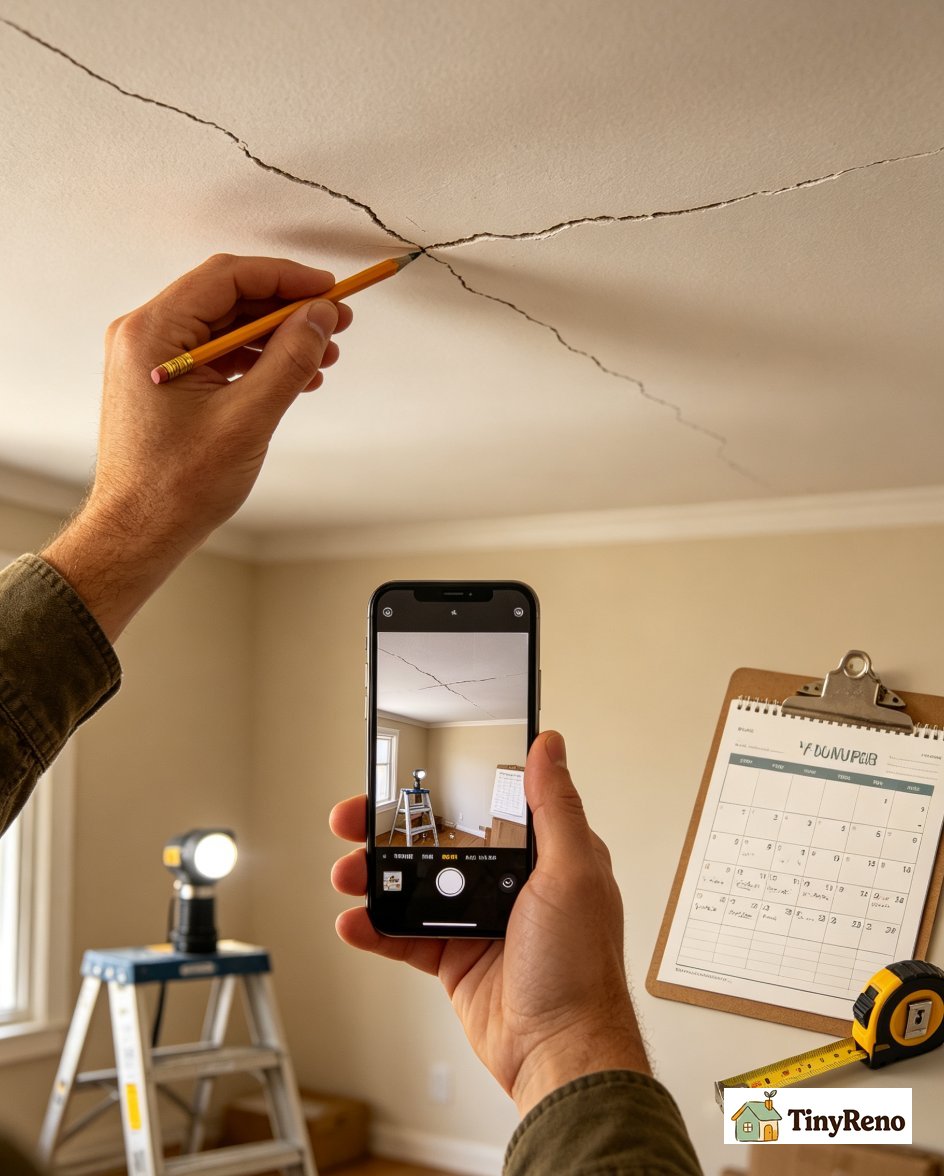
Sasha now does one thing every month that has saved her twice. On the first of the month she walks every room with a pencil and a phone. She draws a tiny tick mark at each end of every existing cracks in ceiling, and she takes a photo from the same angle each time. The tick marks tell her whether the crack is growing longer. The photo series tells her whether it is growing wider. Five minutes per month, no tools.
This is how she caught her second leak, six months after the first. A small new line appeared near the kitchen, the tick mark showed it had grown two inches since last month, and she called the landlord before the brown stain ever appeared. The upstairs neighbor's dishwasher supply line had loosened. Two years ago she would not have noticed until the ceiling was sagging. Today she catches it while a $12 replacement hose is still the entire fix. Cracks in ceilings are not the emergency. Not knowing which kind you have is the emergency. The five-minute monthly check is the difference.


Discussion (0)
Sign in to join the discussion