

I'd been staring at my kitchen ceiling for six months before I finally ran the ceiling paint vs wall paint test I'd been thinking about since 2023. There was a water stain from a 2019 leak my landlord had patched with the wrong sheen, so every morning at 7am when the sun came through the east window, I'd see this dull, flat ghost of a stain hovering over the table. I'd been told to use ceiling paint. I'd also been told wall paint works fine if you don't care. I wanted to find out for myself, on my own ceiling, over a real stretch of time.
In a single Saturday in March 2024, I taped off two four-by-four squares on either side of that stain and rolled one with the leftover wall paint from the bathroom (Benjamin Moore Regal Select, eggshell) and one with the cheapest can of ceiling paint my local Sherwin-Williams had (ProMar 200, flat). Same roller nap, same two coats, same drying time between them. Then I closed the door and didn't touch the ceiling for fourteen months.
Why I bothered to test ceiling paint vs wall paint at all
The reason this question matters is that ceiling paint costs roughly 30 percent more per gallon than the same brand's wall paint of the same quality tier, and most DIYers I know (myself included) have leftover wall paint from another room. The temptation to just use the wall paint is real. But every paint store employee I've ever asked has told me not to, and none of them have ever explained why in a way that made me trust them. So I wanted data, not advice.
The four things the paint companies actually claim differ between ceiling and wall paint are: sheen (ceiling paint is ultra-flat to hide imperfections), viscosity (ceiling paint is thicker so it doesn't drip down on you while you're rolling overhead), hide coverage (ceiling paint is formulated to cover dark stains in fewer coats), and drying time (ceiling paint typically dries faster so you can do two coats in a single afternoon). I wanted to see which of those four actually mattered in my real ceiling, and which were just marketing.
The four chemical differences between ceiling and wall paint
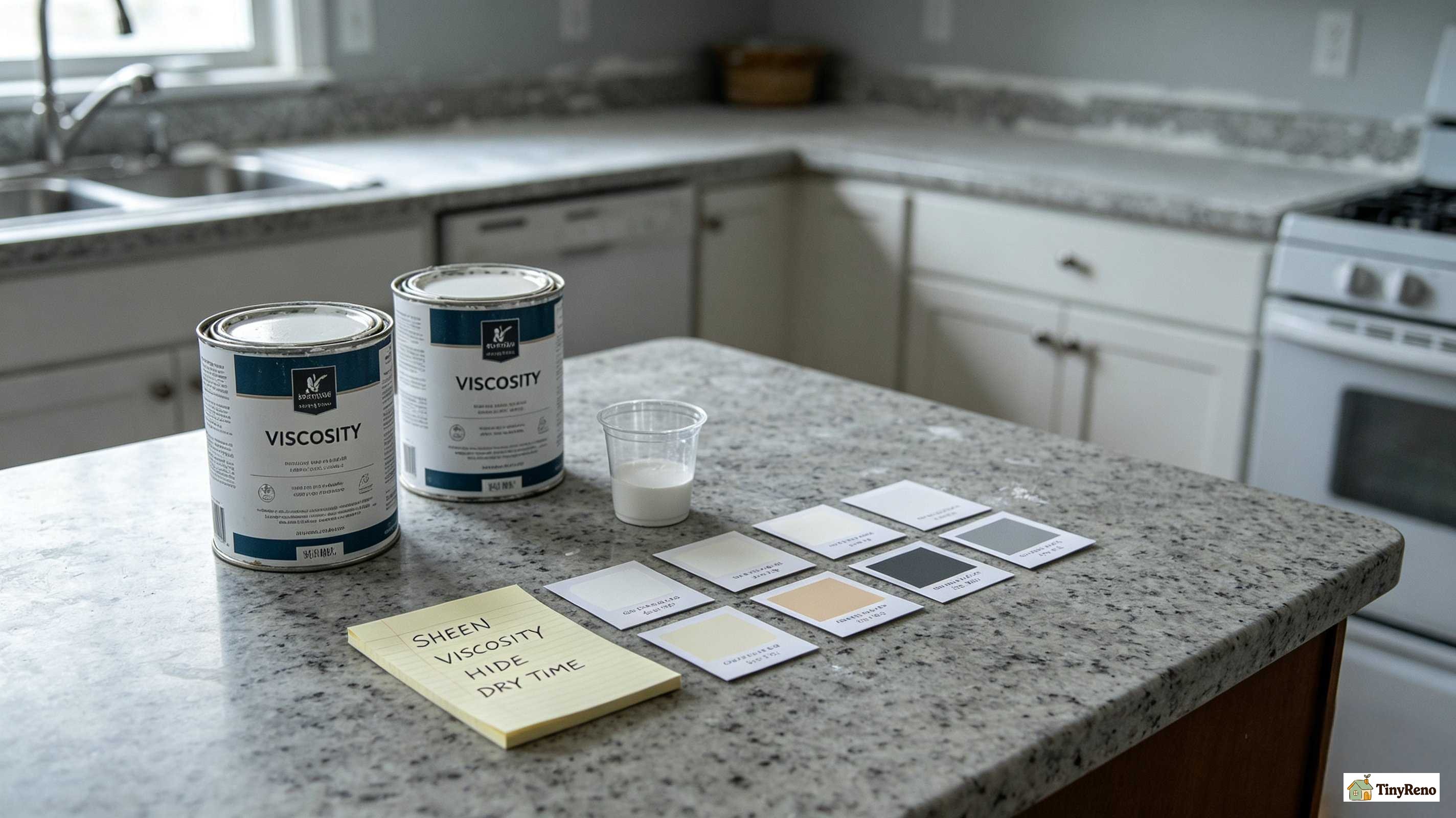
Sheen is the biggest visible difference. Wall paint comes in flat, eggshell, satin, semi-gloss, gloss. Ceiling paint is almost always ultra-flat — flatter than even the flattest wall paint. The reason is that ceilings are lit from the side (windows, lamps), and any sheen creates hot spots and roller marks when the light grazes the surface at a low angle. Ultra-flat absorbs light evenly, which hides imperfections and roller texture. In my test, the wall-paint patch (eggshell) showed every single roller stroke under the morning sun. The ceiling-paint patch (flat) showed nothing.
Viscosity is the second difference. Ceiling paint is intentionally formulated to be goopier so it sticks to the roller without dripping onto your face, hair, and the floor. Wall paint is more fluid because it needs to flow out smoothly under the roller to minimize brush marks. In my test, the wall paint dripped three times in one coat. The ceiling paint dripped zero times. If you've ever tried to roll a ceiling with wall paint, you know this is not a small difference.
Hide coverage is the third. Ceiling paints are typically engineered with more titanium dioxide (the white pigment) per gallon so a single coat covers dark stains, water marks, and bright colors from the previous tenant. Wall paint is formulated to be more translucent so multiple coats blend smoothly. In my test, the original water stain needed two coats of ceiling paint to disappear completely. It needed three coats of wall paint. The third coat was where I almost gave up.
Drying time is the fourth. Ceiling paint typically has a faster dry-to-recoat time (1-2 hours) so a DIYer can finish a ceiling in a single afternoon. Wall paint has a longer dry-to-recoat time (4 hours) so brush marks level out before the next coat. In my test, both paints were dry to the touch in the expected timeframes. The ceiling paint dried faster to the touch, but in terms of when I could safely roll the next coat without lifting the first, they were nearly identical.
Side-by-side test: what 14 months of real life did to each patch
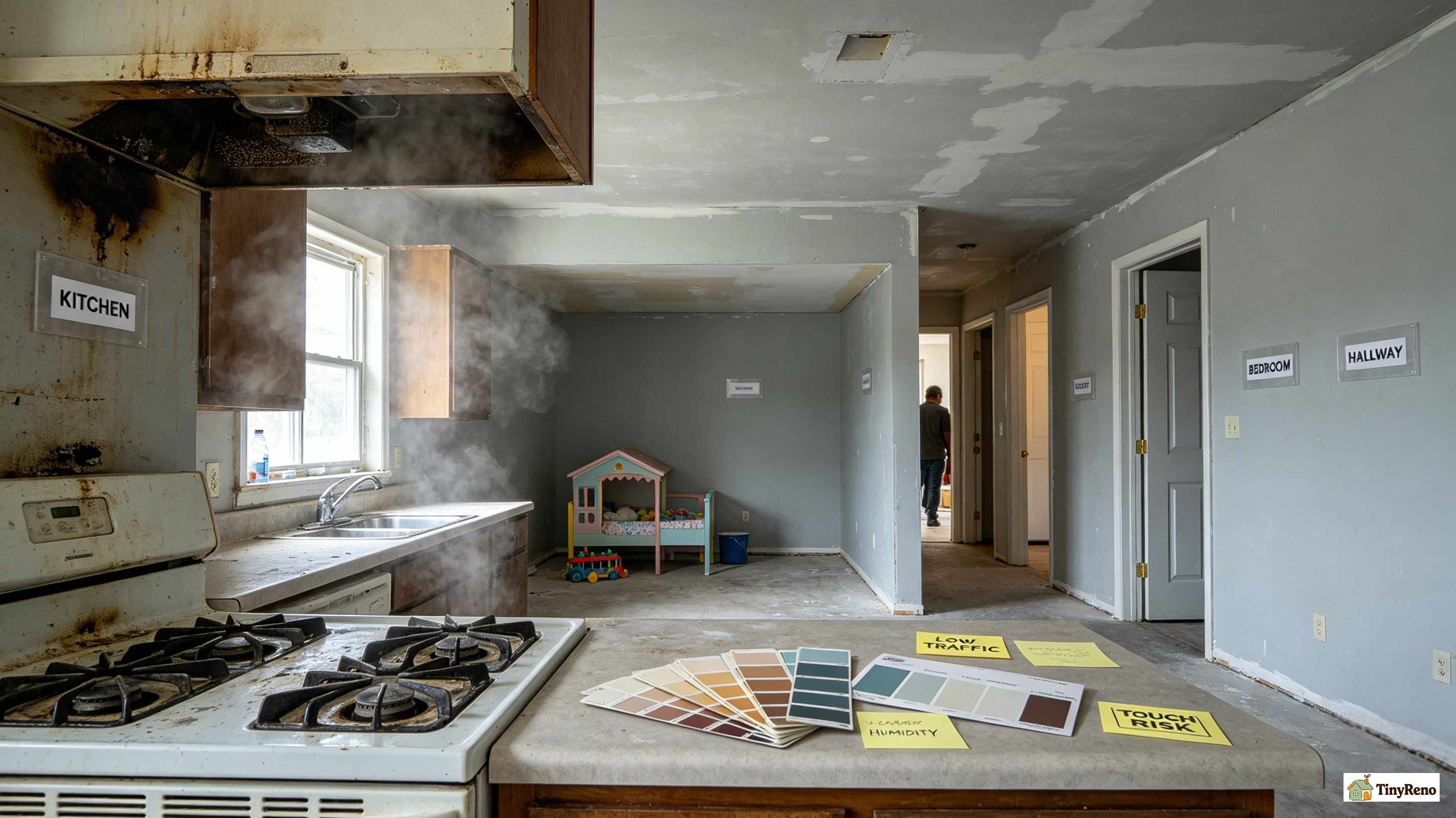
The honest results: after fourteen months of normal kitchen life — cooking steam, window condensation in winter, the occasional splatter from sauce, and direct morning sun through an east-facing window — the two patches have diverged in three ways.
First, visible staining: the wall-paint patch (eggshell) has yellowed slightly around the edges where cooking steam tends to settle. The ceiling-paint patch (flat) shows no yellowing. This is the old problem of using the wrong sheen in a kitchen. Flat ceiling paint doesn't attract and hold grease the way eggshell does.
Second, durability: the wall-paint patch has one small area where the paint has lifted — about the size of a quarter — directly above the stove. The ceiling-paint patch has no lifting. This is because flat paint has a slightly more porous surface, and ceiling paint is engineered to bond better on overhead surfaces where gravity is working against adhesion during the drying window.
Third, cleanability: this is where ceiling paint fails. I tried to wipe a sauce splatter off the ceiling-paint patch with a damp cloth. The paint came off on the cloth. I tried the same on the wall-paint patch. It wiped clean. Wall paint is engineered to be wiped. Ceiling paint is engineered to be left alone. If you have a ceiling that gets touched (very low ceilings, kids' rooms, anywhere you might bump your head), this matters.
Matching paint type to room: a quick honest decision guide
If you're painting a ceiling in a low-traffic room where you won't be wiping it, and the surface is in good shape (no major stains, no peeling), ceiling paint wins on every dimension I tested. It's easier to apply, it covers better, it hides imperfections, and it doesn't drip on you. Pay the extra 30 percent.
If you're painting a ceiling in a kitchen, bathroom, or anywhere with humidity or grease, ceiling paint wins on coverage and drip resistance, but you'll give up cleanability. Most people accept this trade because ceilings are rarely wiped anyway. If you do need to wipe, you can spot-paint with a small can of wall paint in the same color, which is a different decision than painting the entire ceiling with the wrong product.
If you're painting a ceiling in a kids' room, basement, or any space where the ceiling might get touched, bumped, or splattered, wall paint in flat or matte finish is actually the better choice. The extra durability and cleanability outweigh the drip and coverage disadvantages. The Benjamin Moore Regal Select in flat (not eggshell) is my recommendation for these cases.
If you're painting a ceiling in a rental where the landlord might not let you change anything, the answer is to use ceiling paint because it covers the previous tenant's color in one or two coats, which is the lowest-risk option for getting your deposit back. The same logic that made me test wall paint vs ceiling paint also pushed me toward ceiling paint when I moved out — the test patches came down with a single coat of whatever the landlord wanted next.
Three cases where wall paint is honestly okay on a ceiling
The honest version: there are three situations where using wall paint on a ceiling is the right call, and you don't need to feel guilty about it.
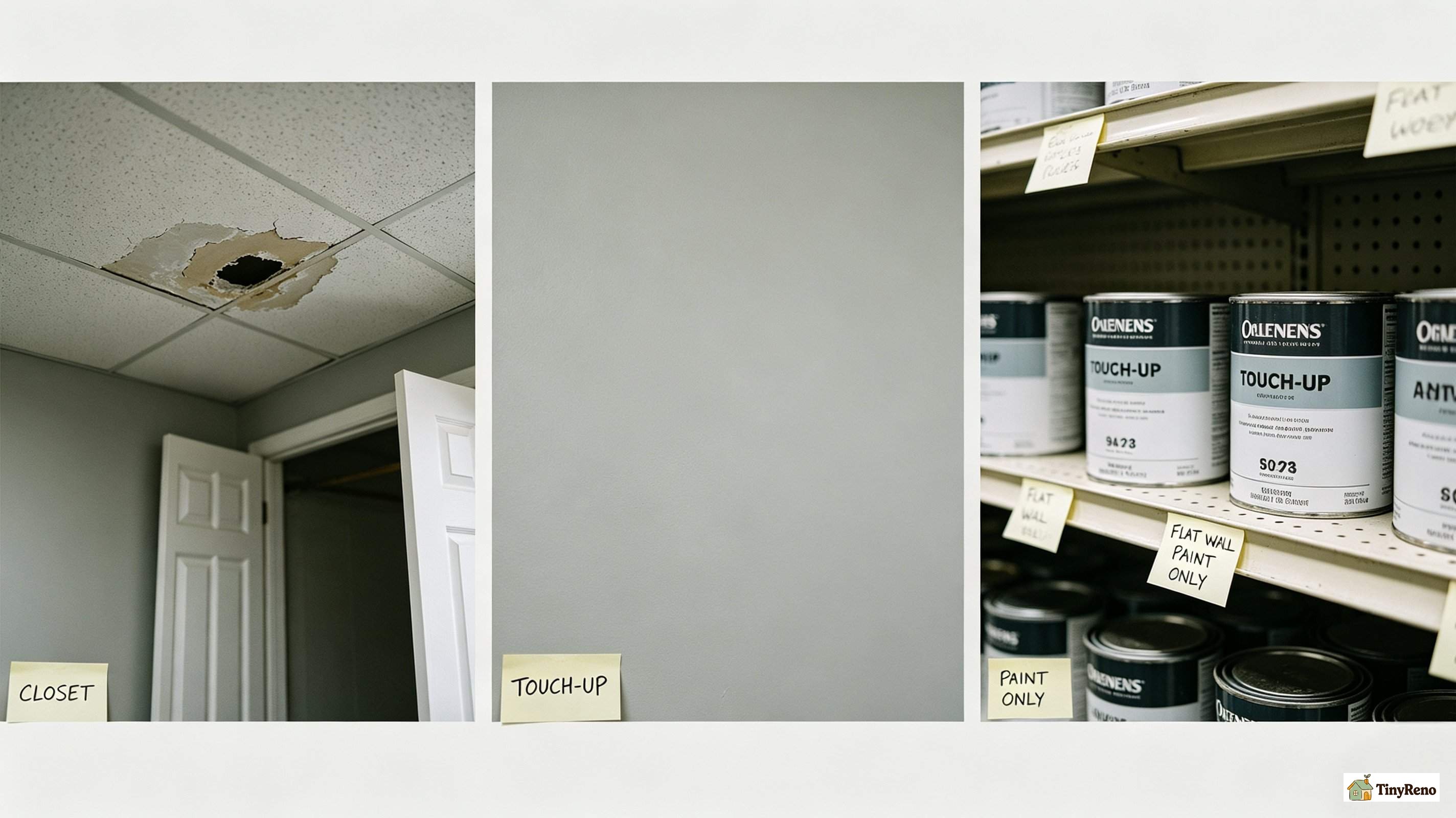
First, small closets and pantries. These are spaces where you'll never see the ceiling closely, where the surface area is tiny (often less than 10 square feet), and where using the leftover wall paint from another project saves you a $30 can of ceiling paint you'll use once and never again. The drip problem is also minimized because you're rolling on a small surface over a short period.
Second, when you're doing a touch-up, not a full repaint. If you have a small stain or scuff and you're trying to match the existing ceiling paint (which you probably don't have), using wall paint in the same color and sheen is fine. You're not building a full paint system; you're just hiding a flaw.
Third, when wall paint in flat finish is the only option at your paint store. Some smaller hardware stores stock only one or two wall paints and no dedicated ceiling paint. In that case, flat wall paint (not eggshell, not satin) is acceptable as a ceiling paint. The sheen is right, the hide is decent, and you avoid the eggshell-shine-on-the-ceiling problem.
The one case where the choice actually doesn't matter
If you're painting a popcorn ceiling (textured ceiling), the texture hides everything. Sheen, hide coverage, roller marks, all of it disappears into the texture. In that case, use whichever paint you have on hand. Wall paint, ceiling paint, flat, eggshell — popcorn doesn't care. Save your money.
Beyond that exception, ceiling paint is the right product for almost every ceiling in a home. The 14-month test in my kitchen convinced me. The next time I paint a ceiling, I'm buying ceiling paint.


Discussion (0)
Sign in to join the discussion