

In 2019 I rented a 350 square foot studio on the Upper East Side for $2,150 a month. I had about $1,800 to spend on furniture, no room for a "real" bedroom set, and one rule: every piece had to earn its 10 square feet or it didn't come home. Here's exactly what I bought, where it went, and the four things I learned the hard way about living in a room where the bed, the desk, and the dinner table all share the same walls.
The 5 Zones (And Why a 6th One Isn't Optional)
Every studio floor plan looks different, but they all have the same five functional zones: sleep, work, eat, entry, and living. A sixth zone — storage — isn't a luxury in 350 square feet, it's survival. I treated it like the other five from day one, and it saved me from the "where do I put this" trap that swallows most studio apartments by month three.
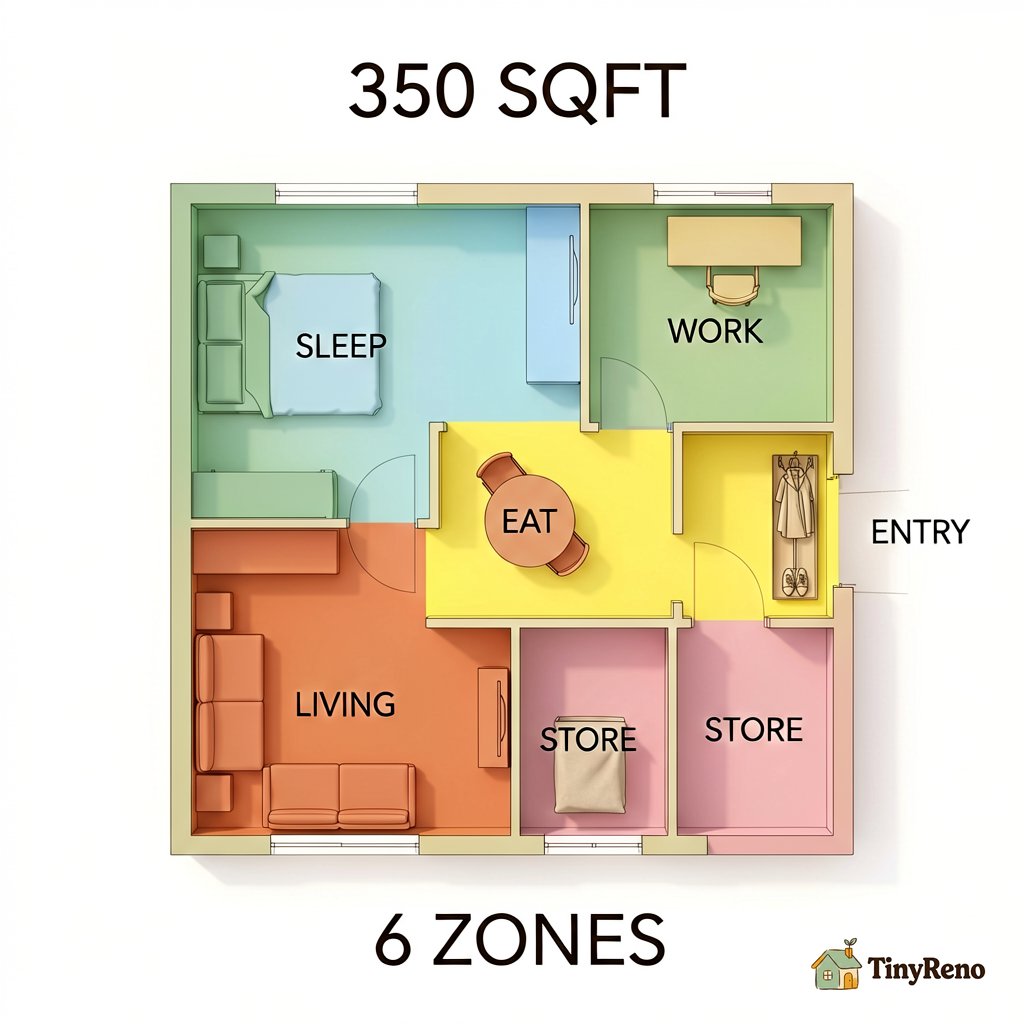
Zone 1: Sleep — A Daybed That Doubled as a Couch
I bought a full-size wooden daybed from West Elm for $850, and that single purchase did three jobs: it was my bed at night, my couch during the day, and the anchor for my living zone. The frame had three drawers underneath, which quietly absorbed my sweaters, extra sheets, and the duvet I rotated by season. Above the daybed I hung two $30 IKEA LACK floating shelves for books and a small plant. That's the entire sleep zone: one piece of furniture, two shelves, and the three drawers it came with. Total $910.
Zone 2: Work — The Folding Chair (Not the Yoga Ball)
I thought I needed a real office chair. I was wrong. I bought a $120 used IKEA MARKUS from a friend, used it for two months, and realized it occupied a full 2.5 feet by 2.5 feet of prime floor space that the apartment could not afford. I sold it and replaced it with a $60 wooden folding chair from a design store that I tuck under the desk when I'm not working. For 3-hour work blocks, it's perfectly fine. When I'm done, the chair disappears and the work zone becomes floor space again.
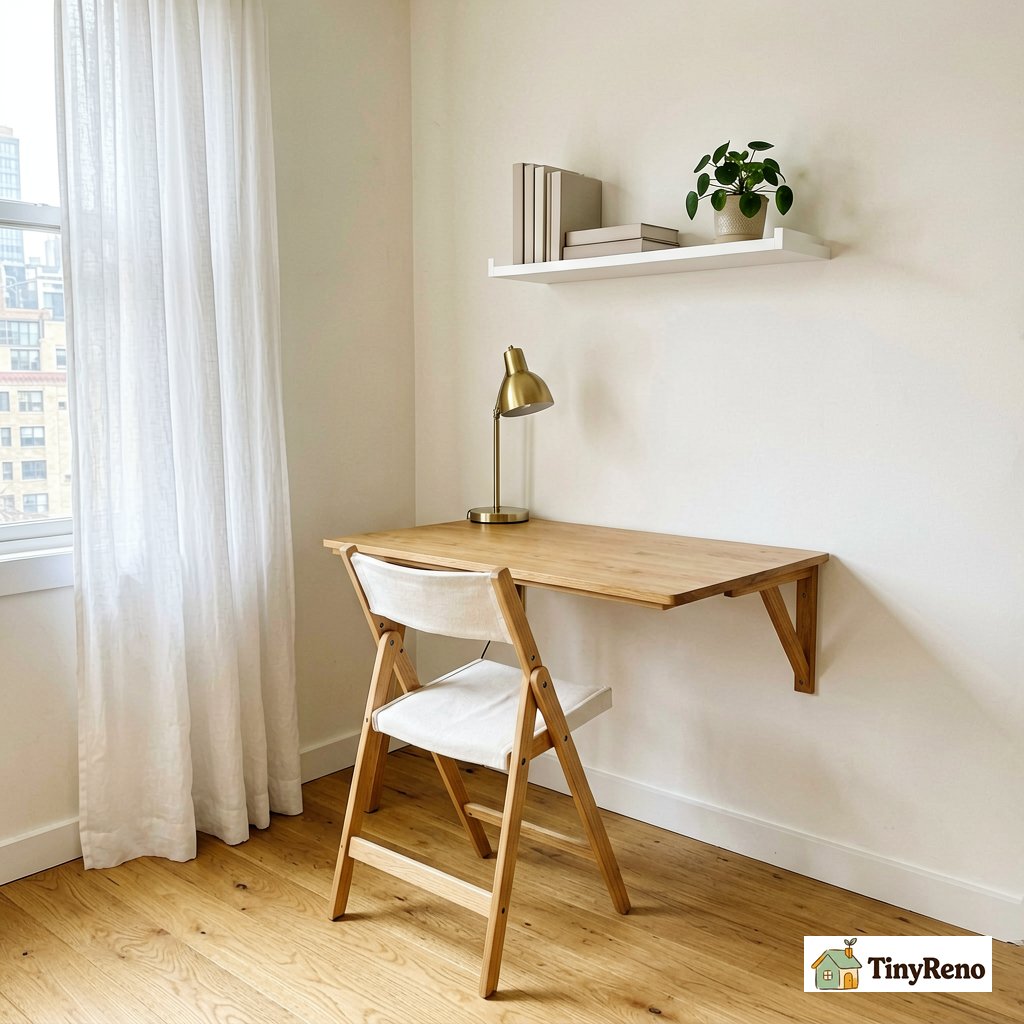
The desk itself is a $70 IKEA NORBERG wall-mounted drop-leaf. It folds down to 4 inches deep when I'm not using it. The lamp is a $40 brass IKEA LAMPAN. Three items, $170, and the entire zone collapses into a 2-foot wall slice when I'm done.
A quick note on what I almost bought: a yoga ball as a chair. It's a tempting idea because it stores by leaning against a wall and supposedly engages your core. The ergonomics reality is harsher — most occupational health guidelines (OSHA, the British Chiropractic Association, and physical therapists I asked later) don't recommend yoga balls as a primary work chair. The lack of back support, the unstable surface, and the pelvic-tilt pressure all add up over a 3-hour writing block. If you have a healthy back and you alternate with a real chair, fine. If you sit 8 hours a day, do not replace your chair with a yoga ball. I kept mine as a 30-second morning stretch tool and used the folding chair for everything else.
Zone 3: Eat — A Gateleg Table That Seats 4 (Sort Of)
The single best purchase in the entire apartment: a $220 IKEA NORDEN gateleg table. Closed, it's a 10-inch-deep wall-hugging console that holds my keys, a plant, and a stack of mail. Open, it's a 47-inch oval that seats 4. The hinge is the entire trick — it's one piece of furniture doing three jobs.
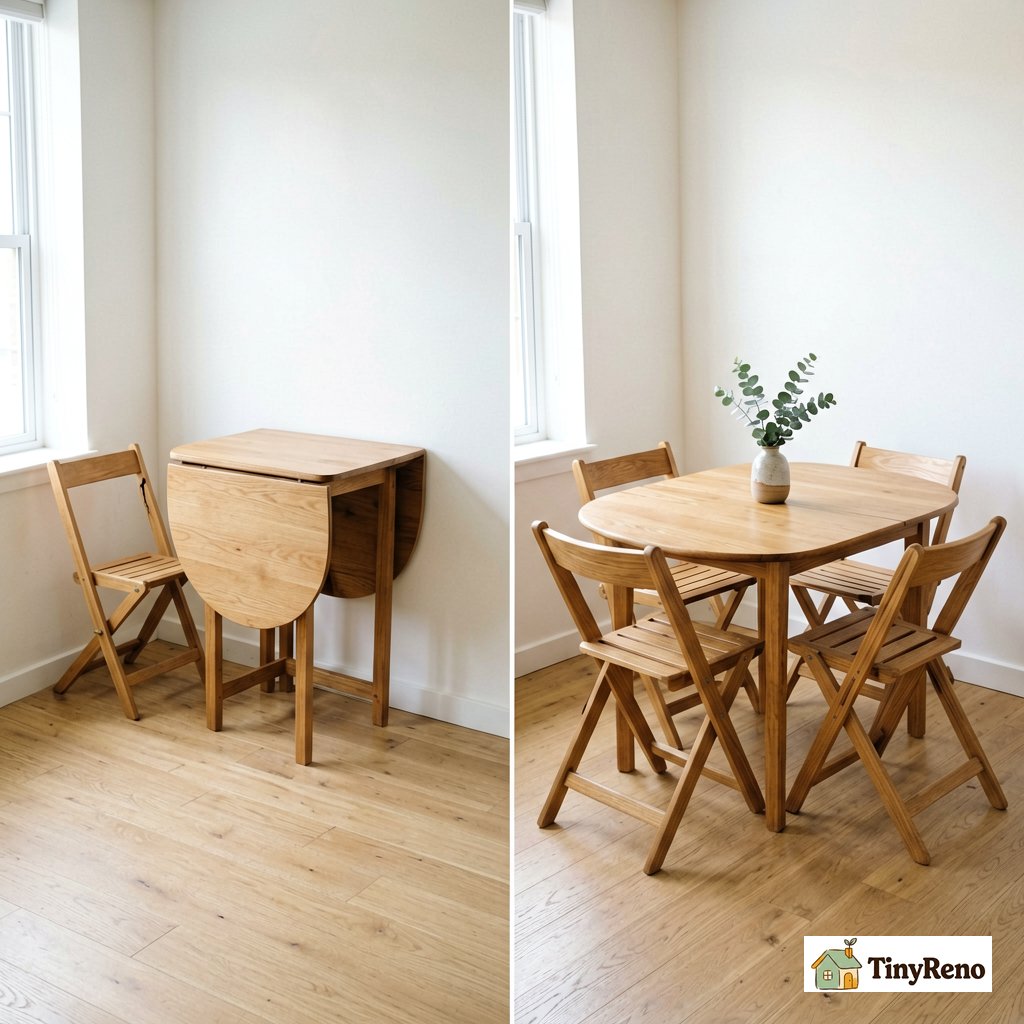
The catch: a gateleg that seats 4 still needs 4 chairs, and I owned exactly one (the folding chair from Zone 2). For the first year, the other three seats were borrowed — I'd ask friends to bring their own chair when they came over, or I'd pull two floor cushions out from under the daybed for casual dinners. If you host more than once a month, budget for two extra folding chairs at $20 each in month three. I bought two in month four and never looked back.
Zone 4: Entry — A $40 Coat Rack and a $15 Shoe Rack
The apartment had a 3-foot-by-3-foot nook by the front door that did nothing but collect mail. I put a $40 IKEA HÖRGRANS coat rack with 4 hooks on the wall (canvas tote, linen scarf, winter coat, umbrella) and a $15 narrow IKEA TRONES shoe cabinet on the floor (holds 6 pairs of shoes). The nook now does its job. Total $55.
Zone 5: Living — One Small Sofa, One Small Side Table
I splurged on one thing: a $650 Room & Board Rosalie sofa in cream linen. It was the only "real" piece of furniture I bought, and it earned its footprint by being the most-used object in the apartment — I sat on it every evening, every morning, and most weekends. Next to it, a $90 IKEA LACK side table for a coffee cup and a book. Total $740. That's the entire living zone. No armchair. No accent chair. No coffee table. The floor did the rest.
Zone 6: Storage — The One Most People Skip
This is the zone nobody talks about, and the one that quietly makes a studio livable. Three rules: use the walls, use the space under the bed, and use the back of the door. Walls took a peg rail ($25 IKEA FROSTA) for scarves, bags, and a brass key hook. Under-bed took three $15 fabric storage bins from Target rolled under the daybed, holding off-season clothes in vacuum bags. The back of the bathroom door took a $20 over-the-door hook rack for the robe I wore every night. Total $100.
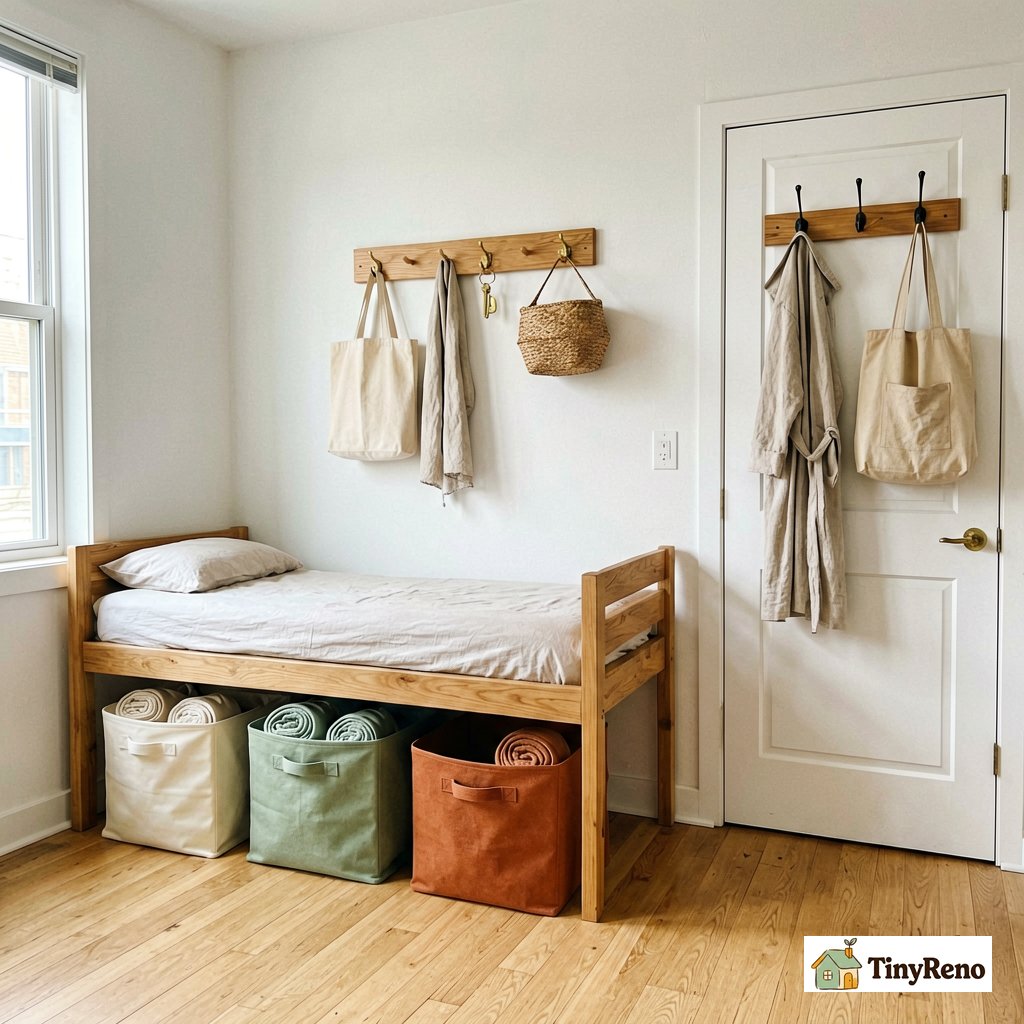
Closet space in a 350 square foot studio is small. Mine held exactly 12 hangers. The off-season rotation was the difference between a livable closet and a buried one — when the sweaters went into vacuum bags under the bed in April, the closet had room to breathe.
Negative Space — The Real Reason My Studio Felt Like 400 Sqft
The biggest mistake I made in month one was filling every surface. The biggest improvement I made in month two was emptying half of them back out. Here's the rule I now follow: leave at least a third of your floor space empty — not under furniture, not behind doors, just open floor. Negative space is what makes a studio feel like an apartment.
Concrete steps that worked: I moved the dresser out entirely and stored it at a friend's place for eight months. I removed the bookshelf I'd been planning to keep — the 14 books I actually re-read fit into two fabric bins under the daybed. I pushed the daybed 8 inches away from the wall to create a "breathing line" behind it. The room went from feeling like 280 square feet to feeling like 400. I never put the bookshelf back.
The Total Furnish Budget: $2,335 (Plus $400 in Mistakes)
Adding up everything I kept: Daybed $850 + Work zone $170 + Gateleg table $220 + Entry $55 + Sofa & side table $740 + Storage $100 + the two extra folding chairs I bought in month four $40 + a $160 floor lamp I forgot to mention = $2,335 out the door. That's $185 over my $1,800 plan, mostly because the sofa was a stretch and the two extra chairs were an unplanned second purchase.
The $400 I lost on mistakes: the $120 office chair I sold at a loss, a $90 area rug that lived rolled up in a corner for six months, a $100 standing desk converter that didn't fit my actual desk, and $90 worth of "decorative" items (throw pillows, a fake plant, a candle set) that all went to Goodwill in 2020. I had the standing desk converter listed for free on a street-corner group within three weeks of buying it.
The apartment still had $2,150 of monthly rent on top of the furniture. The total first-year cost was a number I'm not going to do the math on. But every piece in that room in 2019 is still in a different apartment of mine in 2026, including the gateleg table. Some things just last.


Discussion (0)
Sign in to join the discussion