

My neighbor Priya furnished her 1-bedroom apartment in Boston for $1,440 in furniture in 2023. She had budgeted $2,500. On top of the $1,440 in furniture, she spent another $200 in kitchen basics and cleaning supplies — bringing her real total to about $1,640, still well under her $2,500 ceiling. The reason she came in under budget was not luck — it was the rule she set for herself on day one: buy only what she needed for week one, then wait 90 days before buying anything else.
This post covers furniture only. If you want the kitchen and cleaning checklist (the things you need the day you move in that nobody talks about), see the 30-item first-apartment checklist I wrote for a friend in Atlanta.
If you are staring at an empty apartment and asking how much does it cost to furnish an apartment, here is Priya's full breakdown by category, the exact items she bought, the kitchen and cleaning items she forgot to budget for the first time, and the three things she almost bought that she now thanks herself for skipping.
The 5 categories every apartment needs (and what to budget for each)
Before you buy a single piece, sort everything you might need into 5 buckets. Priya uses this same framework every time she helps a friend move:
- Sleep. Bed frame, mattress, bedding, pillows, window treatments.
- Sit. Couch or seating, chair, lighting for the living area.
- Storage & Organization. Cube shelving, dresser if needed, closet organizers, storage bins.
- Work. Desk, task lamp, office chair (or chair-of-some-kind).
- Eat & Clean. Kitchen basics (pot, pan, knife, utensils, plates) and cleaning supplies.
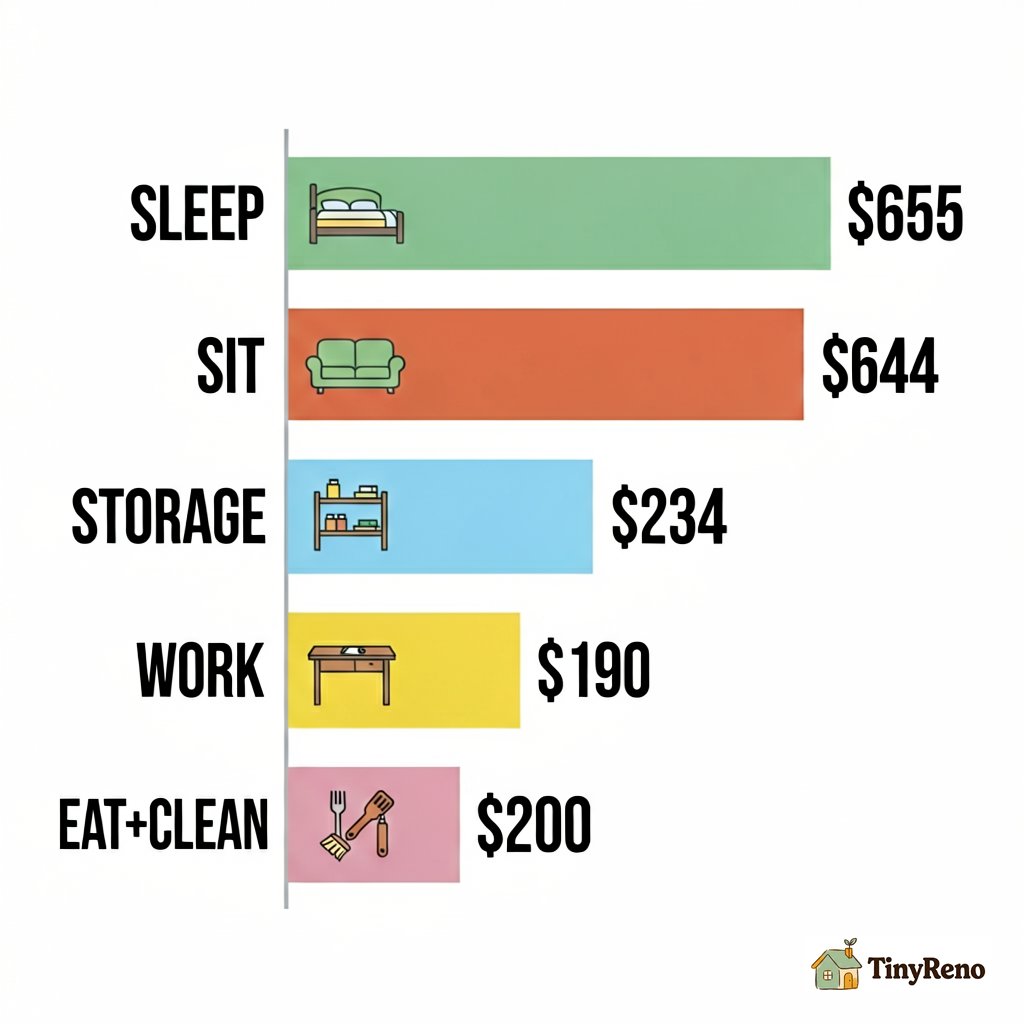
Priya's total across the first 4 (furniture): $1,440. Her Eat & Clean add-on: $200. Combined: $1,640. Below is how each bucket broke down in real dollars.
Category 1: Sleep — the $400 to $800 question (and don't forget the window)
The mattress is the single biggest line item, and the one you should not cheap out on. Priya's actual numbers from April 2023:
- Bed frame: $80 (Facebook Marketplace, from a friend moving to Seattle)
- Mattress: $400 (IKEA MALM medium-firm, brand new)
- Pillows (2): $40 (Amazon basics)
- Bedding (comforter + 2 sheet sets): $60 (Target Threshold brand)
- Window treatments: $75 (IKEA DYTÅG blackout curtains + simple rod, bedroom gets full blackout)
Subtotal: $655.
The bed frame was the surprise win. A friend was moving cross-country and selling her IKEA NEIDEN bed frame for $80 just to not have to disassemble it. Priya drove 15 minutes to pick it up. Without that find, she would have spent $200 on a new IKEA frame and gone over her sleep budget.
The window treatments are the line item most first-apartment budgets forget. Most rental apartments do not come with curtains — either the previous tenant took them, or the landlord never installed them. Sleeping in a bedroom with no window covering for the first week is one of those small things that makes a new apartment feel like a dorm. Budget $50 to $100 and solve it on day one.
Category 2: Sit — where most first-time budgeters overspend
Priya almost bought a $1,400 West Elm sectional. She had it in her cart, measured her living room three times, and was ready to click. Then she saw two things in the same week that changed her mind:
- An IKEA Kivik 3-seat sofa on Memorial Day sale for $599 (was $899).
- A Facebook Marketplace listing for an almost-new West Elm sectional in her size, asking $400 (the seller could not get it through their front door on moving day).
She did not buy either one immediately. She waited. The West Elm listing was gone within 6 hours. The IKEA sale ran for 5 days. She bought the IKEA on day 3 and saved herself $800 compared to her original plan.
- Couch: $599 (IKEA Kivik, Memorial Day sale)
- Floor lamp (living area): $45 (IKEA LERSTA — picked this over the $120 aesthetic lamp she almost bought on Instagram)
Subtotal: $644.
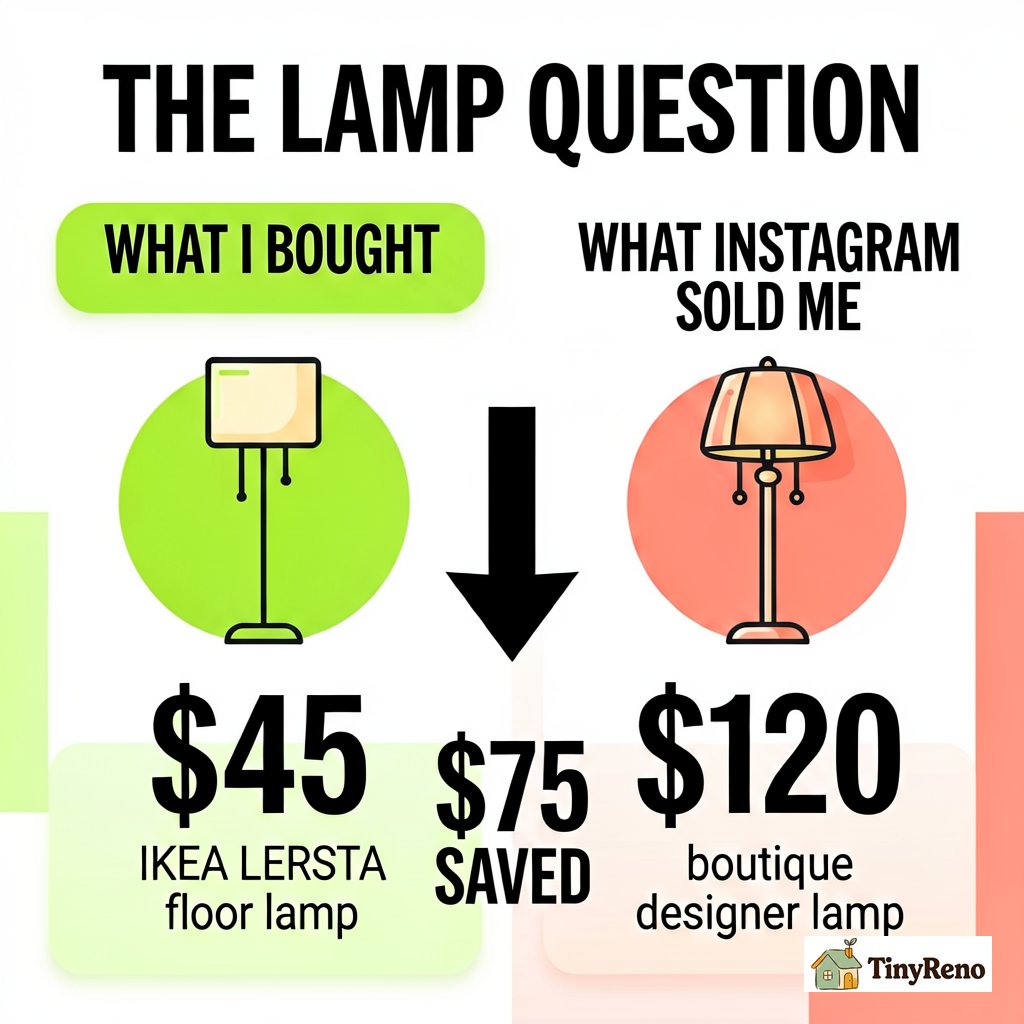
The lamp line item matters. Most rental apartments have one ceiling fixture in the living room and nothing else. That single fixture gives you light, not ambience. A $30 to $50 floor lamp changes the whole room at night. If you are interested in a deeper guide to choosing the right lamp for different rooms, see our lamp buying guide.
Category 3: Storage & Organization — cube shelving plus making the closet work harder
This was Priya's smallest furniture line item, and the one she spent the least time thinking about. Her strategy was twofold: cube shelving for general storage, and maximizing the existing closet instead of buying a dresser.
- IKEA KALLAX 4-cube: $179
- 3 fabric storage bins: $30
- Closet organizer (over-the-door shoe pockets + 2 felt hangers + 1 hanging shelf): $25
Subtotal: $234.
The cube-vs-dresser decision is the one that matters most for renters. When you move, a KALLAX disassembles into one flat panel and fits in a car. A dresser requires a truck, two friends, and a sore back. Priya has moved 4 times in 6 years. She has never regretted the cube choice.
The closet half is where first-time furnishers waste the most money. The default reaction is to buy a dresser because you do not have one. The better reaction is to make the existing closet work harder. Over-the-door shoe pockets run $10 and hold 12 pairs. A second tier of hanging rods doubles your hanging space for $25. Felt hangers triple your usable closet space visually because the bar is thinner. Priya's closet holds 90 percent of her clothes and accessories, and she has never wished for a dresser.
Category 4: Work — the category that did not exist 10 years ago
Priya works remotely 4 days a week. Her desk setup was non-negotiable.
- IKEA LINNMON tabletop: $59
- ADILS legs (pair): $16
- Task lamp (desk): $25 (IKEA TERTIAL, used, picked up at a yard sale)
- Office chair (used): $90 (Facebook Marketplace, Herman Miller Aeron — owner upgrading to a newer version)
Subtotal: $190.
The task lamp is the line item people forget when they think about a home office. Without one, you are working under ceiling light or with the glare from your window. A $20 to $30 desk lamp that aims where you need it will save your eyes within the first week. The Herman Miller find was the second surprise win — the seller listed it for $90 because the armrest padding had worn out. Priya bought replacement pads for $25 on Amazon and ended up with a $1,400 chair for $115 total. Her back has thanked her every workday since.
Category 5: Eat & Clean — the missing $200 nobody budgets for
This is the missing category in most guides about how much it costs to furnish an apartment. This is the category Priya forgot to budget for on day one, and she is not alone. Most apartment-furnishing guides treat kitchen and cleaning as someone else's problem. It is not. You cannot eat off the floor and you cannot live in a dirty apartment, and buying everything on day 7 in a panic costs more than buying it on day 1 with a plan.
- Frying pan + saucepan: $50 (IKEA basic set, or one pan + one pot from Target)
- Chef's knife + cutting board + spatula + can opener: $50
- Plates, bowls, mugs, utensils (4-person set, not 8-person): $40
- Dish soap, sponges, microfiber cloths, all-purpose spray: $25
- Trash can + trash bags + laundry detergent starter: $20
- Toilet brush + plunger + toilet paper (12-pack): $15
Subtotal: $200.
This is the minimum. You can find a deeper 30-item checklist (including what to skip) in the first-apartment checklist post. But the $200 number is the realistic starting point for a kitchen + cleaning bundle on day 7.
Real combined total: $1,440 in furniture + $200 in kitchen/cleaning = $1,640. This is the number Priya wishes someone had told her on day one, because it is the actual cost of moving in.
What you actually need vs what Instagram tells you
Priya had three Instagram-driven purchases in her saved collections that she deliberately did not buy:
- The $89 wall art set. She replaced it with a $14 printable from Society6 that she framed in a $20 frame from Target. Total: $34. Same look, $55 less.
- The $120 aesthetic floor lamp. She bought a $45 IKEA LERSTA and put it in the same corner. Her friends cannot tell the difference in photos.
- The $45 stack of coffee table books. She got a library card instead and borrows books for free. The crate-coffee-table looks better with real books on it anyway.
The pattern: most of the visual polish of a first apartment comes from one or two well-chosen pieces and a clean backdrop, not from 20 small decor items. Priya's apartment looks curated on a $1,640 budget because the backdrop is empty — light walls, one rug, one plant, and the right couch.
The 90-day rule that saved Priya another $800 (and the 3 exceptions)
Priya's one rule: anything that is not an emergency (bed, mattress, basic kitchen) goes on a list and waits 90 days before purchase. Three months later, 60 percent of the items on her original list had disappeared from her mind entirely. The other 40 percent she bought with real confidence.
The biggest beneficiary of that rule was the $800 she would have spent on a second-hand dining table she thought she needed for entertaining. Six months in, she and her friends eat at the couch or on the floor. The table is still on the list. She still has not bought it.
Three exceptions where the 90-day rule does not apply:
- Seasonal necessities. If you move in during winter, you cannot wait 90 days for a heater, a thick duvet, or a draft stopper. These are safety and health items, not wants.
- Time-limited second-hand finds. If a Herman Miller chair shows up on Facebook Marketplace for $90 and you can pick it up this weekend, the find is the find. Waiting 90 days means someone else buys it.
- Graduation / end-of-lease seasons. Late May and late August are when students move out en masse. Furniture supply on the second-hand market is highest and prices are lowest during those two windows. If your move-in aligns with one of those, that is your window for furniture shopping — not 90 days later.
The 90-day rule is not about rigid patience. It is about fighting the impulse that comes with an empty apartment. The exceptions above are the times when the impulse is actually a smart decision.
If you are starting from zero and trying to figure out how much does it cost to furnish an apartment, Priya's number is a useful anchor for how much it costs to furnish an apartment: $1,440 for furniture plus $200 for kitchen and cleaning, broken into 5 categories, with a 90-day waiting period for everything that is not sleep, food, or safety. You will probably land somewhere between her number and $2,500. The framework is what matters, not the exact dollar amount.


Discussion (0)
Sign in to join the discussion