

Alex in Boston paid $3,400 to break his lease in 2022. Two years later, sitting at the same kitchen table where he first did the math, he ran the numbers again. The real cost of breaking that lease, when you add in everything he had not thought to count, was closer to $4,200.
If you are staring at a lease you need to get out of, the question is not just how much does it usually cost to break a lease. The bigger question is which of the four exit strategies fits your situation, and which one your landlord will actually accept. This post walks through all four with real numbers from Alex's break, plus the hidden costs nobody puts in the spreadsheet.
The real cost of breaking a lease is not the fee your landlord quotes you
Most renters hear the word "fee" and stop calculating. The landlord says two months of rent, you wince, you pay it, you move on. That is the visible cost. The invisible cost is the half-dozen smaller things that add up while you are too busy packing boxes to track them.
Alex's visible cost: $3,400 early termination fee (2 months at $1,700/month). Alex's invisible cost over the next 60 days:
- $600 movers (he underestimated the studio furniture volume)
- $1,400 overlap month (his new lease started 3 weeks before the break was finalized)
- $300 deep clean he hired out because he was exhausted
- $200 in storage fees for the month between apartments
Add it up and the actual hit to his checking account was around $5,900, not $3,400. He is not bitter about the $3,400. He is bitter about the $2,500 he did not see coming.
The 4 ways renters actually exit a lease (and what each one costs)
There are exactly four exit paths most renters end up choosing. They are not equally fast, equally cheap, or equally risky. Below is the cost formula for each, in plain English. No state-specific legal advice, just the math.
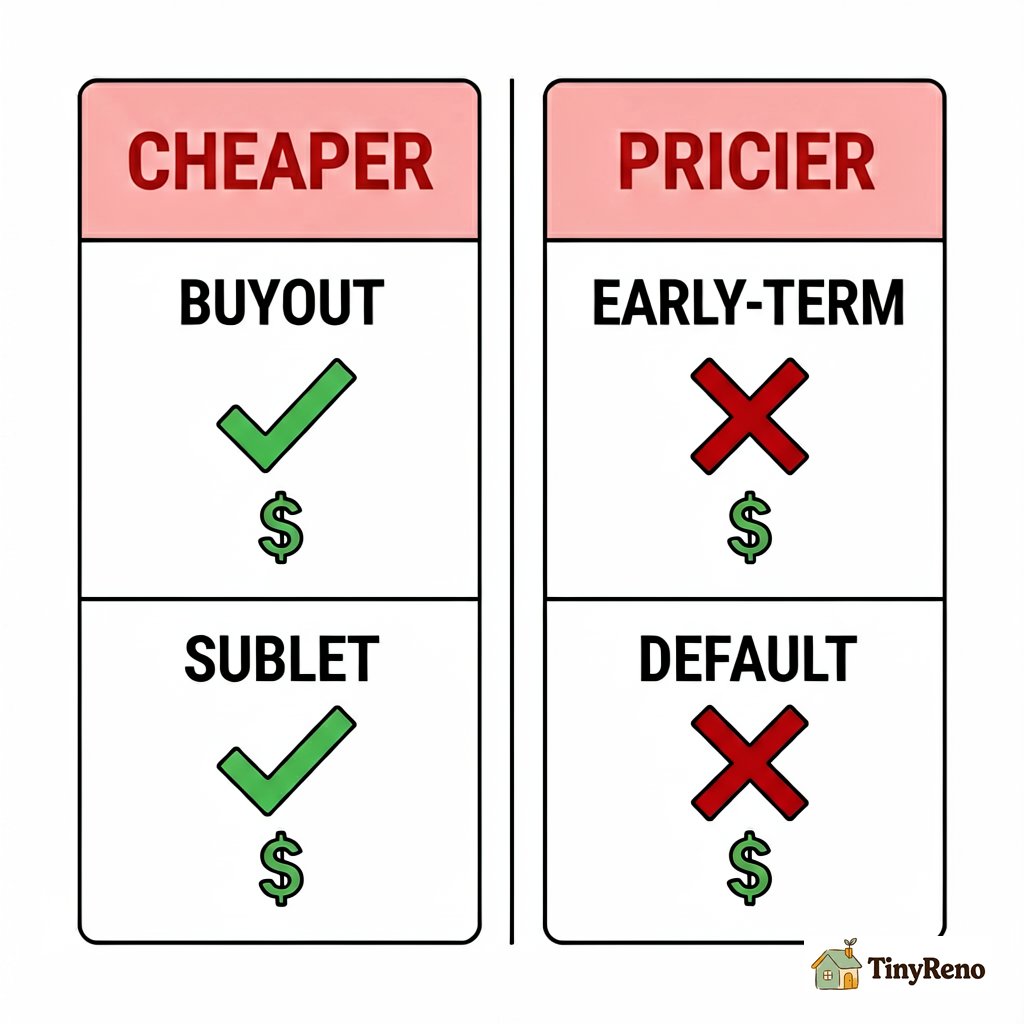
Use the table as a starting point. Your landlord's cooperation and your state's rules shift which option actually works.
Strategy 1: Pay the early termination fee (most predictable cost)
This is the path Alex took. He called his property manager on a Tuesday, asked what breaking the lease would cost, and got a clean number: two months of rent, paid within 30 days of move-out, deposit forfeit. No negotiation. He paid it and moved on.
What this strategy costs: 1 to 3 months of rent, depending on your lease. Corporate buildings lean toward 2 to 3 months. Smaller landlord-owned units often stop at 1 month if you ask nicely.
What you also pay: lost security deposit (almost always), overlap rent if your new place starts before the break is approved, and your own moving costs.
Who this fits: renters who need a clean break within 30 to 60 days, can afford the upfront hit, and do not have time to find a replacement tenant.
Strategy 2: Find a replacement tenant (cheapest if it works)
Most leases have an "assignment" or "sublet" clause that lets you bring in someone to take over the rest of your term. If your landlord approves the new person and they sign the lease, you walk away with zero termination fee.
What this strategy costs: nothing in fees if the swap goes through. Some landlords charge a $200 to $500 administrative fee for screening the new tenant. You also invest real time, usually 2 to 6 weeks of showing the apartment, coordinating applications, and waiting on approval.
The catch Alex ran into: he tried this first. He listed the apartment on Craigslist, Facebook, and a university housing board. Six weeks in, he had two serious inquiries but neither could pass the landlord's income verification (they were grad students on stipend). His property manager told him on week seven that if he did not pay the termination fee, they would start the eviction process against him instead. That is when he pivoted to Strategy 1.
Who this fits: renters with 3+ months left on the lease, a desirable unit, and time to find and screen a replacement.
Strategy 3: Negotiate a buyout with your landlord
This is the path most articles skip, and it is often the cheapest. Landlords do not enjoy turning over apartments. Turnover costs them: cleaning, repainting, listing fees, vacancy months, lost rent while the unit sits empty. If you offer to make their life easier, most will knock 30 to 50 percent off the standard termination fee.
What this strategy costs: typically 0.5 to 1 month of rent, versus the 2 months you would pay under Strategy 1. In Alex's case, a buyout would have saved him roughly $1,700. He did not know this was on the table until a coworker mentioned it months later.
What to actually say: call or email your landlord and say something close to this:
Hi [name], I need to move out by [date]. I know the lease says 2 months as a termination fee. I'm happy to leave the apartment spotless, handle all the cleaning myself, and coordinate every showing for the next tenant. In exchange, would you accept one month as a buyout?
That last line is the one that closes deals. Most landlords will say yes, especially if they have any vacancy anxiety.
Who this fits: renters with a decent relationship to their landlord, who are willing to put in the elbow grease on move-out.
Strategy 4: Just wait out the lease (the option most renters do not consider)
There is a fourth exit strategy that nobody recommends but everyone quietly runs the math on: stop paying rent, wait for eviction, deal with the credit damage later.
Here is the math Alex ran, just so you see how seductive it is. He had 4 months left on his lease at $1,700/month. The early termination fee was $3,400. If he just walked away, he would save $3,400. The cost was a potential eviction on his record.
I am not recommending this. An eviction stays on your credit report for 7 years. Future landlords will deny you. Some employers run credit checks. Auto loan rates climb. The math almost never works out in your favor unless you are already in financial free-fall and the lease is the smaller problem.
Who this fits: honestly, almost no one. I include it so you can rule it out with confidence instead of being tempted by the spreadsheet.
The hidden costs nobody puts in the spreadsheet
Beyond the fee your landlord quotes, there are five smaller line items that surprise people:
- Security deposit loss. Almost always forfeit on a break. Plan on losing this entirely.
- Mover costs. Studios run $400 to $800. One-bedrooms $600 to $1,200. Two-bedrooms $900 to $2,000. Last-minute bookings cost more.
- Overlap rent. The gap between when your new place starts and when the break is finalized. Two to six weeks is common.
- Credit inquiry hit. Every future landlord pulls your credit. If your score dropped during the chaos, expect more applications denied.
- Time cost. Showing the unit, coordinating movers, returning keys, forwarding mail. Estimate 20+ hours of admin work most people do not budget for.
What I tell friends now when they ask
Three questions, in order, before you pick a strategy:
- What does your lease's termination clause actually say? Read it. Not the summary your property manager gave you on the phone, the actual text.
- How many months are left? If you have 1 month or less, the math usually favors paying rent through the end. If you have 3+ months, a buyout or sublet becomes viable.
- How is your relationship with the landlord? Adversarial? Strategy 1 is your only realistic path. Decent? Strategy 3 might save you real money.
Answer those three, and the four strategies pretty much sort themselves. The fee your landlord quotes is not the final number. The fee plus everything you did not see coming is.


Discussion (0)
Sign in to join the discussion