

Last winter my upstairs neighbor knocked at 11pm. A slow hissing behind the water heater closet and a puddle creeping out under the door. I didn't know whether to grab a wrench or grab the phone. If you've just noticed a water heater leaking from the bottom, this guide is for you.
Only a few of the possible causes are things you can safely touch. Most are not. The trick is figuring out which one you're dealing with before you do anything — because the wrong move on the wrong cause can mean scalding water, a flooded floor, or a repair bill you shouldn't be paying. So when your water heater leaking from the bottom is the problem, here's how to triage it in 5 minutes.
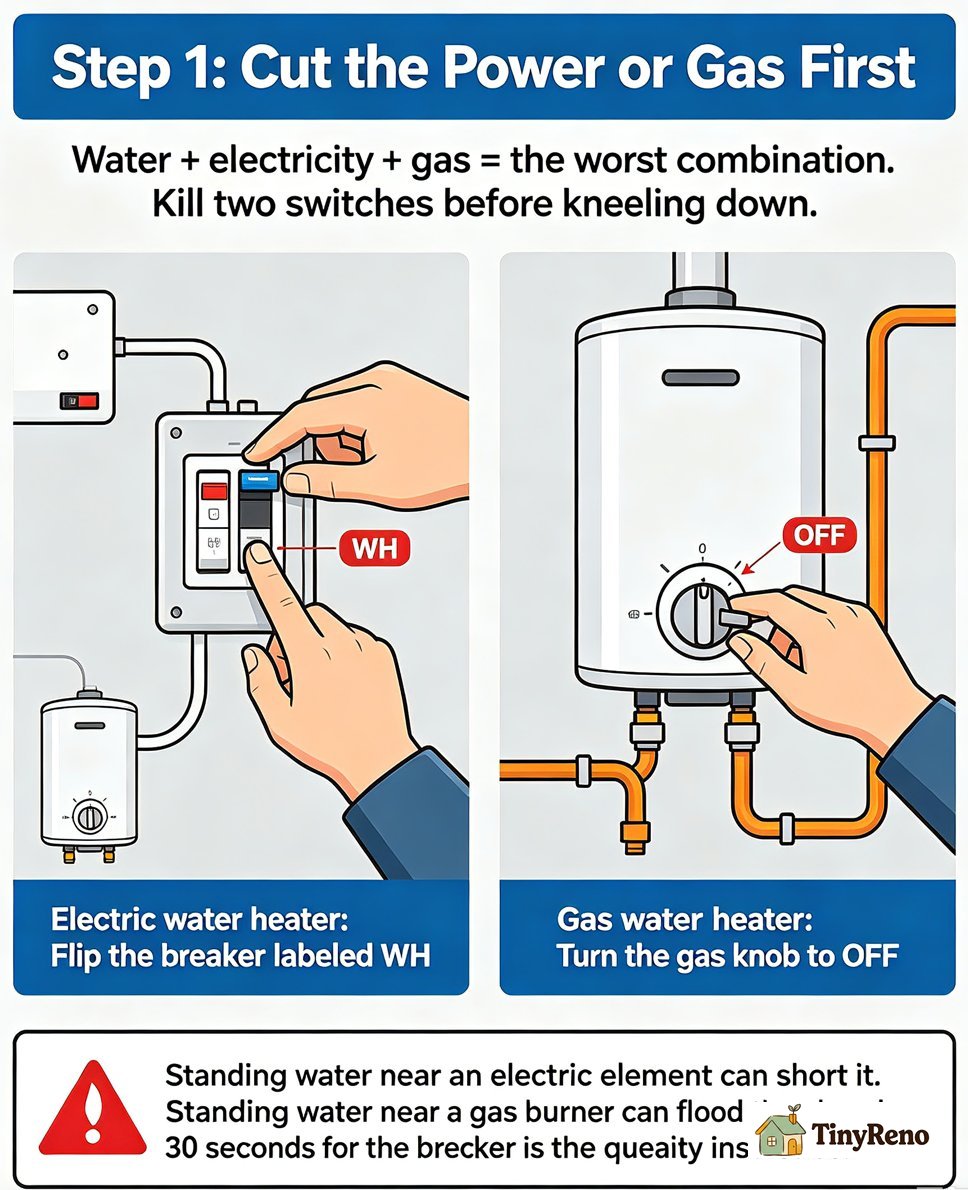
Step 1: Cut the Power or Gas First
Water + electricity + gas = the worst combination. Kill two switches before kneeling down.
Electric water heater
Flip the breaker labeled "water heater" or "WH." The tank holds heat for hours — don't worry about losing hot water now.
Gas water heater
Turn the gas knob (ON / OFF / PILOT) to OFF. Don't relight — leave that for a pro. Also flip the breaker if the unit has electric components.
Why this matters
Standing water near an electric element can short it. Standing water near a gas burner can flood the chamber and extinguish the flame without shutting off the gas. 30 seconds for the breaker is the cheapest insurance you'll buy all year.
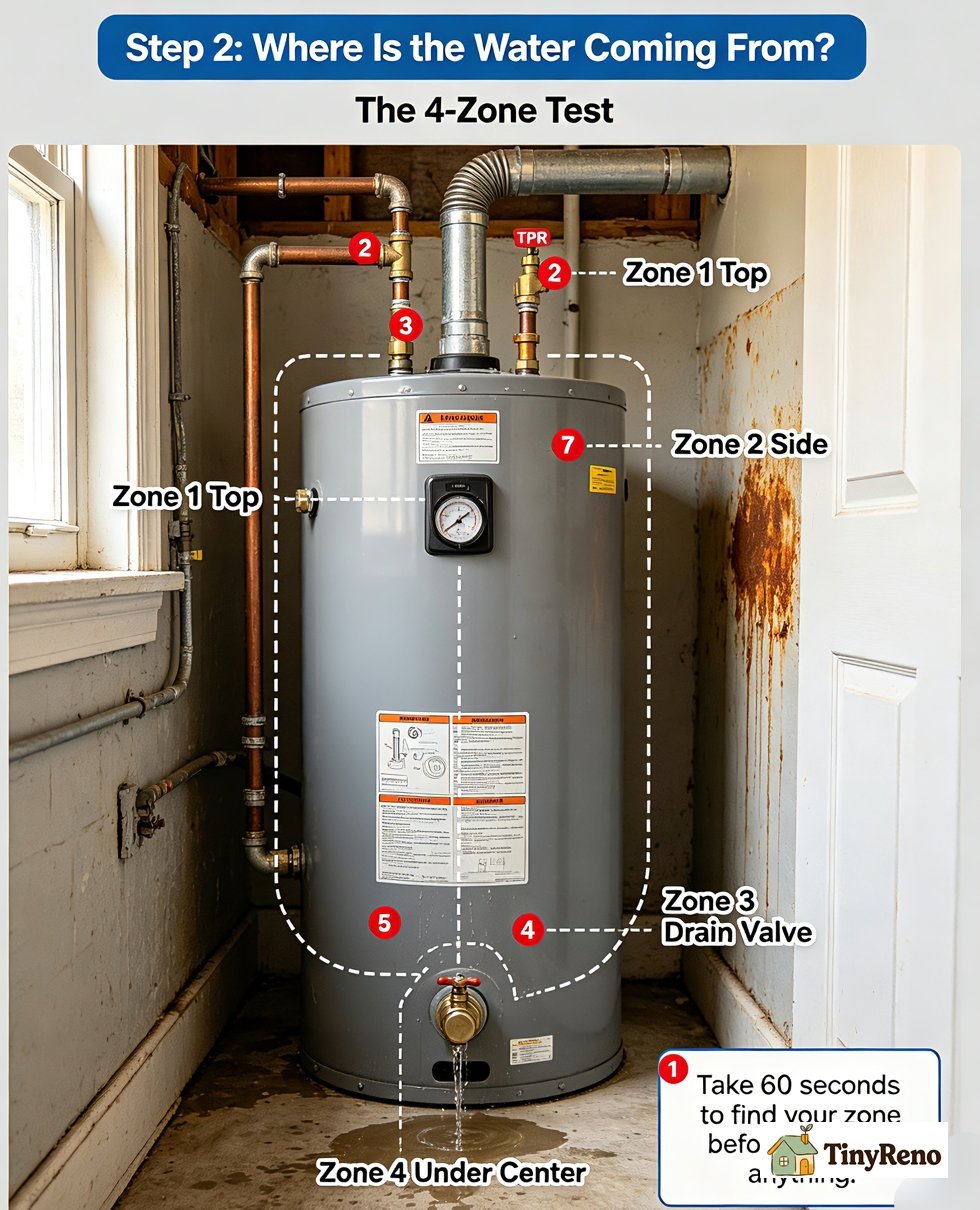
Step 2: Where Is the Water Coming From? (The 4-Zone Test)
Where the puddle sits matters far less than where the water is on the heater. Four zones. Identify yours before doing anything else.
Zone 1 — Top of the heater
Look at the cold inlet pipe, hot outlet pipe, and the temperature & pressure relief (TPR) valve on the upper side. Water dripping from any of these means the leak is in the plumbing above the tank — not the tank itself. Great news: none of these failures mean a new heater.
Zone 2 — Side seam or jacket
Rust streaks running down from above the base mean water is escaping a top fitting and traveling down the outside before dripping off. Puddle is real, but the leak is up top — much better than tank failure.
Zone 3 — Around the drain valve
The drain valve is the small spigot at the bottom front. Water dripping right from this valve or its threaded fitting is the most renter-fixable leak of the bunch. The valve costs about $8 and replaces with basic tools.
Zone 4 — Directly under the center of the tank
The zone you don't want. Puddle squarely under the middle, no traceable source — the leak is almost certainly coming from inside the tank: failed inner tank, rusted through, or cracked glass lining. Water seeping out around the heating element or along the bottom seam.
This diagnostic decides everything. Take 60 seconds and figure out your zone. You cannot skip it.
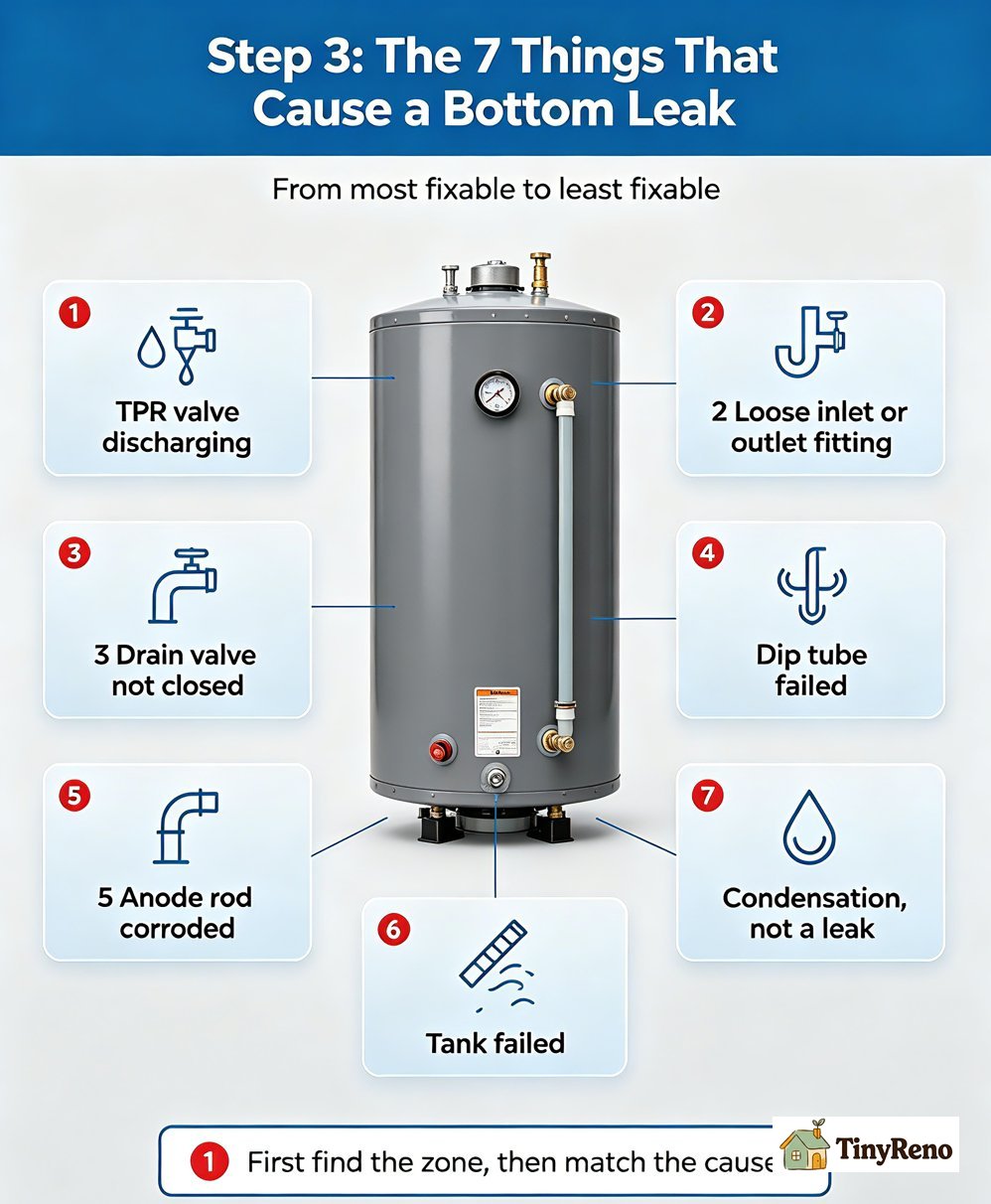
Step 3: The 7 Things That Cause a Water Heater Leaking From the Bottom (And What Each Means)
Now that you've identified your zone, here are the usual suspects ranked from most-fixable to least-fixable.
1. TPR valve is discharging
The temperature & pressure relief valve opens automatically if pressure or temperature climbs too high. A small drip from the discharge pipe during heating is normal. A steady stream or continuous drip is not.
If your TPR valve is venting continuously, tank pressure is too high — usually a lost air charge in the expansion tank. Plumber's job. Don't ignore: a stuck-open TPR is a scald and water-damage hazard.
Renter move: Stop using hot water. Notify landlord. Never cap the discharge pipe — capping a TPR is illegal in every U.S. jurisdiction because it can cause the tank to rupture.
2. Loose cold inlet or hot outlet fitting
The threaded connections above the tank can slowly work loose as pipes expand through heating cycles. Sometimes the fix is a quarter turn with a wrench.
Renter move: If a quarter turn stops the leak, fine. If it doesn't, plumber's job — landlord's bill.
3. The drain valve is loose or not fully closed (Zone 3 — most common cause)
The single most common cause of a water heater leaking from the bottom in rentals. The drain valve is meant to be opened occasionally to flush sediment. If it wasn't fully closed after the last flush, or the rubber washer hardened, it drips steadily.
Hand-tighten the valve clockwise, gently — over-tightening cracks the plastic. If the drip stops, that was the whole problem. If it continues, screw a $3 hose cap onto the valve outlet as a temporary stop.
Renter move: Hand-tighten. If that fails, cap with a hose cap. Notify landlord for replacement.
4. The cold-water dip tube has failed
Inside every tank-style water heater is a plastic pipe (the dip tube) that pushes incoming cold water to the bottom. When it cracks, cold water short-circuits to the outlet and broken plastic pieces clog the drain valve.
Symptoms: plenty of hot water but not as hot as it used to be, plus a small leak at the drain valve. Internal failure requiring pro replacement of the dip tube (and usually the anode rod while they're in).
Renter move: Notify landlord. Plumber visit.
5. The anode rod has corroded through
The anode rod is a magnesium or aluminum rod inside the tank that "sacrifices" itself to corrosion — that's its job. Once it's gone, the steel tank starts corroding. Rusty-colored water and eventually a slow leak from a hole in the tank wall.
Anode rods last 4–6 years in hard water, longer in soft water. If your heater is 8+ years old and the rod was never checked, this is a real possibility. Fix is a new water heater.
Renter move: Notify landlord. Whole-tank replacement.
6. The tank itself has failed (Zone 4)
End-of-life failure. The glass-lined steel tank has rusted through, usually at a weld seam or around the heating element flange. No fix — replace the unit.
For renters: unambiguously the landlord's responsibility. Bad news: no quick patch. You'll be without hot water for 1–3 days.
Renter move: Document everything (photos, video, date). Notify landlord in writing. Ask for a heater loaner or hotel reimbursement if replacement takes more than 24 hours — many states require landlords to provide habitable conditions including hot water within a defined time.
7. Condensation (not actually a leak)
On humid summer days, the outside of a cold tank can "sweat" — water beads form on the jacket and drip down, looking exactly like a leak. Giveaway: the puddle appears and disappears with the weather. Wipe dry and check back in 24 hours.
Renter move: If the puddle goes away, it was condensation. Mention to the landlord so they can improve closet ventilation.
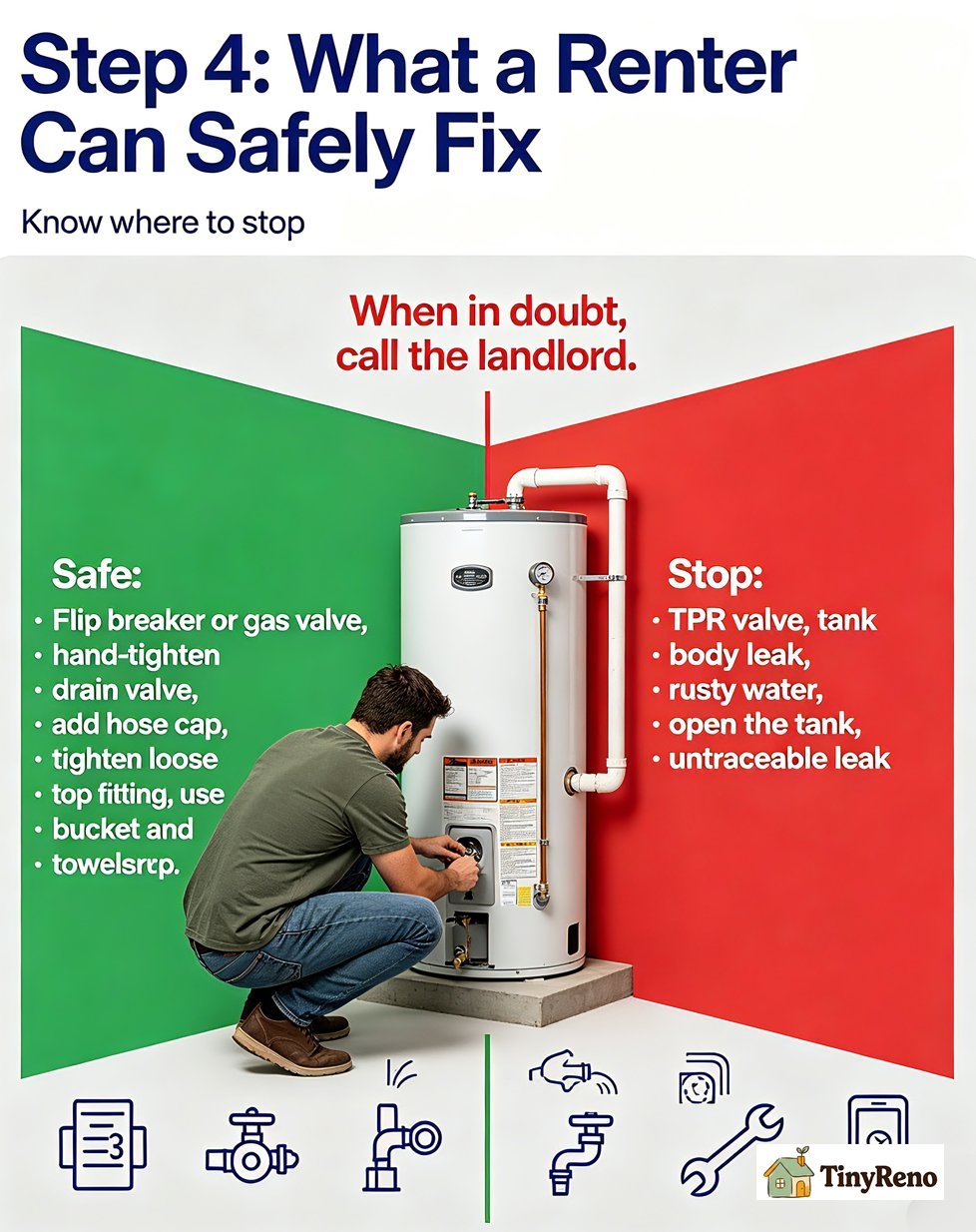
Step 4: What a Renter Can Safely Fix (And What You Must Not Touch)
Crossing the line can void your renter's insurance, put you on the hook for a new heater, or burn you.
Safe for most renters
- Flipping the breaker / gas valve to OFF before inspecting
- Hand-tightening a drain valve (clockwise, gently)
- Attaching a $3 hose cap to stop a drain valve drip temporarily
- Tightening a visibly loose pipe fitting at the top (quarter turn)
- Placing towels / a bucket / taking photos for documentation
Stop here and call the landlord
- Anything involving the TPR valve or its discharge pipe
- Any leak from the tank body itself (Zone 4)
- Any sign of rust-colored water at the base
- Any failure that requires opening the tank (anode rod, element, dip tube)
- Any leak you can't fully diagnose in 5 minutes
If you have any doubt, the repair isn't yours. Most lease agreements say so explicitly, and most state landlord-tenant codes put all water-heater repairs on the property owner. The same principle applies to a water heater leaking from the bottom that you can't fully trace.
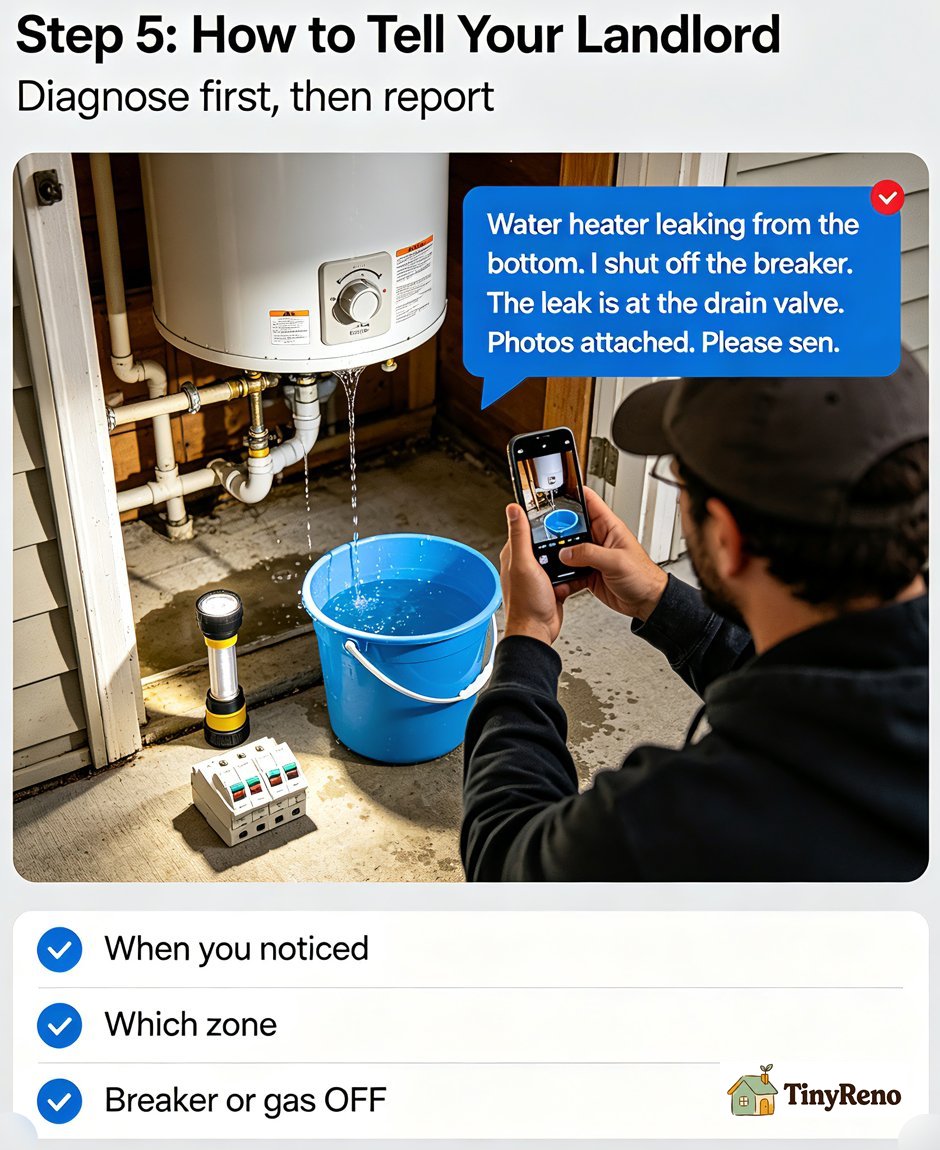
Step 5: How to Tell Your Landlord (Without Sounding Panicked)
"There's water under the water heater" gets a shrug. "Water heater leaking from the bottom — I shut off the breaker, the leak is at the drain valve, photos attached" gets a plumber dispatched the same day. A small wall fix request works the same way — diagnostic info beats panic.
Send the message in writing (text or email). Include:
- When you noticed the water
- Which zone the leak is in
- Whether you shut off the breaker / gas
- Photos of the puddle and the source
- Ask: "Please send a plumber today. I'm without hot water."
If the landlord doesn't respond within hours for an active leak, escalate. Most states have a "right to repair" clause — hire a plumber yourself and deduct from rent if the landlord fails to act within 24–72 hours. Check your local tenant-rights organization first.
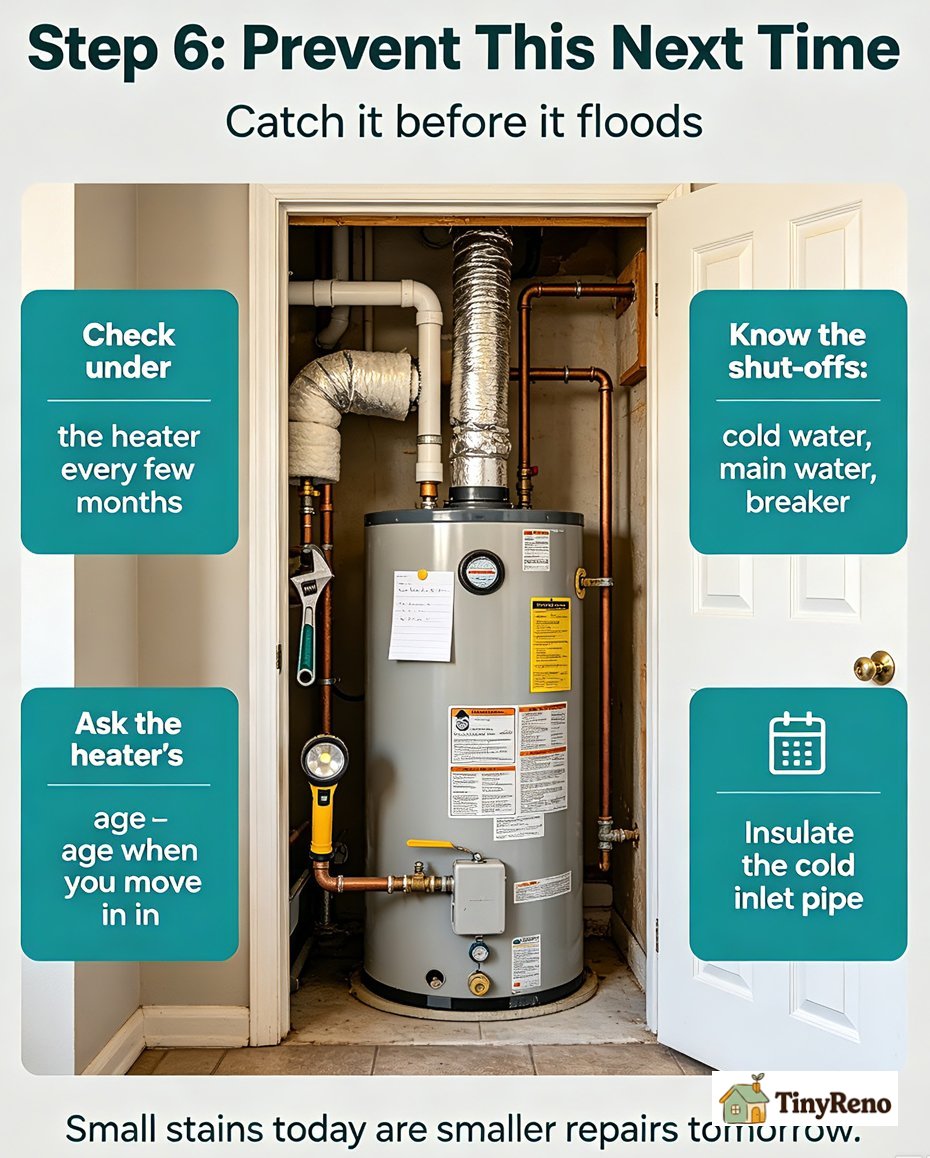
Step 6: Prevent This Next Time (Quick Wins)
You can't stop a tank from eventually failing, but you can catch it early.
Walk past the heater every few months
10 seconds. Look at the floor under it, the base of the tank, the pipes above. A small rust stain in October is a smaller problem than a flooded closet in March. If you're also noticing moisture issues in nearby rooms — like damp curtain rods or window condensation — that's another early sign worth flagging.
Know the shut-offs before you need them
Cold-water shut-off is on the pipe coming in from above. Main water shut-off should be on your emergency cheat sheet. The breaker should be labeled. Write all three on tape stuck to the closet door.
Ask the heater's age when you move in
Tank-style units last 8–12 years. If it's already 10 years old, the conversation is "replace this before it fails" — not "wait and see."
Insulate the cold inlet pipe
Pipe insulation is cheap, renter-friendly (foam sleeves with a slit), and reduces condensation on the cold pipe during humid weather. It won't stop a real leak, but it cuts down on the false-alarm puddles that fool people into thinking they have one.
The Bottom Line
A water heater leaking from the bottom looks identical from across the room — a puddle on the floor. The cause ranges from a $3 hose cap to a $1,200 tank replacement, and renter responsibility ranges from "screw this on" to "absolutely do not touch this." The 4-zone test is the only thing that tells you which one you're in.
Zone 3 leak = most fixable, cheapest repair. Zone 4 leak = heater is on its way out, your only job is to document, notify, and not make it worse.
Either way, your next call after the breaker should be to the landlord. The water heater is their problem — including the plumber bill.


Discussion (0)
Sign in to join the discussion