

I have lived in four apartments in seven years, and in none of them was I allowed to drill holes for curtain rods. Two landlords said no outright. One said yes, then charged me $80 when I moved out to patch two quarter-inch holes I had made in the window frame. The fourth place had a clause in the lease that any wall damage above nail-hole size forfeited my whole security deposit. The same lease-clause trap that makes renters skip curtains is the one that catches people trying to apply removable wallpaper with the wrong prep, or mount a window AC bracket without checking the lease first.
So I became weirdly obsessed with curtains that look like a real adult lives there, with zero tools that touch the wall.
That obsession cost me a curtain rod that fell on my cat at 2 AM, a static-cling "film" I cut with the wrong scissors, and about $40 in failed experiments across the first two apartments. It also taught me which no-drill tricks actually last past month three, and which ones quietly tear paint off the wall in slow motion so you only notice when you move out.
This is the short list. Three methods that survived a full lease. Two that I would never use again, even if you paid me.
Trick 1: Kwik-Hang brackets for standard window frames
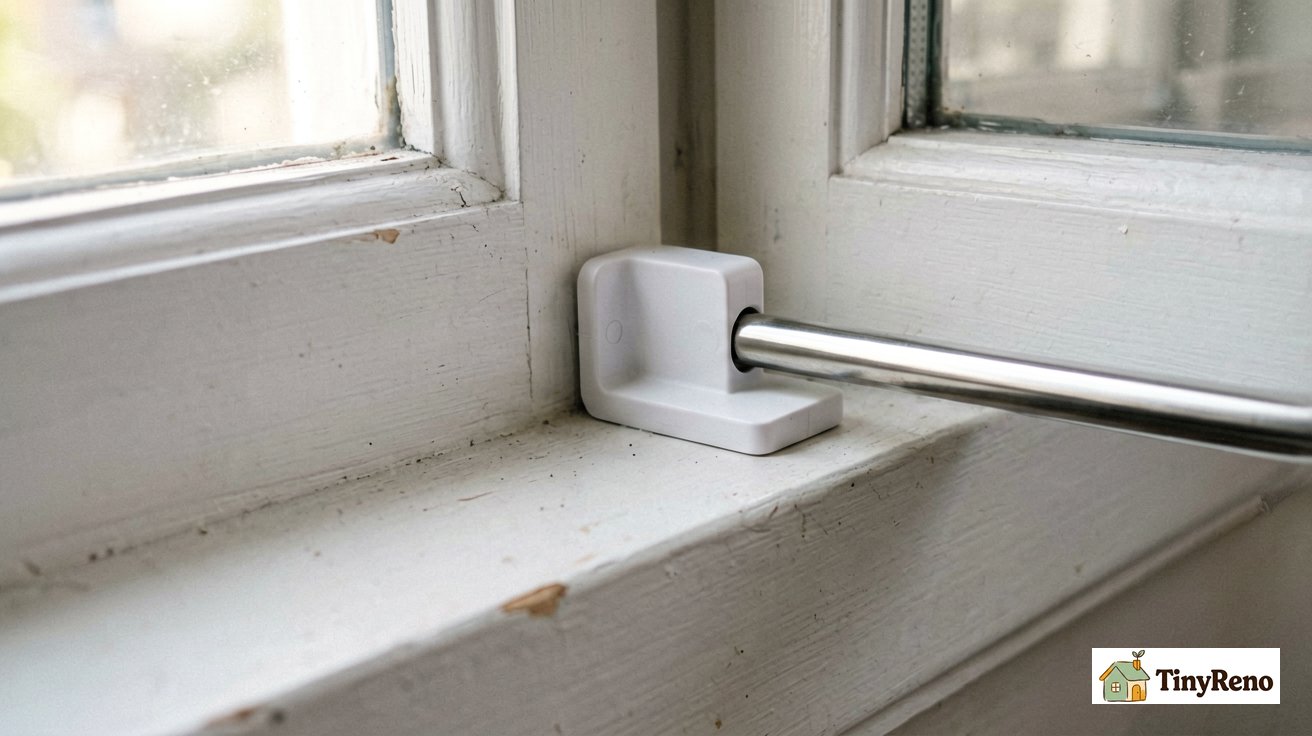
Kwik-Hang brackets are the only reason my third apartment's curtains ever looked intentional. They are small L-shaped plastic pieces that hook onto the inside lip of your window frame. You put the curtain rod on top of the L. No screws. No adhesive. Nothing touches the drywall at all.
The reason these worked when other things failed is that they don't carry the weight of the curtain through the wall. They carry it through the window frame, which is part of the building. Your landlord can't be mad at you for hanging something on a window frame. You are basically using the window.
Here is the part most guides skip: you have to measure the depth of your window frame before you buy. Kwik-Hang comes in two depths, and if you grab the wrong one, the bracket either will not sit flush or will sit so loose that the rod tilts forward when you pull the curtain. The bracket needs the deeper of its two notches to clear the frame edge. I learned this by buying the wrong size twice.
The whole install takes maybe eight minutes. Slide the brackets onto the frame, drop the rod in, hang the curtain. Done. I had these up for 14 months in apartment #3 and the only thing I had to do at move-out was wipe the window frame with a damp cloth.
The catch is that Kwik-Hang works on standard window frames, meaning the kind that have a flat interior lip at least a quarter inch deep. If your window frame is flush with the wall (some newer construction), the bracket has nothing to hook onto. That was apartment #2. Keep reading, that one had a different fix.At move-out the only line on my checklist was 'wipe window frame' — took 40 seconds, got 100% of my deposit back on that window.
Trick 2: Magnetic curtain rod for metal doors and steel frames
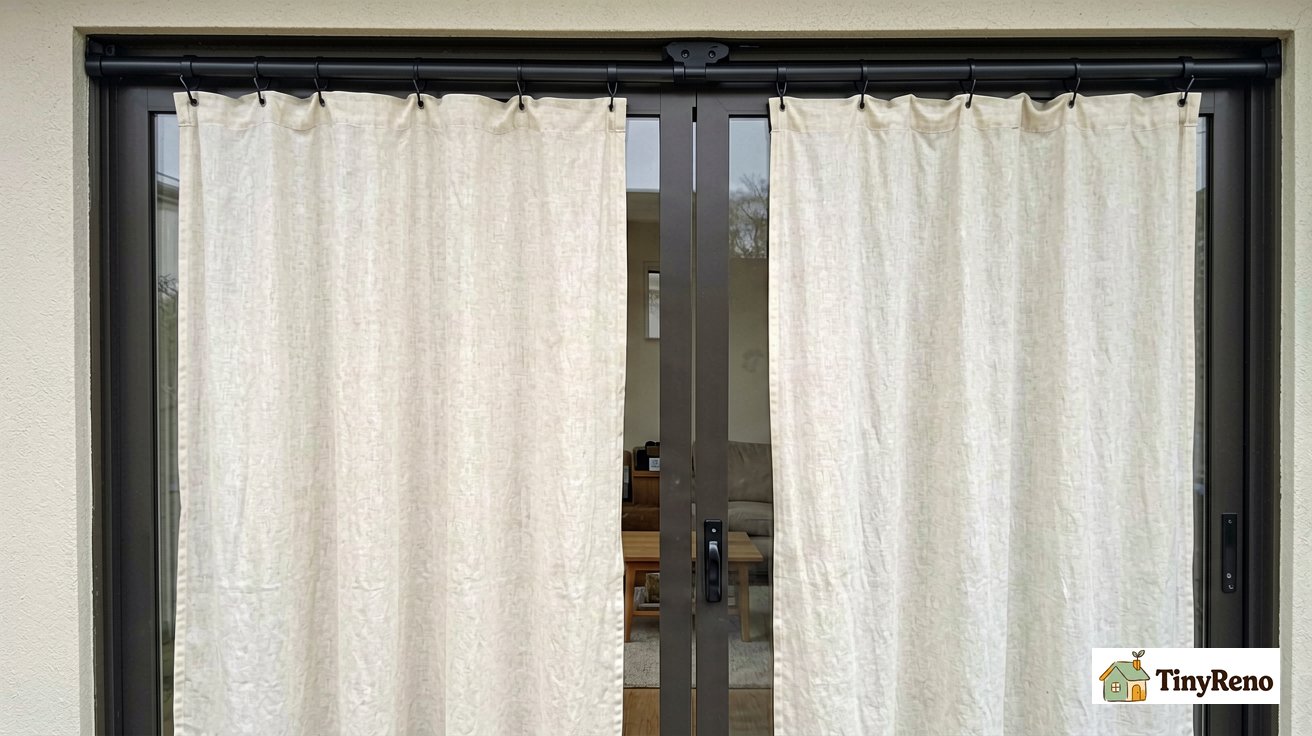
Apartment #2 had a sliding glass door to the patio, framed in dark metal. I had been hanging a bedsheet over it for six months when a neighbor told me magnetic curtain rods exist. I did not believe her. I bought one for $18, mostly to prove her wrong.
She was right. The rod is two pieces of hollow metal with strong neodymium magnets at each end. You stick one end to the metal door frame, the other end to the opposite metal frame, and the magnets hold the rod in place across the gap. The curtain hangs off the rod like normal.
This is the trick I never thought would work, and it has now survived two apartments. The key thing the product photos don't tell you is that the magnets need a flat steel surface to grip. If your door frame is aluminum (most modern sliding doors are), the magnets will not hold. Apartment #4 had an aluminum frame and I had to use Trick 3 instead. If your frame is steel — old buildings, fire doors, some patio doors — the magnets hold like the rod is bolted in.
I have one small warning: the rod will come down in a strong wind if you leave the patio door open and a gust catches the curtain. Mine fell once during a thunderstorm and bent a butter knife that was on the floor (no other damage). I now slide the rod down when the door is open for more than a minute. Five seconds of habit, zero drama.
Trick 3: Tension rod for narrow window frames
Apartment #4 was the one with the lease clause that scared me. It also had the narrowest window frames I had ever seen — less than an inch of depth from the wall to the glass. Kwik-Hang had nothing to hook onto. The metal patio door was aluminum. I was back to the tension rod, but this time I knew what I was doing.
Tension rods are the cheap, spring-loaded rods you probably remember from college showers. They work for narrow window frames because they sit inside the frame between the two side walls, pressing outward with spring pressure. No contact with the drywall. No contact with anything except the window frame itself.
Here is what bit me the first time I tried this, in apartment #1: I bought a tension rod that was too short and cranked it to extend across the wider window. The spring pressure was uneven and the rod slipped at 2 AM. Cat woke up. I woke up. Rod, curtain, and cat were all on the floor in different parts of the room.
The fix is to measure the exact width of the window frame at the height you want the curtain to hang, and buy a rod that is rated for that width with maybe half an inch of slack. Do not try to stretch a too-short rod. The slack is what gives the spring even pressure. A rod rated for 24 to 36 inches used in a 30-inch window is exactly what you want.
For the curtain itself, use a lightweight panel. Tension rods will slowly creep downward if you hang a heavy velvet drape off them. A basic cotton or linen curtain from a discount store is fine. I have had the same tension rod up for 11 months in apartment #4 and it has not moved a millimeter.
What not to do, even though the internet tells you to
Two things I will never do again, even if a Pinterest pin says they work great:
Command Hooks as curtain rod brackets. I tried this in apartment #1 for about two weeks before the hooks started to peel off the wall one by one. The rod was heavy. The curtain was heavier. The hooks are rated for maybe five pounds each and a curtain rod with fabric is closer to eight. Worse, when the hooks finally let go, they took a layer of paint with them. I had to pay $40 out of my deposit to patch and repaint three spots. The whole point of no-drill is to not damage the wall, and Command Hooks defeat that point within a season.
Static-cling window film in a bathroom. I tried this in apartment #2 because the bathroom window had zero privacy and the landlord would not let me install anything on the glass. The film looked great for about three weeks. Then the steam from showers started to lift the edges. By month two it was bubbling in the middle. By move-out it had fused to the glass in some spots and peeled off in others. Static-cling film is fine for a window that never gets wet. It is a disaster in a steamy bathroom.
The real lesson
After four apartments and around $140 in failed and not-failed buys, the no-drill curtain setup that actually looks like a custom install costs about $25 total. Two Kwik-Hang brackets, a basic curtain rod, and a $15 curtain panel from the discount store down the street. If your window is unusually narrow or your door frame is steel, swap in the tension rod or the magnetic rod instead. None of them touch the drywall. All of them come down in under five minutes with zero damage.
You can have curtains in a rental. You just cannot use the methods that show up first when you search. If you want more renter-tested projects, I wrote up the same no-drill pattern for kitchen cabinet organizers, and the same quiet-window logic for rental window AC setups.
FAQ
Q: Can curtains in a rental actually look like custom window treatments, or will it always be obvious they are temporary?
A: Honestly yes, they can look custom. The trick is the curtain panel: choose one that skims the floor, hang the rod close to the ceiling, and use a rod that extends past the window frame so curtains stack outside the glass. Most people who say "it looks cheap" use a rod too narrow and curtains too short. The no-drill hardware is invisible. The curtain choice is everything.
Q: Which curtain rod type is best if I am not allowed to drill in my apartment?
A: For a standard window with at least a quarter inch of frame depth, Kwik-Hang brackets are the most stable and the easiest to remove. For a steel patio door or metal window frame, a magnetic curtain rod works but only if the frame is actually steel — test with a refrigerator magnet before you buy. For a narrow window with a frame too shallow for Kwik-Hang, a tension rod rated for your exact window width works, but use a lightweight curtain or the rod will creep down over time.
Q: Are noise-reducing or blackout curtains worth the extra money in a rental?
A: Only if you have a specific problem they solve. Blackout curtains are worth it if streetlight or morning sun is the reason you cannot sleep — they also tend to be heavier, so pair them with Kwik-Hang or a magnetic rod, never a tension rod. Noise-reducing curtains (the thick triple-weave kind) are mostly marketing. They will not stop a loud neighbor. If noise is the issue, the fix is a rug and a door seal, not a heavier curtain.


Discussion (0)
Sign in to join the discussion