

I was slicing an onion. I turned around to grab the oil. When I turned back, my silver Persian was standing on the cutting board, calmly licking the onion juice off the wood like she had paid rent.
I yelled "NO". She jumped down. Same energy as when my cat scratched the wall corners apart — yelling never fixes anything, only deters you while you are watching. She jumped back up four minutes later.
That was the night I started looking for actual solutions instead of yelling her name every twelve minutes. The yelling did nothing. The actual solutions did most of the work. Here are six things I tried, in roughly the order I tried them, that cut her counter time by maybe 80 percent in my apartment.
Why Cats Love the Counter Anyway
Before the fixes, the explanation: cats prefer counters because they are high, warm (kitchen appliances throw heat), close to food smells, and smell like you. Your cat is not being defiant. Your cat is being a cat. That framing matters because it stops you from taking the next six fixes personally when the cat walks around the foil and sits on the cutting board anyway.
1. The Aluminum Foil Trick
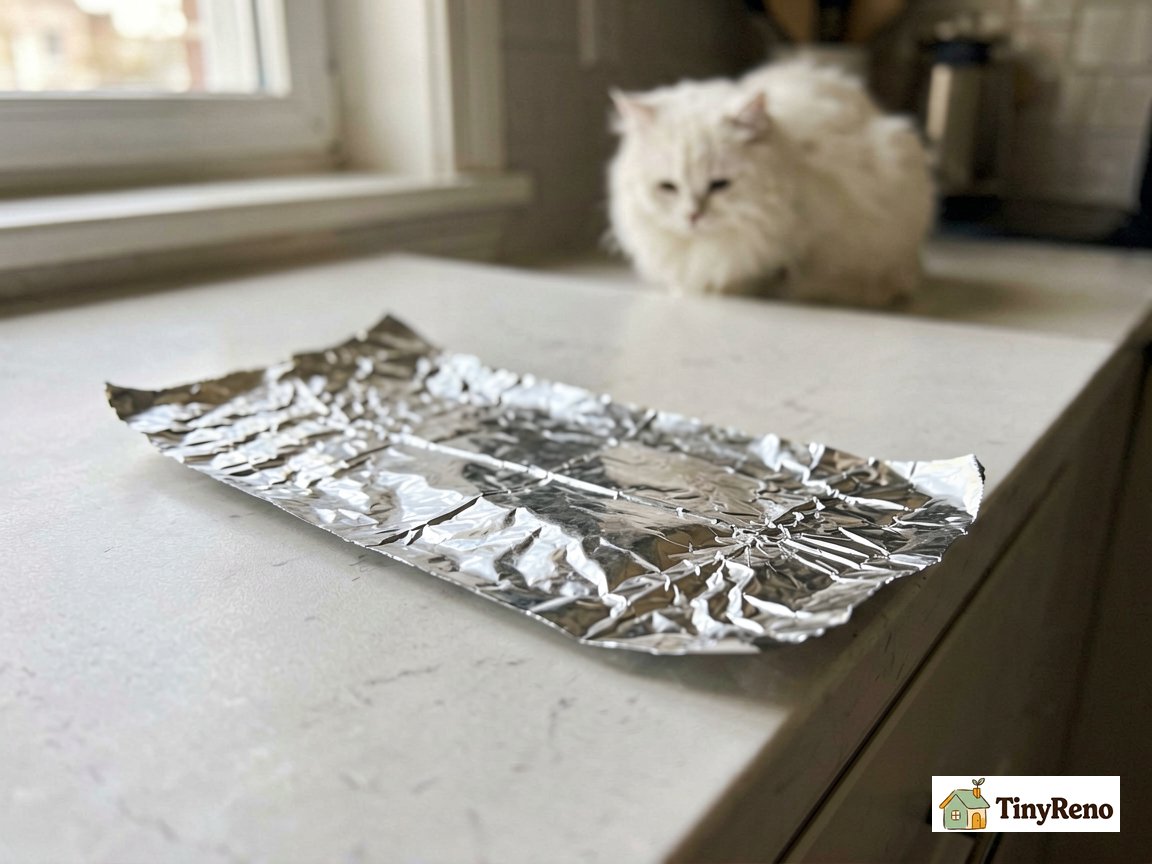
Lay a strip of aluminum foil along the front edge of the counter, sticky side up. The foil crinkles when her paws touch it, the surface feels wrong, and the sound startles without hurting.
The key is the front edge — that is where she lands when she jumps up. If you cover the whole counter you will spend a week tearing it off every time you cook. Just the front six to ten inches is enough to break the landing habit.
The reason this works the first time and sometimes stops working by week three is that cats are smart enough to learn to land further back on the counter. The fix is to move the foil back an inch or two every few days. The cat learns that the entire counter surface is suspicious now, not just the front strip.
What I used to do wrong: I covered the whole counter. Within four days I had foil stuck to my phone, foil in the toaster, and a cat who had decided the back of the stove was her new throne. Targeted foil works. Full-coverage foil is chaos.
2. Double-Sided Tape on the Edge
The same front-edge logic, but with double-sided tape instead of foil. Cat paws are sensitive to sticky surfaces — the tape does not hurt, but the sensation is unpleasant enough that she walks off after one step.
Use painter's tape (the blue kind) with double-sided sticky applied to the counter-facing side. The painter's tape protects your counter from any residue when you peel it off in a week or two. Regular clear tape works too but can leave a faint line on certain counter finishes, especially laminate.
This is the fix I keep coming back to after trying everything else — same way I finally stopped my cat from destroying the door frame by accepting that the cat was going to scratch SOMETHING and giving her a designated post. The cat lands, hits the sticky, looks betrayed, jumps down. Within two weeks she stopped trying the front edge entirely. She walks to the back of the counter now and I have just given up on the back of the counter. Eighty percent reduction is the realistic goal, not zero.
3. The Citrus Spray Boundary
Cats dislike citrus. Mix water with a few drops of lemon or orange essential oil in a spray bottle. Lightly mist the counter edge and any spot where she tends to land. Reapply every day or two because the scent fades.
This is the gentlest fix in the list and also the one with the weakest results. It works on some cats and is invisible to others. My cat hated it for about three days, then started walking through the citrus mist like she had decided it was not her problem. The citrus still works as a daily top-up alongside one of the other fixes, but on its own it is more like a reminder than a deterrent.
Do not spray citrus directly on the cat. Spray the surface. The cat smells the counter from across the room and changes direction before jumping.
4. Give Her a Higher Place to Sit
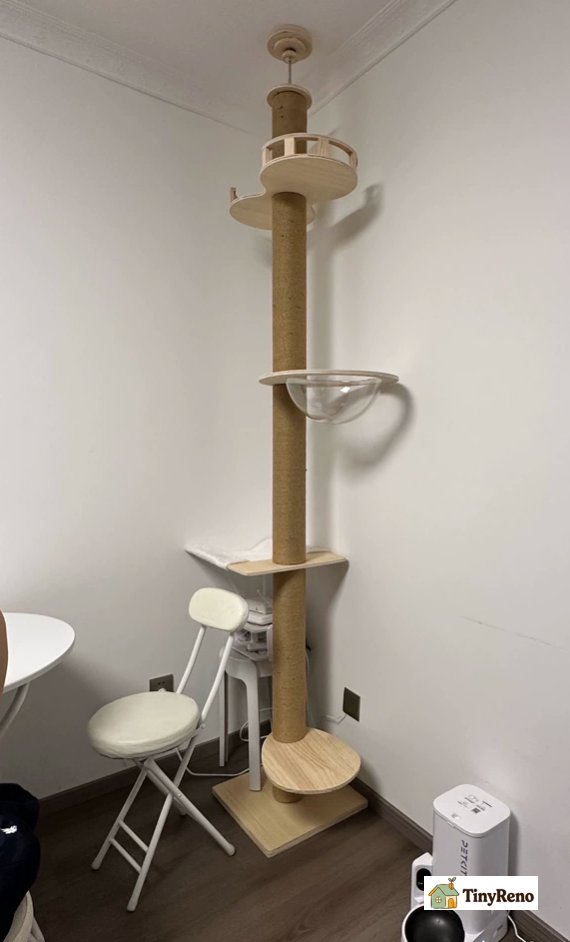
Cats want height. The counter is the highest surface in most apartments. If you give the cat a higher place to sit that is not the counter, she will often choose the higher place instead.
A tall cat tree by the kitchen doorway is the textbook fix. A cleared shelf above the fridge works if you do not have floor space. A window perch with a view of the street is the dream but most renters cannot install one without drilling.
What worked in my apartment: a 1.4-meter cat tree placed inside the kitchen doorway, not in the living room where the cat tree usually goes. Inside the doorway means she has a perch. I have already cleaned the grease off the kitchen wall behind the stove twice this year — the cat tree means she is up high looking down at me cooking instead of being on the counter looking up at the food. that is closer to counter height than to floor height. She started choosing the tree over the counter about a week after I moved it. She still gets on the counter when I am not home — and then I come home to a cat hair situation that takes twenty minutes to fix because she shed all over the cutting board., but she is on the tree when I am in the kitchen, which is when I actually care.
The cost: a decent cat tree runs fifty to a hundred and fifty dollars. If you cannot afford that, a stack of two or three firm cushions on top of a tall dresser can substitute. Anything that gets her above counter height is the point.
5. Close the Door (When You Can)
The simplest fix in this list, and the one with the most asterisks. Close the kitchen door when you are cooking or eating. The cat cannot get on the counter if the cat is not in the kitchen.
The asterisks: a lot of apartments are open-plan, where the kitchen is part of the living room and there is no door. Even when there is a door, a determined cat can push through a door that is not latched. And some landlords do not want you leaving the kitchen door closed for fire-code reasons. Check your lease.
What I do: I close the door when I am actively cooking because that is when the cat is most interested (raw chicken, fish, anything with strong smell). The rest of the time the door is open and the other five fixes are doing the work. Cooking time is the only time I need a 100 percent solution.
6. Block Access With Cutting Boards and Pans
When the cat has decided she is getting on the counter regardless, the last fix is to make the landing physically unattractive. Stand your cutting boards upright along the back of the counter, dry the pans and stack them so they clatter when something lands on them, leave a baking sheet half-off the edge so it tilts when touched.
This is the messy fix. It is also the most reliable. A cat who lands on a wobbly cutting board or a clattering baking sheet will not try twice. The downside is that you have to set this up every time you leave the kitchen, which is its own chore.
I use this only when I am cooking something the cat cannot have — raw meat, chocolate, onions, garlic, anything in the allium family. The setup takes thirty seconds. Same routine as my cat litter smell cleanup schedule — do the thirty-second setup before you leave the kitchen, and the smell problem stays small enough to ignore. The cat looks at the counter from the doorway, decides it is not worth the effort, and goes to the cat tree. Effective but not a daily solution for me.
What I Won't Do Anymore
A few things I tried that did not work or made things worse:
The spray bottle. I sprayed water at her when she jumped up. She jumped down. She also started associating me with the spray bottle, which made her avoid me when I was in the kitchen instead of avoiding the counter. She got on the counter more, not less, because I was not in the room to spray her. Spray bottles break trust. Do not spray your cat.
Yelling her name. I yelled "PERSIA NO" so many times that my neighbor asked if everything was okay. The cat associated her name with the yelling and stopped responding to her name entirely. She still got on the counter. I had to start using treats to get her to come when called. Do not yell your cat's name in anger.
Sticky paws tape. The commercial product designed for this. Worked great for one cat I had years ago. Did nothing for this cat. Also leaves residue that is annoying to clean. The painter's tape version above is cheaper and works as well or better.
Closing
You will not get a cat to zero counter time. She is a cat. She wants the high warm place near the food. The goal is to make the counter annoying enough that she chooses a different high warm place, most of the time, and only gets on the counter when you are not looking.
In my apartment, the painter's tape on the front edge plus a cat tree by the doorway cut Persia's counter time by maybe eighty percent. The citrus spray handles the other fifteen percent on bad days. The remaining five percent I just accept, because I once caught her licking the cutting board and I would rather share a cutting board than spray her with a water bottle every time I cook.
If you only do one of these fixes, do the painter's tape. It is cheap, it does not hurt her, and it works the fastest. The cat tree is the long-term fix. Everything else is a daily reminder.


Discussion (0)
Sign in to join the discussion