

A friend crashed at my place for two weeks while her building did pipe work. Day 3 she said, very gently, "so… your apartment kind of smells like litter box, right?" I played it off. Day 7 she asked if I had an air freshener she could borrow. Day 10 I started pretending I wasn't home when she came back early.
The litter box lives in a hallway cabinet, sealed, hooded, with a charcoal filter pad on top. And still — the entire 600-square-foot apartment smelled like a small barn by Friday afternoon. I had 14 days before she left and 14 days before I'd admit to myself that the problem was real.
If you're renting a small apartment with a cat, you've probably had the same moment. The internet will tell you to "scoop more often" or "buy better litter." That's not the whole answer. Here are the six fixes that actually moved the needle — and two that made things worse.
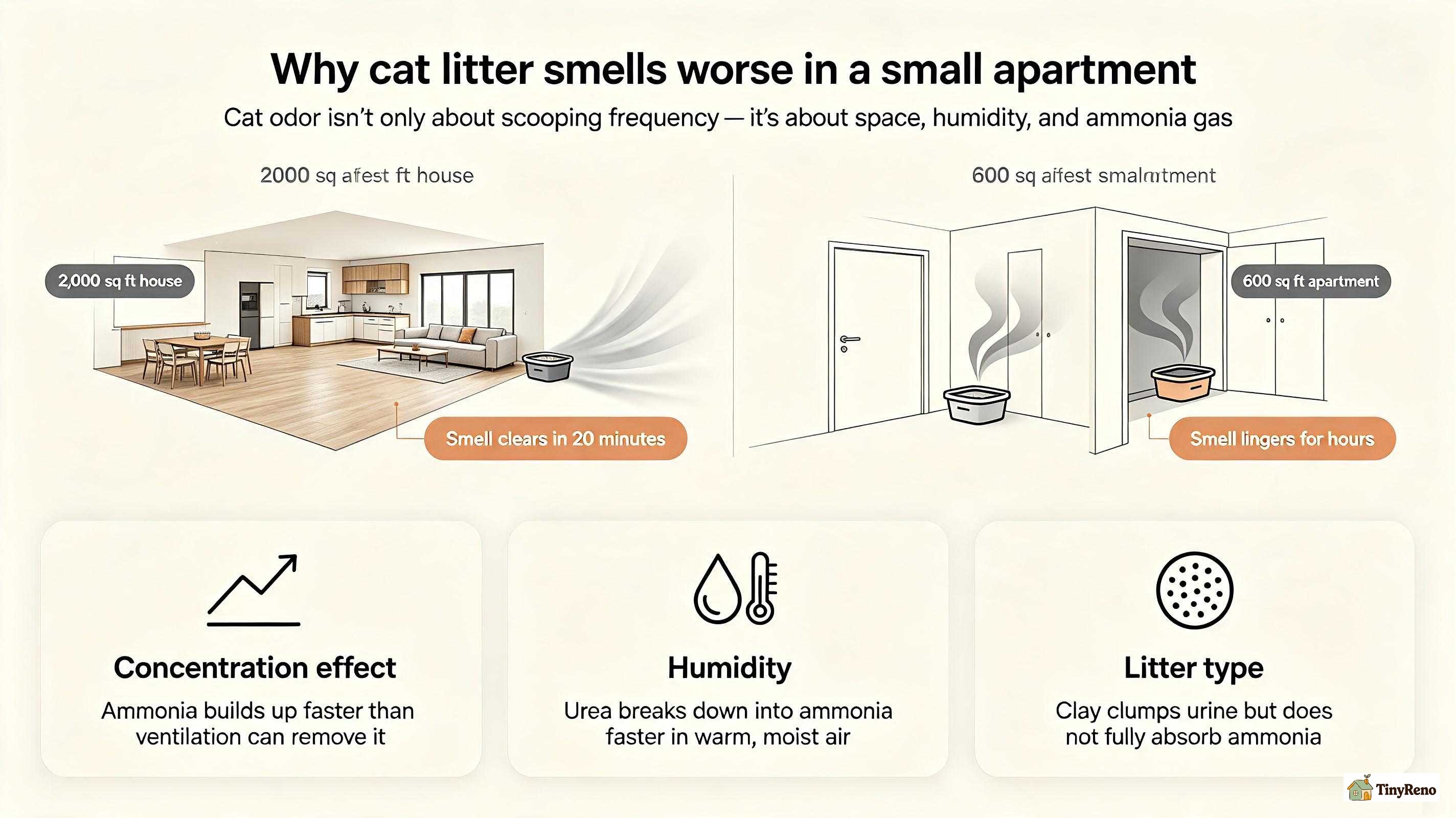
Why Apartment Cat Litter Smells 3x Worse Than You'd Expect
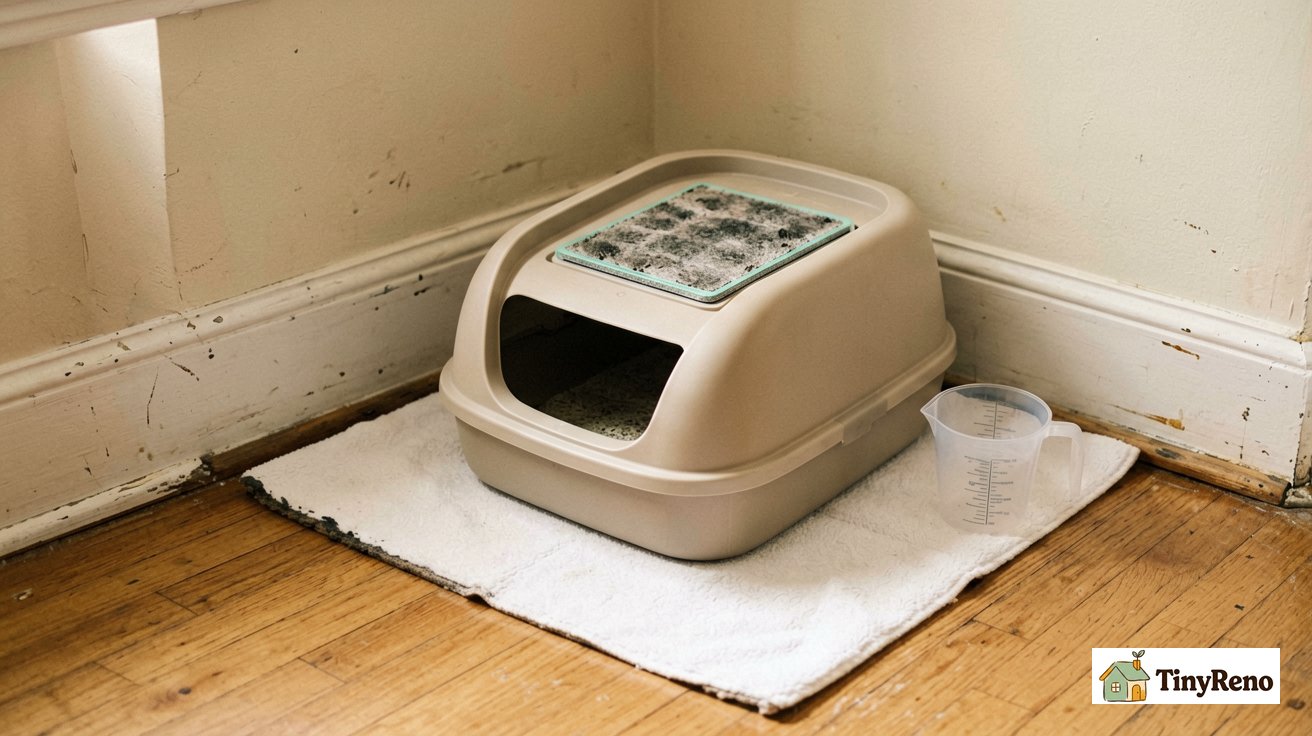
Cats aren't smelly animals. Cat litter boxes are. The smell gets worse the smaller your apartment gets, because there's no dilution space. A box in a 2,000-square-foot house with open floor plan clears in 20 minutes. The same box in a 600-square-foot apartment with the door closed lingers for hours.
Three things stack against the renter cat owner. Concentration effect: ammonia off-gasses from used litter continuously, and in a small space the concentration rises faster than your return air vent can pull it out. Humidity: cat urine contains urea, which breaks down into ammonia faster in warm, humid conditions — heat shifts the NH₃ equilibrium toward gas. Litter type: standard clumping clay clumps urine but doesn't absorb ammonia, so ammonia slowly off-gasses from every clump you've ever left in the box.
The key insight: the smell isn't "the litter isn't good enough." The smell is ammonia that has already escaped the box. You can swap litter every week and still have the same problem. That's why the cheapest fixes on the internet usually disappoint.
Cat smell isn't the only apartment cat problem I keep running into — if your cat is also scratching the corners of your walls, I covered that in a separate piece on the renter fixes that actually stopped it: Cat Scratched the Corner of My Wall — 6 Renter Fixes That Saved My Deposit.
The 6 Fixes I Tested (Day 1-14, Same Cabinet Setup)
I kept the litter box in the same hallway cabinet the whole time and changed one variable per day. Here's what each fix did over 14 days.
Fix #1: Switch Litter Type
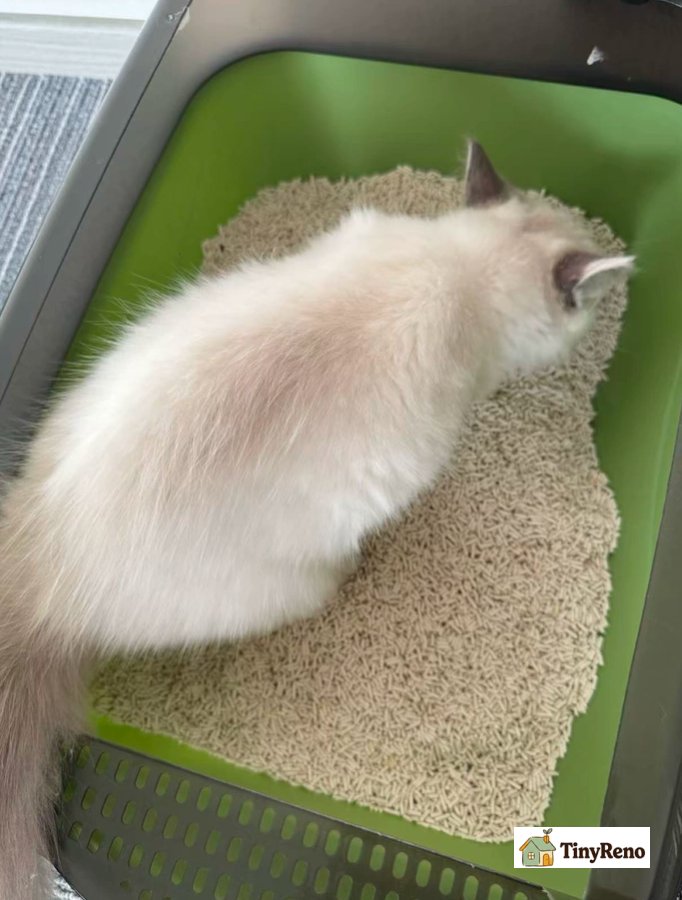
From clumping clay to tofu pellet litter ($14 per 6-liter bag). Tofu pellets clump and suppress ammonia noticeably better than clay.
- Price: $14 per bag (lasts ~3 weeks for one cat)
- Effect: Noticeably less, maybe a third immediately
- Side effect: My cat refused the box for two days. Tofu pellets feel different under paw. Had to mix 50/50 with old clay and gradually increase the tofu ratio over 5 days.
Necessary but not sufficient. If you stop here, you'll be disappointed. The clay-to-tofu swap is table stakes, but on its own it doesn't fix the smell.
Fix #2: Add a Baking Soda Layer on Top
Sprinkle a thin layer of baking soda on the litter after each daily scoop. The baking soda reacts with ammonia to form ammonium carbonate, which has much less odor.
- Price: $1 per box (lasts 6+ months)
- Effect: About 15% reduction
- Side effect: Some cats sneeze from the dust at first.
Worth doing because it's so cheap, but it's an assist, not a primary fix.
Fix #3: Upgrade to Medical-Grade Carbon Filter
The carbon filter pad that came with my hooded litter box was a thin felt-like sheet that did almost nothing. I replaced it with a 4-pack of medical-grade activated carbon pads ($18).
- Price: $18 per 4-pack (each lasts ~30 days)
- Effect: About 40% reduction at the source
- Side effect: Carbon saturates around day 30 in humid climates and stops working. Swap on a schedule, not when it stops.
This was the single biggest improvement per dollar. The stock filter pads on most hooded litter boxes are basically decorative. A real carbon filter actually does the job the marketing copy claims.
Fix #4: Move the Box Into an Enclosed Closet or Balcony Storage
I moved the box out of the hallway cabinet (door but no ventilation) and into the small storage closet on my building's balcony. The closet has a louvered door for airflow.
- Price: $0
- Effect: Most of it, honestly in apartment smell
- Side effect: Only works if you have a balcony closet, a bathroom with a door that closes, or a spare closet with ventilation. Also, the cat has to walk further — some cats will hold it and develop urinary issues if the box is too far away.
Physical isolation beats chemical adsorption every time. If you have any option to put the box in a separate ventilated space, that will do more than any product you can buy.
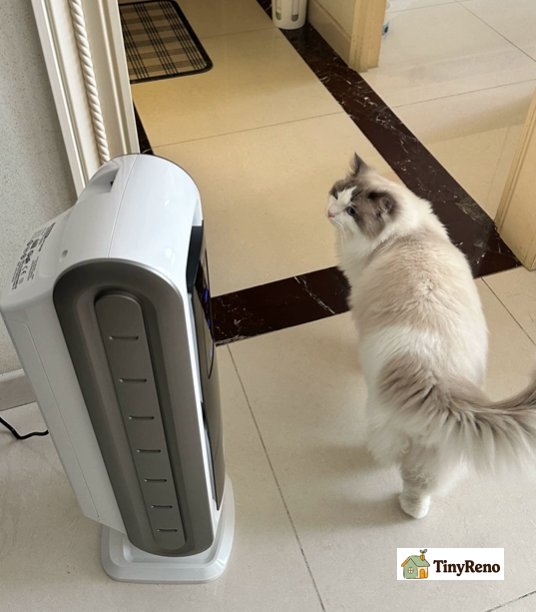
Fix #5: Add a Small HEPA Air Purifier Near the Box
Bought a $40 HEPA purifier with an activated-carbon pre-filter, placed in the hallway blowing toward the litter box closet.
- Price: $35-60
- Effect: Continuous 50% reduction while running
- Side effect: Standard HEPA filters only catch particles — they don't filter gases. You need the activated-carbon pre-filter stage to adsorb ammonia. Pure HEPA with no carbon will move air around but won't touch the smell.
Force multiplier for the other fixes, not a standalone solution.
Fix #6: Scoop Twice a Day + Add a Puppy Pad Under the Box
From scooping once a day to twice — morning before work, evening after. Also added a washable puppy pad under the box to catch kicked-out litter.
- Price: $8 for 50 disposable pads, or $15 reusable
- Effect: About 60% reduction in source smell
- Side effect: Twice-daily scooping is a real commitment. Disposable pads look kind of ugly; reusable ones need weekly washing.
Lowest-cost, highest-ROI fix on the list. Every other fix assumes the box is being maintained; this one makes the maintenance count for more. Urine that sits 12 hours instead of 24 produces dramatically less ammonia.
The 3-Step Combo That Actually Worked
Single biggest improvement was Fix #3 (real carbon filter) plus Fix #4 (relocate to ventilated closet) plus Fix #6 (scoop twice a day). Total first-month cost: about $26 (one tofu bag, one carbon filter 4-pack, one box of puppy pads). Ongoing monthly cost: about $10 for carbon filters and $5 for litter.
If you can only do one thing, do Fix #3 — replace the stock filter pad with a real one. That alone will probably surprise you. The worst combination I tried was skipping Fix #6 while doing everything else. The smell persisted because the source was still producing ammonia faster than the filter and purifier could clear it. Fix the source first, then add the controls.
4 Things That Made the Smell Worse
Mistake #1: Scented litter. Adds fragrance that competes with ammonia. You get cat-litter-plus-floral-bouquet, which is more offensive than either alone. Most cats also dislike scented litter and may avoid the box.
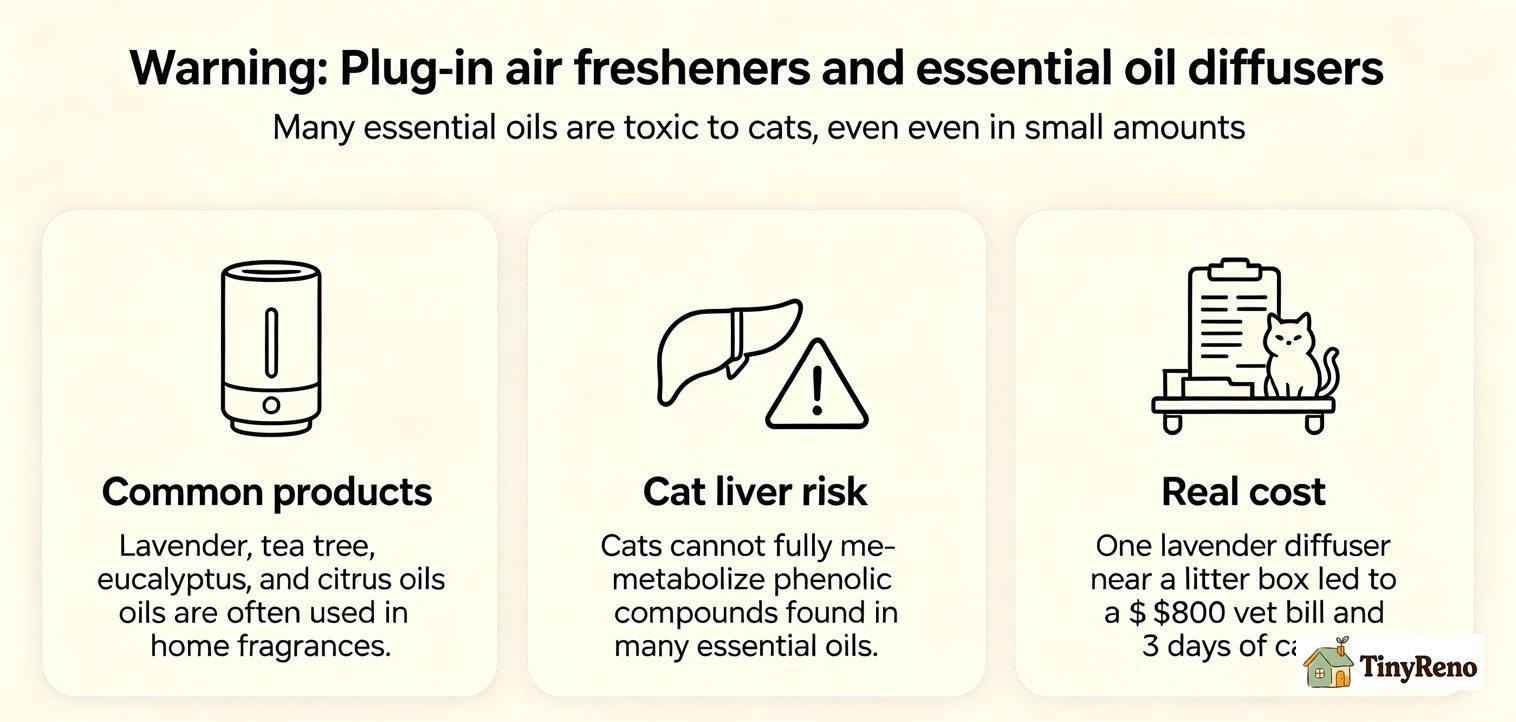
Mistake #2: Plug-in air fresheners or essential oil diffusers. Many essential oils (lavender, tea tree, eucalyptus, citrus) are toxic to cats — their livers can't metabolize the phenolic compounds. A friend's cat spent 3 days at the vet after a lavender diffuser was running near her litter box. The bill was $800. Don't do this.Call your vet if you're unsure — I'm not one, I just learned this the expensive way via my friend's $800 bill.
Mistake #3: Candles near the box. I tried cinnamon candles for a week. Candle heat accelerates ammonia off-gassing (higher temperature shifts the equilibrium toward gas). The candle scent mixed with the litter smell made the whole room worse.
Mistake #4: Enzyme cleaner on the floor near the box. Enzyme cleaners are for breaking down fresh urine before it dries. They can't reach ammonia that's already soaked into the subfloor, and using them on the floor near the box can encourage the cat to mark that spot again because the cleaner has a faint smell cats find interesting.
The Move-Out Cheat Sheet
If your lease has any of these phrases — "pet odor removal," "carpet cleaning at move-out," "deep cleaning required" — start building evidence now, not 14 days before you leave.
Day 1 (move-in): Photograph the litter box area from four angles — straight on, left close-up, right close-up, overhead. If the box is in a closet, photograph the closet floor from two angles. Email the photos to yourself so the timestamp is on a server you control.
Every month: One photo from the same straight-on angle. Ten seconds. Zero cost. This is your maintenance log.
30 days before move-out: Deep clean — empty the box, wash with mild dish soap (no bleach — bleach + cat urine creates toxic chloramine gas), rinse twice, refill with fresh litter. Vacuum the surrounding floor thoroughly. Photograph again from the four baseline angles.
Move-out day: Photograph once more, then hand the maintenance log to your landlord. Show them you've been actively managing the smell, not just reacting at the last minute.
My neighbor did nothing for two years, then tried to scrub the carpet for 4 hours the night before move-out. Final deduction: $350 for "odor remediation and carpet treatment." I did the monthly photos plus the move-out deep clean. Final deduction: $0. Same building, same landlord, same floor plan. The only difference was the paper trail.
If your lease has a "professional carpet cleaning required" clause, a $30 Rug Doctor rental for 24 hours counts as professional cleaning for most leases. Do it twice — forward and backward — and let it dry fully before your landlord walks through.
If you're also worried about wall damage from scratching (which goes hand-in-hand with smell concerns as a "did this tenant keep a pet?" signal), I covered the deposit-saving fixes in a separate piece: Cat Scratched the Corner of My Wall — 6 Renter Fixes That Saved My Deposit. Both go on the same move-out inspection checklist.
FAQ
Does baking soda actually work for cat litter smell?
Partially. Sprinkled on top of fresh litter, it reacts with ammonia to form less-smelly ammonium carbonate — maybe 10-20% reduction. It's a cheap assist, not a primary fix. For meaningful results you need to address ammonia that's already off-gassed (carbon filter, ventilated relocation, air purifier) and reduce how much is being produced (twice-daily scooping, better litter). Baking soda is 5% of the solution, not 50%.
Are essential oil diffusers safe around cats?
Most are not. Cats lack the liver enzymes to metabolize phenolic compounds found in lavender, tea tree, eucalyptus, peppermint, and citrus oils. Diffusing these near a litter box (or anywhere the cat spends time) can cause drooling, vomiting, wobbliness, and in severe cases liver damage. Safe options for apartment scent: unscented ventilation, simmering herbs on the stove, or beeswax candles far from the cat's space — never essential oil diffusers.
How often should I scoop the litter box?
Twice a day is the standard recommendation and noticeably better than once. The morning scoop catches the overnight deposit before it has 12+ hours to off-gas. The evening scoop catches whatever accumulated during the day. In a small apartment with a smell problem, three times is better — before work, after work, before bed. One minute per scoop. Significant smell reduction.
What type of litter controls odor best in a small apartment?
Tofu pellet and walnut litter both control ammonia noticeably better than standard clumping clay. Wood pellets (sold for horse stalls, also marketed as "feline pine") are also strong performers and cheapest. Downside is cost — natural litters run $10-20 per bag vs $5-8 for clay. Upside is a single bag lasts longer because pellets are more absorbent by volume. For one cat in a small apartment, the monthly cost difference is $5-10. Worth it if smell is chronic.
Can a HEPA air purifier remove cat litter smell?
Only if it has an activated carbon pre-filter. Standard HEPA filters catch particles but don't touch gases like ammonia. Look for purifiers marketed as "HEPA + carbon" or "HEPA + activated carbon pre-filter." The Levoit Core 300, Amazon Basics air purifier, and Winix 5300-2 are entry-level models with carbon stages in the $35-70 range. None eliminates the smell alone, but they make a meaningful dent when combined with source control.
How do I get cat urine smell out of carpet before move-out?
Three steps. First, blot (don't rub) any visible wet spots with paper towels until no more moisture transfers. Second, saturate with an enzymatic cleaner formulated for cat urine (Nature's Miracle, Simple Solution, or Rocco & Roxie) and let it sit 10-15 minutes so the enzymes penetrate. Third, rinse with cool water and blot dry. Repeat the enzyme step if any smell remains after 24 hours. If urine soaked into the carpet pad or subfloor, no consumer product will reach that deep — the carpet needs professional cleaning or replacement. Budget $30-50 for a Rug Doctor rental and a bottle of enzyme cleaner if you DIY.
Discussion (0)
Sign in to join the discussion