

I bought the same plastic drawer bins three times before I realized I was buying them for the same reason every renter does: they put a grid inside the chaos. Cube bins handle the outside of the closet — corners, walls, the spots with no furniture around them. Drawer bins handle the inside, where the chaos actually lives. After three rounds of trial and error, two of them the expensive way, here's what works, what breaks, and which bins I now refuse to buy.
1. What "Stackable Drawer" Actually Means (And What It Doesn't)
The term gets stretched. When a product listing says "stackable drawer storage," it usually means a rectangular plastic box with a pull-out drawer front and a flat top that another identical box can sit on. Some versions have a small lock-clasp on the drawer front. Some have wheels molded into the bottom. Some have ridges on the top surface that lock into the bottom of the unit above, so the stack doesn't slide when you pull a drawer.
What it doesn't mean: it isn't a flat-pack modular cabinet. It isn't the tall fabric cube with a removable bin inside. It isn't a single plastic tub with a hinged lid. Those are different products with different jobs. A stackable drawer bin is specifically the kind where you pull the front panel and the drawer slides out on rails or on molded ridges. If the drawer doesn't slide, it's a different product and this article isn't about it.
I bought a fabric drawer bin once because it said "stackable" — what it actually meant was "trust the fabric to hold the weight." I didn't. The bin on top collapsed and I spent an evening re-folding. A real stackable drawer bin is rigid. If the listing photo shows a floppy fabric front, it isn't the product this article is about.
2. The Three Sizes Worth Buying (And Why One of Them Doesn't Make Sense)
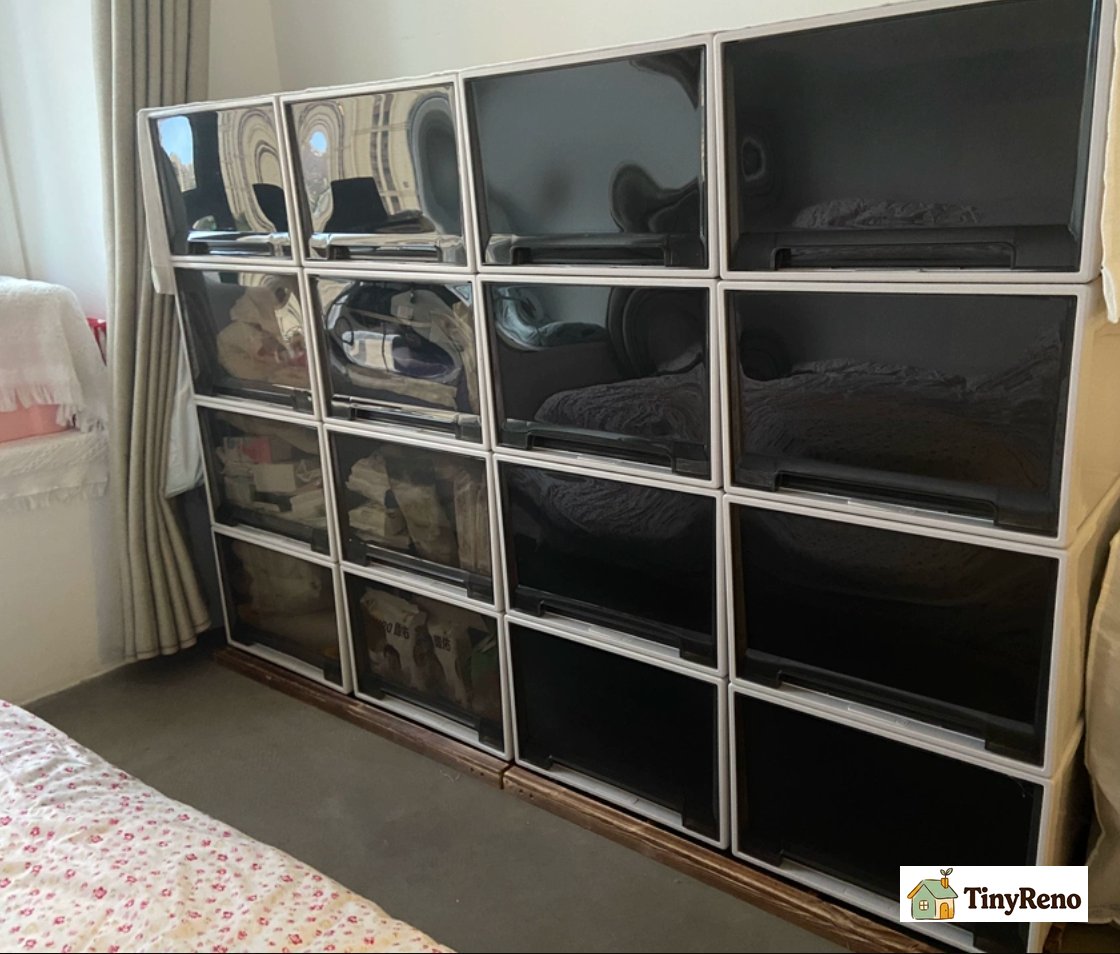
Drawer bins come in roughly three size brackets. The small bracket, 15 to 20 liters, fits socks and underwear. The medium bracket, 25 to 35 liters, fits T-shirts and light sweaters. The large bracket, 45 to 60 liters, fits winter sweaters and folded bedsheets. There's a fourth bracket above 60 liters, and that's the one I don't buy anymore.
The reason the over-60-liter bracket doesn't make sense: a drawer bin only works if you can pull it out without the whole stack falling over. A 60-liter drawer bin filled with winter coats weighs around 12 to 15 pounds. Pull that drawer out at full extension and you've shifted the center of gravity of the stack by about 8 inches. On a single-bin stack that's fine. On a four-bin stack of 60-liters, the math stops working somewhere around the third drawer pull.
Stick to the 15-to-60-liter bracket. Buy the size that fits the thing you actually need to store, not the size that promises to store everything. The bin that holds your socks should not be the same bin that holds your sweaters. Mixing sizes inside a single closet layout is fine. Mixing sizes inside a single stack is fine. What isn't fine is putting four 60-liter bins on top of each other and expecting the tower to stay upright after a year of use.
3. Why the Drawer-Front Design Beats Open-Top Bins Every Time
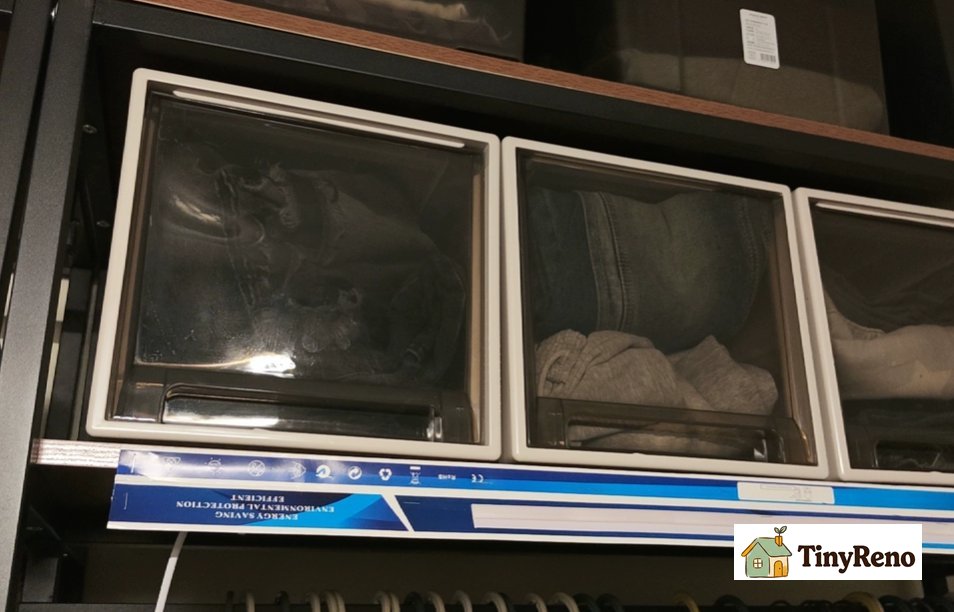
The first thing I stored in a stackable drawer bin was the thing I never wanted to see again — my sock drawer. With an open-top bin, I saw the socks every time I opened the closet. With the drawer-front bin, I saw a flat plastic panel until I pulled it open.
The drawer front hides the contents. In a closet where you have 30 seconds to grab a shirt, hiding the contents means your brain doesn't have to filter them out. The drawer front takes the visual noise off the table.
The second reason is practical. With an open-top bin, taking one thing out usually disturbs the others. With a drawer bin, you pull the whole drawer out and it becomes a tray. In a tight closet, this is the difference between finding your shirt in 20 seconds and finding it eventually.

4. The Stacking Rule I Learned After One Tipped Over
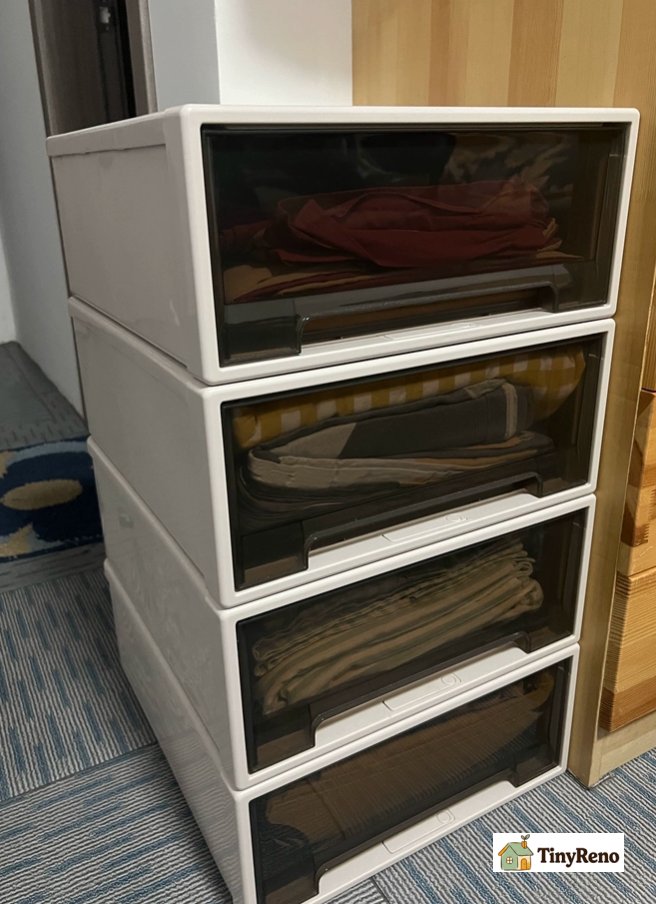
Here is the rule: stack no more than three high. Three bins loaded is 75 to 100 pounds — within the structural range of any reasonable drawer bin. Four bins is 110 to 140 pounds, where the molded rails start to flex, especially on the slightly uneven floor that every closet has. If you need to stack more than four bins, only lightweight items can be placed inside them.
The reason I learned this the way I learned it: I had a four-bin tower of 35-liter bins in the corner of my bedroom closet. The bottom bin held jeans. The second held sweaters. The third held sheets. The fourth, on top, held winter coats. One morning I pulled the bottom drawer out to grab a pair of jeans and the whole tower rocked forward about two inches. The tower didn't fall, but I could feel it wanting to. I pulled the fourth bin off the top that night and put the winter coats in the hall closet. The tower stopped rocking.
Three rules from that experience: the bottom drawer should be the one you open least; always push the tower flush against a wall; the top bin should hold the lightest things, not the heaviest. A four-bin tower with winter coats on top is a physics problem waiting for a morning to solve itself.
5. Plastic Won't Last Forever — The Honest Warning About Cheap Models
Cheap drawer bins fail in two ways. The first is the side walls bowing outward — usually from overloading past 8 kilograms or from cold temperatures making the plastic brittle. The bin doesn't crack; it deforms. The drawer sticks halfway out. The fix is to load it lighter or buy a heavier bin.
How to spot a bin that won't bow: look at the side walls. Molded vertical ridges mean the bin is reinforced and will hold shape. Flat walls mean reinforced by hope, and hope runs out around month eight. The price difference between flat-wall and ridged-wall is usually 30 percent. The lifespan difference is closer to 300 percent.
The second failure mode is the drawer rails wearing down. On a cheap bin, those ledges are part of the main body and wear down with every pull. On a better bin, the rails are reinforced with a second molded piece. The bin I bought the second time had flat walls and flat rails. The third time had ridged walls and stepped rails. The third bin is still in service. The second bin lasted 14 months.
6. The Three Places in a Rental Closet Where These Actually Fit
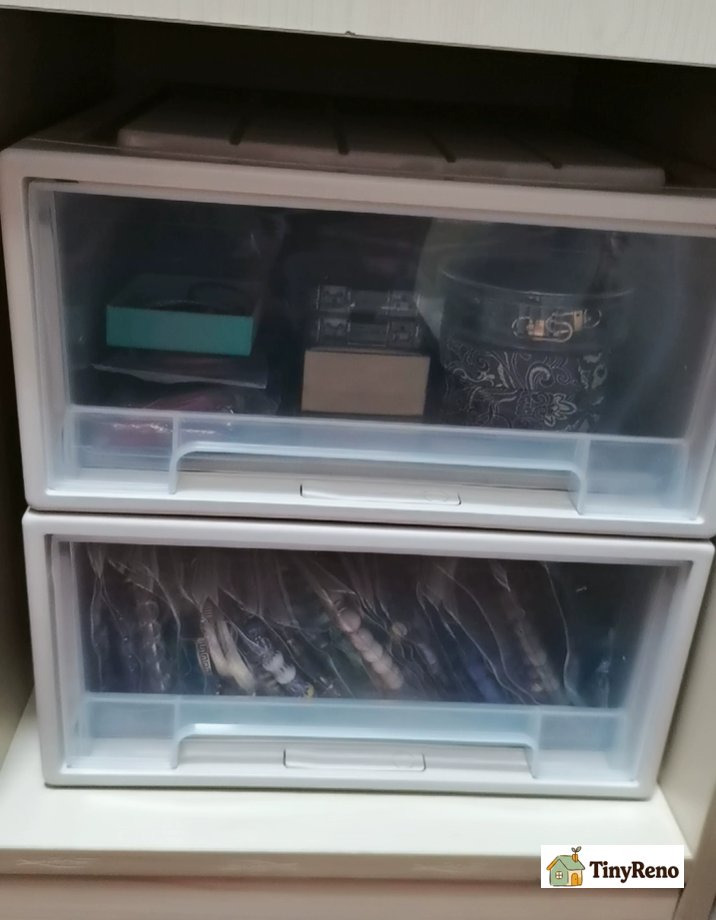
The standard rental closet is 60 centimeters deep and 90 to 200 centimeters wide. Three configurations cover almost every renter.
Configuration one is a two-by-three grid, six bins total on the closet floor. This works in a closet 90 to 120 centimeters wide. The two back-row bins stay accessible because drawer bins pull straight out. The configuration holds 150 to 200 liters of clothing — a full wardrobe for one or a partial wardrobe for two.
Configuration two is a single-column four-bin tower in the corner of a closet 150 centimeters wide or more, with hanging space on one side. The tower holds 80 to 120 liters. It needs to go against two walls, not in the middle of the closet, for the stacking rule to apply.
Configuration three is the under-bed row — drawer bins made 22 centimeters tall instead of 30, designed to slide under a standard bed frame. Excellent for sheets, winter clothes, and the box of cables you've been meaning to organize. The under-bed bin is the one place I'd ignore the three-high stacking rule, because the floor is supporting everything.
7. The Lock-Clasp Feature Is Not Optional (And Why)
A drawer bin with a small plastic clasp on the front, the kind that clicks into place when you push the drawer closed, costs about a dollar more than a drawer bin without one. The dollar is the most underrated dollar in closet storage. The clasp does three things the no-clasp drawer can't do.
First, it prevents the drawer from sliding open when the closet door slams. A closet door that closes hard shakes the whole closet, and on a smooth-rail drawer bin, the shake is enough to slide the drawer out by an inch. Over a year of door slams, that inch becomes three inches, and three inches is enough for the drawer to fall out completely. The clasp holds the drawer shut through the shake.
Second, it prevents the drawer from sliding out when you tilt the stack to move it. Without the clasp, lifting a four-bin tower off the floor slides the bottom drawer open by gravity. With the clasp, the drawers stay put until you release them.
Third, the clasp tells your brain the bin is closed. A drawer that's technically closed but looks slightly open feels wrong; you keep pushing it. A clasped drawer looks closed and you walk away.
8. What I Put in Each Drawer (So You Don't Have to Guess)
The principle that finally worked for me was sorting by frequency, not by category. Category sorting is what closet magazines tell you to do, and it's also why you end up digging through three bins every morning. Sorting by frequency puts daily-use items in easy-reach drawers and seasonal items in the ones that take effort.
My two-by-three layout: front-left (opened every morning) holds socks and underwear; front-middle (daily) holds T-shirts; front-right (3-4 times a week) holds light sweaters; back-left (weekly) holds jeans; back-middle (monthly) holds gym clothes; back-right (seasonally) holds winter coats. The back-right drawer requires bending, which is exactly why it holds the things I touch least.
The exception: sheets and towels go in the under-bed bin, not the closet tower. Bulky and low-frequency — exactly what the under-bed bin is for.
9. Where Stackable Drawer Bins Fail (And What to Buy Instead)
Not every storage problem is a drawer bin problem. The bin fails when what you're storing doesn't match how it works. Three categories where I stopped using them, and what I use instead.
Heavy things over 10 kilograms per drawer. The rails bow, the plastic wears. Use a rigid tub with no drawer, the kind that stacks on a shelf. I use those for books, canned goods, and tools. Drawer bins handle clothes.
High-frequency access. Twenty opens a day finishes a plastic drawer bin in about six months. The thing you reach for twenty times a day is the thing you hang. Use the closet rod for that.
Odd shapes. Shoes, sports balls, vacuum attachments, cables. A drawer bin works when things stack flat; if they don't, they shift every time you open the drawer and the system falls apart by week two. Use an open-top bin or basket for those.
The closet test: pull out one of your dresser drawers and look at it. If it's full of neatly folded clothes that don't shift, drawer bins will work. If it's unfolded clothes you dig through, drawer bins will make that worse — you've added a moving plastic part to a system that doesn't work. The drawer bin is for people who already know how to fold. It isn't a tool that teaches you how.


Discussion (0)
Sign in to join the discussion