

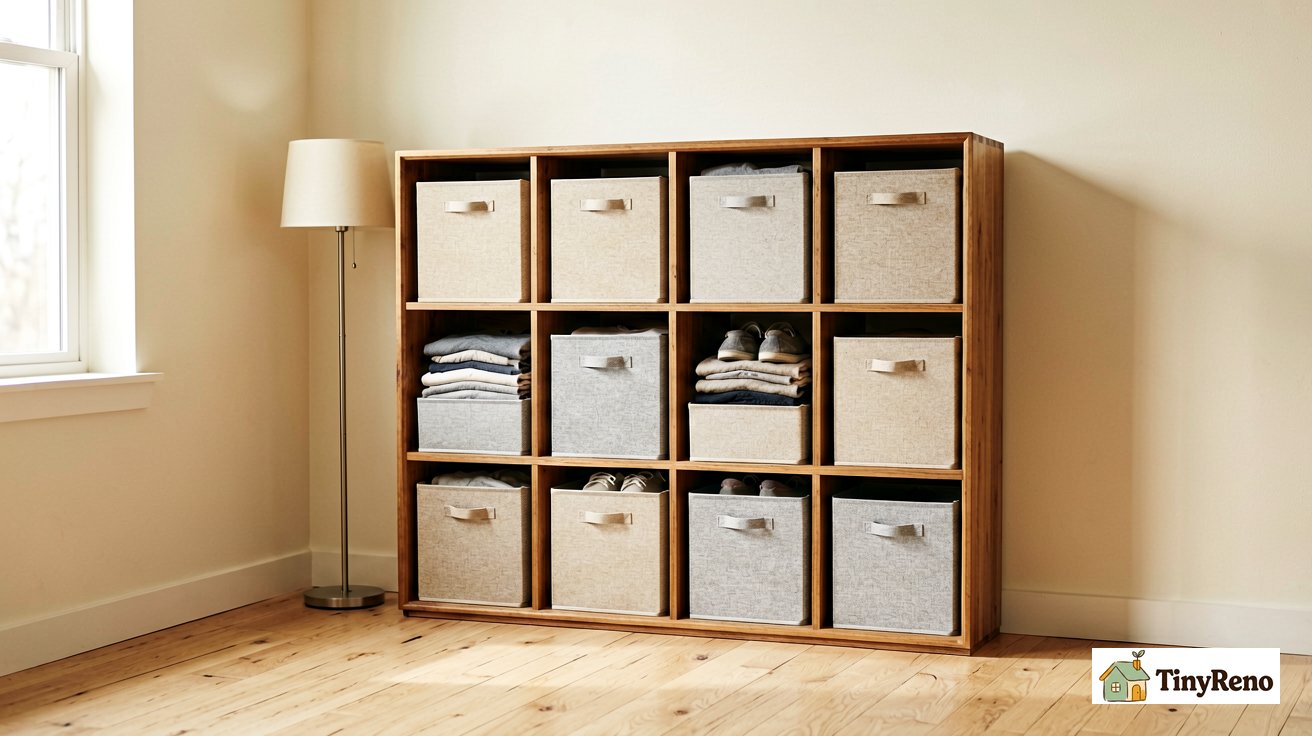
I owned a 12-cube fabric storage shelf for two years before I realized I was using it wrong. I was treating each cube as a junk drawer — shove things in, close the fabric bin, move on. By month six, I had lost two sweaters, one phone charger, and a decent amount of optimism. By month twelve, I had given up and started piling clothes on the chair in the corner.
The shift that changed everything was not buying more cubes. It was treating the 12 cubes like a tiny wardrobe with specific rules: each cube has a job, each job has a stacking method, and the methods work together so the whole system holds more than the sum of its parts. Once I rewired it that way, the same 12 cubes held roughly twice what they held before. The chair was empty for the rest of the lease.
This is the system I use now. It works for any renter without a built-in closet — studios, one-bedrooms with hallway closets, sublets where the previous tenant took the rods. The total cost is $90 to $180 depending on how you source it, and the whole thing comes apart and moves with you.
Why Cube Hacks Beat Closet Hacks (For Most Renters)
The conventional advice for renters without a closet is to install a closet system — tension rods, hanging shelves, drawer dividers. This advice assumes the renter owns the apartment. Most do not. Tension rods work, but they leave rubber marks on the wall that need to be cleaned at move-out. Hanging shelves require anchors. Drawer dividers assume you have drawers, which assumes you have a dresser, which assumes the apartment came with a dresser. Most sublets and studios come with none of those things.
A 12-cube storage system does not need to attach to the wall. It is freestanding. It is also modular — if you leave a cube empty for a month, you do not feel like you wasted anything. If you move apartments, the whole system comes apart in 30 minutes and reassembles in the next one. The cube shelf survives moves that would destroy a tension-rod closet system.
The other thing cube systems have going for them is visibility. A closet hides its contents. A cube with a fabric bin shows you, at a glance, which cubes are full and which are empty. You stop losing things because you stop having to open 12 different doors to find the one black t-shirt you need. The visibility is what makes the system scalable — once you can see what is in each cube, you can apply rules to what goes where.
The 12-Cube Starter (Which Frame + Which Bin + Which to Skip)
Before any of the stacking rules matter, you need the right combination of frame and bins. Most people buy the wrong combination and then blame the system for not working. The system works. The combination does not.
The frame. Buy a wood-frame 12-cube organizer (3 rows by 4 columns), not a metal-frame one. The wood frame is stiffer, holds more weight per cube, and does not bend over time the way cheap metal frames do. The IKEA Kallax 4x4 is the industry standard (yes, 16 cubes — keep one row empty or stack two 12-cube organizers from a cheaper brand). Amazon Basics and Wayfair Basics both sell 12-cube wood organizers for $90 to $130 that work the same way. Avoid plastic-frame cubes — they warp within a year and the cubes stop being square.
The bins. Buy fabric bins that match the inside dimensions of the cube exactly. A 12-inch cube needs a bin that is 12 inches by 12 inches at the base. Off-by-half-inch bins sag, catch on the cube walls, and pull out crooked. The IKEA Kallax inserts are made for the Kallax frame, which is why they fit. Amazon Basics bins are sized for Amazon Basics frames. Mixing brands usually means a 0.25-inch gap that drives you crazy within a week.
What to skip. Skip bins with handles that stick out 3 inches past the cube edge. The handles catch on adjacent cubes when you try to pull one out, and you end up yanking two bins out at once. Skip bins with windows. The point of the fabric bin is to hide what is inside so you cannot see clutter — a window defeats that. Skip bins that are a different height than the cube. A 10-inch-tall bin in a 12-inch cube wastes vertical space and looks unfinished.
The frame and bin combo is the foundation. If the foundation is wrong, the stacking rules below will not save you.
The 3 Stacking Rules That Double Capacity
These three rules are the difference between a 12-cube system that holds 12 things and one that holds 25. Apply them together.
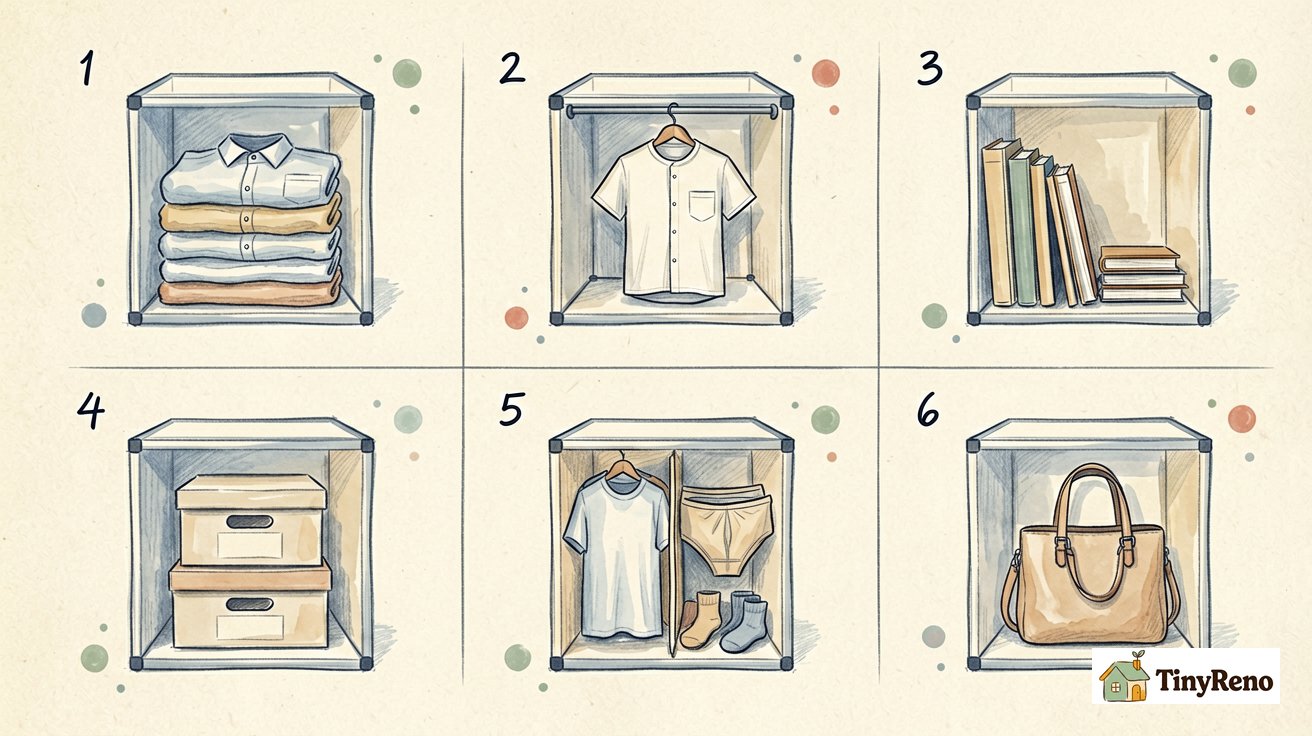
Rule 1 — Horizontal stack height limit. A cube holds 5 to 7 folded t-shirts stacked flat. More than 7 and the stack gets tall enough that pulling the bottom shirt out collapses the stack and wrinkles everything. Less than 5 and you are wasting cube space. This is the single biggest capacity win — most people overstack cubes with 10-12 shirts and then cannot access the bottom half without pulling everything out.
Rule 2 — Category purity. One cube, one category. T-shirts in one cube. Sweaters in another. Socks in a third. Underwear in a fourth. Mixing categories in a cube makes every search slower because you have to dig past the wrong things to find the right ones. Purity sounds obvious, but it is the rule people break first when they run out of cubes — they start dumping mixed items into the nearest empty space. Resist. The system only works if every cube has one job.
Rule 3 — Frequency of use controls cube position. Items you reach for daily (t-shirts, underwear, socks) go in the middle row, eye-level. Items you reach for weekly (sweaters, jeans) go in the bottom row. Items you reach for monthly (seasonal clothes, extra linens) go in the top row. This is the same logic professional organizers use for kitchen shelves — the things you use most are at the height you reach without bending or stretching. The cube shelf gives you three heights. Use all three deliberately.
Together these three rules mean a 12-cube system with 4 cubes of t-shirts (5-7 shirts each), 2 cubes of underwear/socks, 2 cubes of sweaters, 1 cube of jeans, 1 cube of workout clothes, 1 cube of seasonal overflow, and 1 cube for bags/accessories holds roughly 55 to 65 everyday items. That is a small reach-in closet worth of clothing, distributed across 12 cubes with full accessibility.
The 3 Bin Configurations (Vertical vs Horizontal)
Beyond stacking rules, three specific bin configurations unlock capacities that the default "shove it in" approach misses.
Configuration 1 — Vertical divider for small items. Take one cube dedicated to underwear and socks. Insert a vertical fabric divider (or fold a stiff piece of cardboard into a + shape) to split the cube into 4 quadrants. Each quadrant holds one category: socks in one, underwear in another, bras in a third, hosiery in the fourth. The cube now holds what would otherwise need 2 or 3 cubes. Vertical dividers are the single highest-density trick in the system.
Configuration 2 — Tension rod for hanging. Install a small tension curtain rod (the 12-to-18-inch kind) across the top of one cube, about 2 inches below the cube ceiling. Now the cube holds 6 to 8 hanging items on hangers — dresses, button-up shirts, jackets, anything you would otherwise fold and crease. This single cube becomes a mini-closet within the system. The tension rod costs $4 and takes 60 seconds to install. Most cube storage systems ship with a place to add one, but you have to think of it yourself.
Configuration 3 — Stacked rigid boxes. For shoes, books, or anything with a hard shell, drop a rigid container inside the fabric cube. The rigid container holds the shape of the contents so the fabric bin does not sag. Two shoebox-sized rigid boxes stacked vertically inside one fabric cube gives you 4 pairs of shoes in one cube without crushing the back pair. The same trick works for handbags (which lose shape when stacked directly on each other) and for books (which are heavy enough to stretch the fabric cube floor over time).
These three configurations are how the 12 cubes become a system instead of 12 separate junk drawers.
The "Add More Cubes" Mistake
The most common mistake after building a working cube system is to add more cubes. It feels productive. You buy a second 12-cube organizer, stack it next to the first, and suddenly you have 24 cubes. You fill them. The system gets harder to use because you have to remember which category lives in which cube across two separate physical units. The chair in the corner starts collecting overflow again.
The rule is this: 12 cubes, fully optimized, hold what most single people need for everyday clothing and accessories. If you have run out of space, the answer is not to double the cubes — it is to apply the three stacking rules and the three configurations above more strictly. Most people who "ran out of cubes" are running 4 or 5 shirts per cube where they could be running 7. They have vertical space they are not using. They have category mixing that wastes volume.
The legitimate reason to add cubes is not "more stuff." It is a specific category overflow that does not fit the existing 12 — like a large sneaker collection, or a serious book collection, or a hobby that needs its own space (yarn, art supplies, vinyl records). When that happens, dedicate the second organizer to that one category and leave the first organizer untouched. Do not interleave the contents across two organizers.
The $18 IKEA Hack That Adds 6 Months of Capacity
The cheapest upgrade that extends a 12-cube system is a set of 4 SKUBB shoe organizers from IKEA. Each SKUBB holds 3 pairs of shoes in a vertical fabric divider. Four SKUBBs cost $18 total and fit inside 4 cubes of the system. Suddenly those 4 cubes hold 12 pairs of shoes instead of 8 (which is what you get from a default horizontal stack of 2 pairs per cube). That is 6 months of wardrobe growth absorbed without buying a single new cube.
The SKUBB trick also works for handbags, scarves, and rolled t-shirts. The vertical divider principle is the same — instead of one layer of items per cube, you get multiple vertical columns.
What to look for in any cube-bin upgrade:
Rigid insert compatibility. The cube must accept a rigid insert without forcing you to remove the fabric bin. Some bins are sewn to the cube frame — those do not accept inserts.
Bottom seam strength. Lift the empty bin and look at the bottom seam. If it is a single row of stitching, skip it — the seam will split within 6 months under load. Look for double-stitched or reinforced bottom seams.
Front handle height. The handle should sit 1 to 1.5 inches below the cube top edge. Higher handles catch on the cube above when stacked. Lower handles are hard to grip.
Color that hides wear. Solid neutral colors (gray, oat, beige, charcoal) hide the small stains that fabric bins accumulate over years. Patterned bins show every spot.
The 90-Day Capacity Test (What Actually Held Up)
I tracked my 12-cube system for 90 days after applying all six rules above. Here is what actually changed versus the system I had before.
Items stored (vs the old system): 62 everyday items, up from 31. The capacity roughly doubled, and the only physical change was the addition of one $4 tension rod and a few $1 cardboard dividers.
Time to find any item: Under 10 seconds for any category, up from "I will just wear something else." The category-purity rule made the difference — I never had to dig past the wrong items to find the right one.
Items lost or damaged: Zero. The old system averaged one lost item per month, usually something that had slipped behind a fabric bin or been buried under a stack.
Fabric bin sag: None at 90 days. The cubes I had overloaded before (10-12 shirts per cube) had visible fabric stretching by month 3. The optimized cubes (5-7 shirts per cube) showed no sag at 90 days. This is the rule that protects the bins long-term — the rule exists not just for capacity but for the fabric itself.
Move test: I moved apartments at day 75 of the test. Took 28 minutes to disassemble the 12-cube organizer, 42 minutes to reassemble at the new place. The system survived the move with no damage. A tension-rod closet system I had used in a previous apartment took 6 hours to install, left rubber marks on the walls, and required a 2-hour wall-repair session before move-out. The cube system recovered the time difference on its first move.
When the Cube System Breaks Down (3 Honest Tradeoffs)
The 12-cube fabric system is not for everyone. There are three situations where it does not work, and pretending otherwise just wastes your money.
Situation 1 — You have less than 8 square feet of floor space. A 12-cube organizer is roughly 4 feet wide and 3 feet tall. It needs floor space plus 6 inches of clearance on every side for pulling bins out. If your apartment does not have a corner that can spare this footprint, the system will not fit. A smaller 6 or 8 cube unit works but holds half as much, and you lose the critical mass that makes the category rules worth applying.
Situation 2 — You live in a high-humidity climate without climate control. Fabric bins absorb moisture. In a humid climate (Florida, Gulf Coast, Pacific Northwest in winter, any basement apartment), the bins develop mildew within months. The clothes inside smell musty. The fabric degrades faster. If you live in a humid place, switch to rigid plastic bins inside the cube frame. The frame is the same. The bins are different. The cost is roughly 3x higher, but the system survives.
Situation 3 — You are subletting for less than 4 months. The cube system takes about 2 weeks of use to "break in" — to figure out which categories work where, which configurations hold what, which bin positions feel natural. If you are subletting for a short term, the 2-week break-in is a meaningful fraction of the whole stay. A simpler system (one cube per major category, no dividers, no tension rod) is faster to set up and faster to dismantle. Save the optimized system for places you will live at least 6 months.
For every other renter — long lease, reasonable climate, at least 8 square feet of floor space — the 12-cube system is the most cost-effective way to add closet-equivalent storage without drilling holes or risking a deposit deduction. The frame costs less than a year of using a laundromat to wash clothes that you had to keep replacing because they disappeared into overstuffed cubes. The bins cost less than a single month of storage unit rental.
The chair in the corner has been empty for two years now. I do not even own a chair in the corner anymore.
Discussion (0)
Sign in to join the discussion